New Issues and stamp news 926
Faroe Islands – The Faroese National Anthem – 120 Years
Date of issue: 2026-10-19
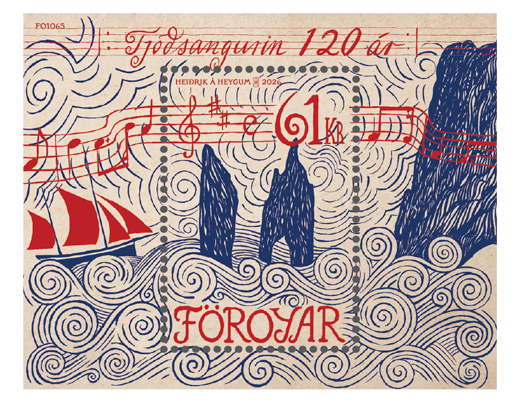
On a winter’s day in 1906, Símun av Skarði sat at Føgrulíð, the Faroese Folk High School on the island of Borðoy, looking out across the surrounding mountains and fjords. Inspired by the beauty of his homeland, he wrote Mítt alfagra land (“My Fairest Land”), a poem that would become the national anthem of the Faroe Islands.
The poem celebrates the islands’ dramatic landscape, the strength of their people and Símun’s deep love for his homeland, while expressing his faith in God. Its imagery captures the contrast between wild winter seas and the peaceful stillness of summer.
In 1907, Petur Alberg composed the melody, and the song was performed publicly for the first time on Boxing Day that year. Published in the newspaper Tingakrossur in January 1908, it quickly gained popularity and became a powerful symbol of Faroese identity.
The anthem emerged during a period of significant growth in Faroese literature and national consciousness, when writers and poets were increasingly embracing their native language and celebrating their culture.
Today, Mítt alfagra land remains an enduring expression of Faroese pride. Sung at national celebrations, including Ólavsøka, and at international sporting events, it continues to unite Faroese people through its timeless words and melody, more than 120 years after its creation.
Faroe Islands – Saint Lucia
Date of issue: 2026-10-19
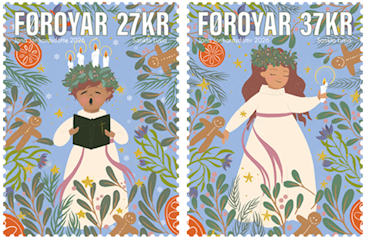
The night between December 12th and 13th is the darkest night of the year. It is pitch dark, and no light can be seen. This is the Night of Lucia.
Lucia was a young Christian girl, born in the year 328 in Syracuse, Sicily. It was certainly not safe to be a Christian in the Roman Empire, as the Christian faith was forbidden. Those discovered as Christians were punished with torture and death. Therefore, Christians had to hide in the catacombs beneath Rome.
Lucia helped the people who were hiding in the catacombs. It was dark, so she wore a wreath of candles on her head, allowing her to see while keeping both hands free to help others.
Lucia’s father was a wealthy man who had promised his daughter to a Roman man, but Lucia refused to marry. She wished her entire life to be devoted to God, and therefore she would not enter a marriage. When her intended fiancé learned of this, he became very angry and reported her to the authorities, stating that Lucia confessed to the Christian faith.
It was Emperor Diocletian, who held all power in the Roman Empire at the time. He arrested Lucia and ordered her to be punished. But it was difficult, as it is written that “it was as if a divine power protected her.”
The story says that Lucia gouged out her own eyes so that no man could fall in love with her. Another version tells that her eyes were removed but that she miraculously received new, beautiful eyes. They also tried to burn her at the stake, but the flames would not touch her. Several attempts failed, but eventually she was pierced with a sword and died.
Lucia was canonized as a patron saint, Saint Lucia. There are very few women in the Catholic Church who have been made saints.
Lucia is often depicted in images with a bowl containing two eyes beside a lit lamp. She is the patron saint of the blind and of people with eye diseases. Saint Lucia died on December 13th, 304.
The name Lucia comes from the Latin word lux, meaning light. Lucia’s work in the catacombs, helping the persecuted, has been and still is an example of selfless action. When it is darkest, the light rises again. Saint Lucia, with her wreath of candles on her head, and the girls who follow her carrying candles, symbolize hope that light will overcome darkness.
In the Catholic Church, people ask patron saints for help in times of need. Likewise, people have prayed to Saint Lucia for assistance. One story tells that a famine broke out in Syracuse in 1646. The people prayed to Saint Lucia for help, and on her death day, December 13th, a fully loaded ship of grain arrived, and the people were saved. They cooked porridge, and this custom continues to this day. On December 13th – Saint Lucia’s death day – it is traditional to cook a special porridge called Cuccia.
The Lucia procession honors Lucia, who gave herself for others, for humanity, and brought light and hope where there was none.
The tradition of Lucia is celebrated differently in various countries. In Italy, it is a church holiday with a service and a procession carrying Lucia’s relics, where the light holds the greatest significance. In Sweden, Lucia wears a wreath of candles on her head and children follow with candles in hand, all dressed in long white robes with red sashes. This tradition is also upheld in Denmark and the Faroe Islands. It is a beautiful tradition symbolizing what humans long for: hope and light, and the anticipation that something good and beautiful will happen.
On these beautiful stamps, children hold lit candles in their small hands, and Saint Lucia, with her candle wreath and free hands, is ready to help those in need. Children are always a beginning—they are our hope, innocent and pure. They represent the good and beautiful; the child who can change the world and bring light where darkness reigns. It is a reality of everlasting value. We must have hope and light to live as human beings. This is what Saint Lucia, and the children show us on these beautiful stamps.
Children are always the new beginning, and as long as we can light candles for each other, we can live.
Australia – Waterscapes: Australian External Territories Joint Issue
Date of issue: 2026-10-13
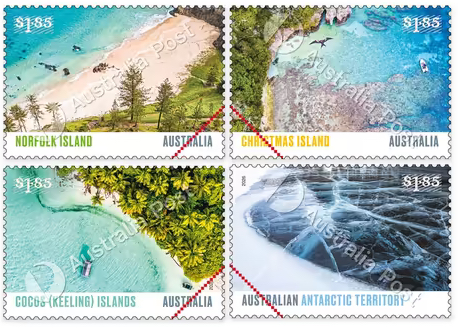
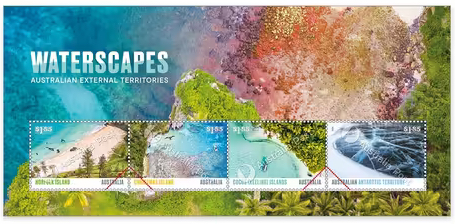
This joint issue of stamps for four of Australia’s seven external territories covers Cocos (Keeling) Islands, Christmas Island, Norfolk Island and the Australian Antarctic Territory (AAT).
Australia Post took over the responsibilities for postal and philatelic services on the Cocos (Keeling) Islands from 1 January 1994, on Christmas Island from 4 March 1993 and on the AAT from 27 March 1957. Australia Post has issued stamps for Norfolk Island since 1 July 2016, when the administration of Norfolk Island was restructured as a regional council under the jurisdiction of New South Wales.
The stamps feature coastal or inland waterscapes of great beauty.
© Australia Post
Australia – Wilderness Society: 50 Years
Date of issue: 2026-10-06
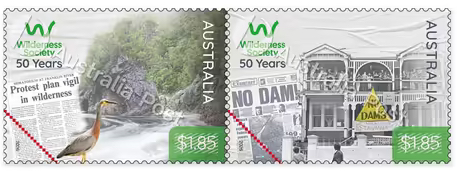

This stamp issue marks the 50th anniversary of the founding of the Wilderness Society, which today is one of Australia’s leading conservation groups. The movement began in Hobart in 1976, with the meeting of a small group of people wanting to save the Franklin River in south-west Tasmania from being dammed as part of the state’s hydro-electric power generation project. From this grew a campaign of blockades, arrests, rallies, door knocking, petitions and nationwide political action. Success came after UNESCO World Heritage listing of the region in 1982, the election in 1983 of a new Federal government that vowed to halt the project, and a battle in the High Court of Australia.
Since that time the Wilderness Society has fought alongside other conservation groups and individuals to protect many of Australia’s most significant places and environments for future generations.
© Australia Post
Alderney – The Christmas Story
Date of issue: 2026-11-02
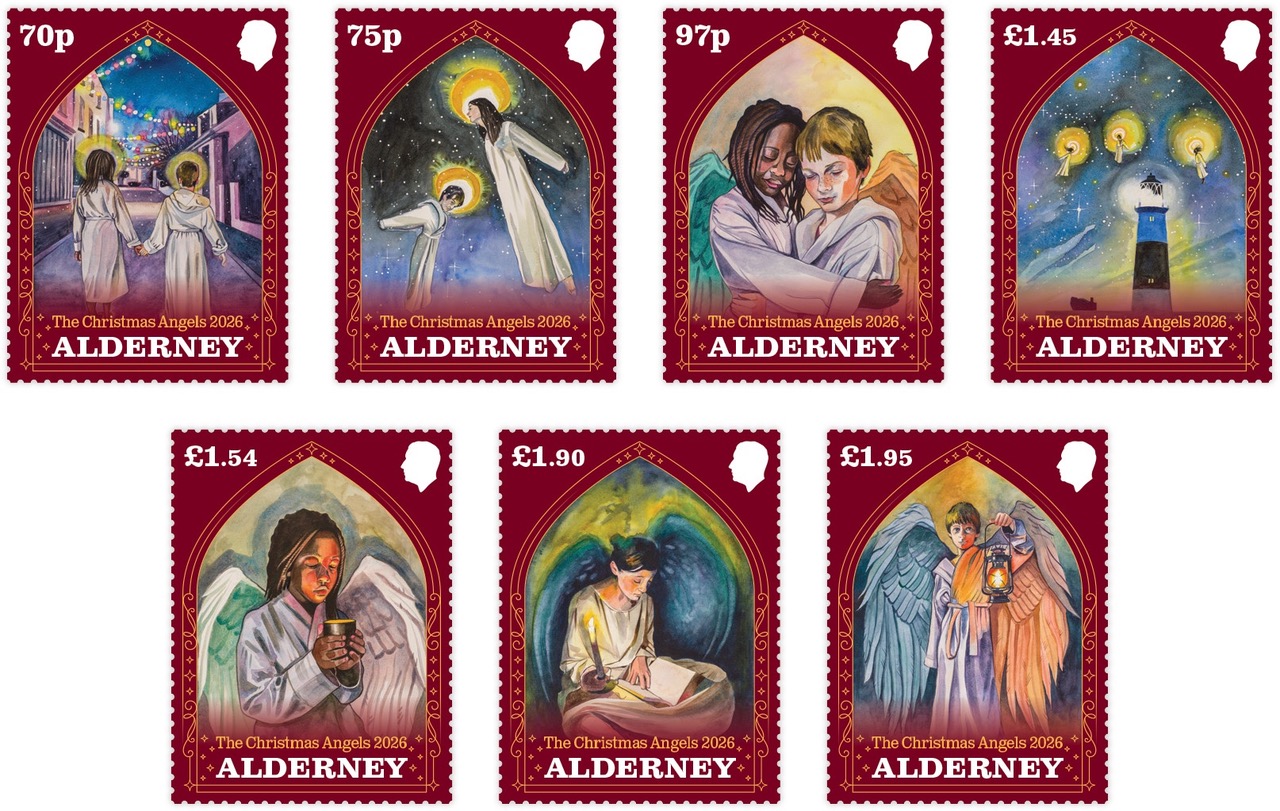
Guernsey Post’s philatelic bureau is delighted to announce the release of its 2026 Christmas stamps, bringing the Christmas story to life through two distinctive collections inspired by the islands of Guernsey and Alderney. Both sets, designed by Guernsey-based artist Charlie Buchanan.
The Alderney Angels collection explores the idea of angels walking among us, bringing messages of comfort, hope and peace to everyday island life. Set against familiar Alderney scenes, the seven designs combine the timeless symbolism of angels with the warmth and community spirit of the island.
The collection takes inspiration from the golden age of Victorian and Edwardian watercolour illustration, with candlelight and lantern light creating dramatic chiaroscuro effects. Rich golds, deep blues and soft winter tones add warmth and atmosphere, while each stamp is framed within an architectural arch inspired by St Anne’s Church, creating a distinctive visual connection with Alderney.
The journey begins with Christmas Eve on Victoria Street (70p local stamp), followed by Messengers of Peace (75p), An Embrace of Light (97p), The Angels of Mannez (£1.45), The Guiding Light (£1.54), Christmas Reflections (£1.90) and The Glow of Christmas (£1.95).
Bridget Yabsley, head of philatelic at Guernsey Post, said: “This year’s Christmas stamps offer two different interpretations of a story that continues to resonate around the world. Charlie Buchanan has captured the spirit of Christmas through the character of our islands, bringing together light, hope, compassion and community in designs that we hope will bring warmth and joy to festive greetings sent from the Bailiwick.”
© Guernsey Post
Guernsey – The Christmas Story
Date of issue: 2026-11-02
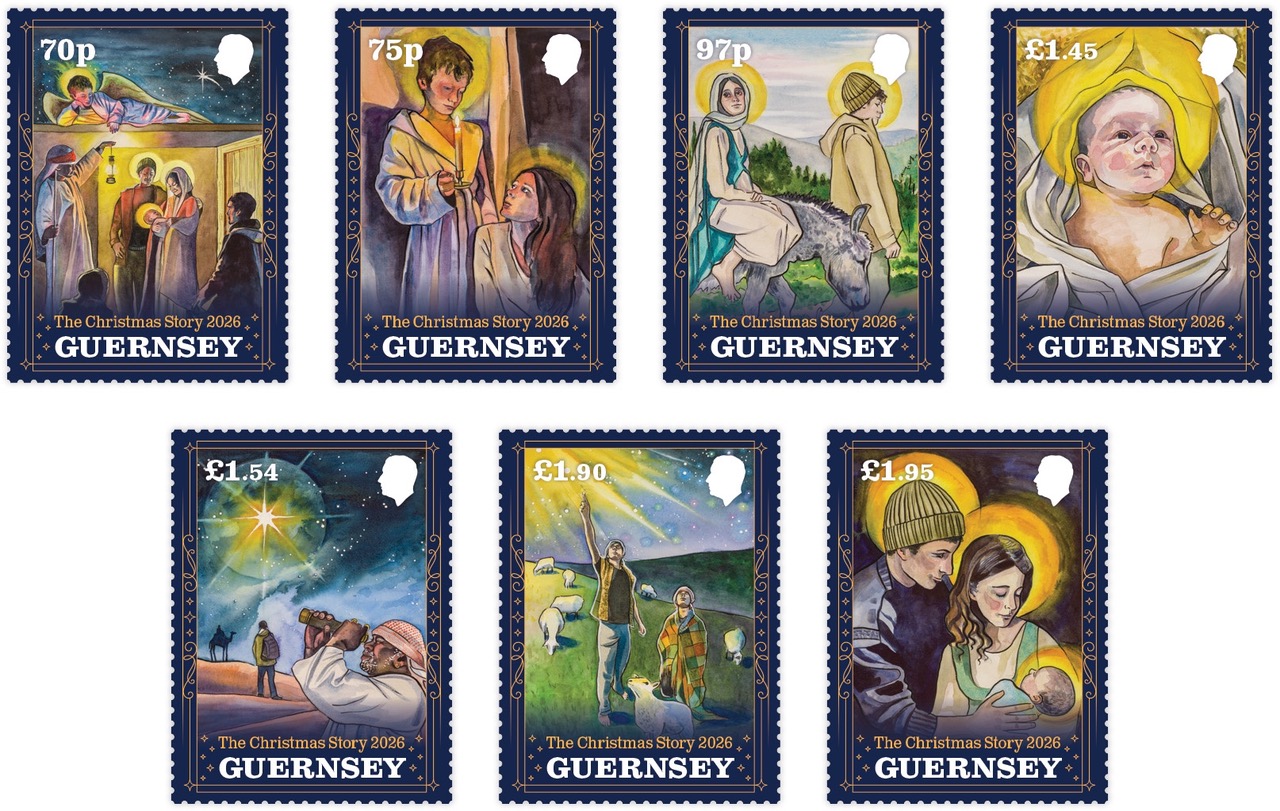
Guernsey Post’s philatelic bureau is delighted to announce the release of its 2026 Christmas stamps, bringing the Christmas story to life through two distinctive collections inspired by the islands of Guernsey and Alderney. Both sets, designed by Guernsey-based artist Charlie Buchanan.
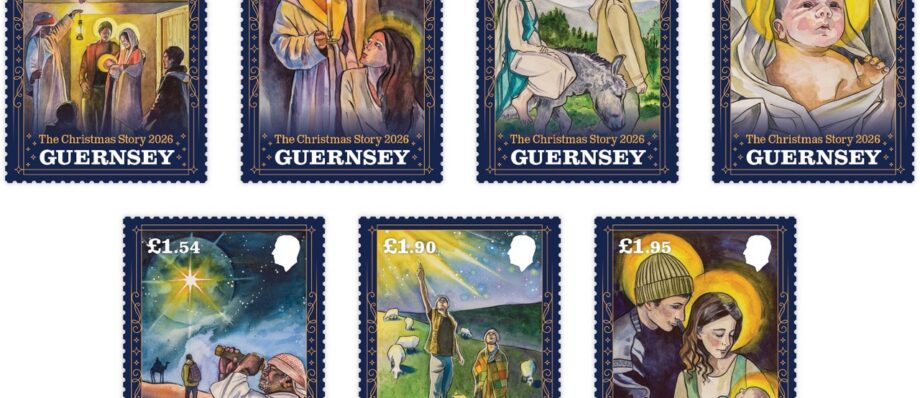
Guernsey’s seven-stamp collection presents the Nativity story whilst reflecting the island’s local character, blending traditional religious imagery with contemporary details to explore themes of hope, compassion, peace and community.
Drawing inspiration from the rich visual tradition of stained-glass windows, the designs feature flowing black contour lines reminiscent of traditional leadwork, while vibrant colours create the impression of light shining through glass. The setting brings together contemporary and traditional clothing, including a Guernsey jumper and Guernsey beanie.
The seven stamps follow key moments in the Christmas story, from The Annunciation (75p) and The Journey to Bethlehem (97p), through The Nativity Scene (70p local stamp), The Baby Jesus (£1.45) and The Shepherds in their fields, visited by Angels (£1.90), to Three Wise Men follow the Star of Bethlehem (£1.54) and The Holy Family (£1.95).
Bridget Yabsley, head of philatelic at Guernsey Post, said: “This year’s Christmas stamps offer two different interpretations of a story that continues to resonate around the world. Charlie Buchanan has captured the spirit of Christmas through the character of our islands, bringing together light, hope, compassion and community in designs that we hope will bring warmth and joy to festive greetings sent from the Bailiwick.”
© Guernsey Post