New Issues and stamp news 850
Åland – Parrot crossbill
Issue date: March 15, 2023

The elusive parrot crossbill pictured on Åland stamp
The 2023 bird motif will be released on 15 March and challenged artist Bo Lundwall’s bird detective skills, but he managed to capture the elusive parrot crossbill. The bird is endemic to Åland and Scandinavia, and this may be the first time that parrot crossbills appear on a stamp.
Artist Bo Lundwall had to resort to different tricks to successfully paint the parrot crossbill (Loxia pytyopsittacus):
“It was an extra challenge to obtain reference material for this bird species. When I was bird watching, I sometimes saw the common crossbill but more rarely the parrot crossbill. One trick was to check the species observation system of the Swedish University of Agricultural Sciences, where I could follow whether the bird was visible in my immediate area every day. In the end, I got hold of sketching material. I also met conservator and sculptor Lennart Pettersson, who lent me a mounted specimen of a female so that I could study details more closely. It’s my first time painting parrot crossbills, so it was extra fun to paint this particular bird for a stamp.”
Both parrot and common crossbill breed in Åland, and they can be difficult to tell apart in the forest. Crossbills are characterized by the crossed tip of the beak, which is adapted to snap up the pineal scales. The parrot crossbill’s beak is both wider and longer than that of other crossbills. The bird mainly eats pine seeds.
The crossbill has a large head, long wings, and a forked tail. The female is greyish green or greyish brown while the male plumage varies from brick red to magnificent red. Up close you see similarities with parrots, the precise meaning of the Greek word psittakos in the species name
British Antarctic Territory – Frozen Planet II
Issue date: March 13, 2023

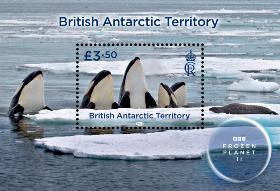
In 2011, the BBC’s Frozen Planet gave viewers an unprecedented insight into life in the Poles. Now, 11 years later, Frozen Planet II returned to capture wildlife dramas playing out across all the world’s coldest regions: our high mountains, frozen deserts, snowbound forests, and ice-cold oceans. The series involved 2188 filming days across three years by small crews working in the most remote corners of our frozen worlds.
Filmed in ultra-high definition using the very latest camera technology, and featuring dramatic new behaviours, intimate stories, and sensational natural spectacles filmed for the very first time, this six-part series is a chance to experience the wonder of our planet’s frozen realms as they stand on the brink of major change.
As temperatures rise at an unprecedented rate our frozen planet is literally vanishing before our eyes. The series reveals the true impact on both wildlife and humans.
Frozen South (Episode 4), takes us to the most hostile ice world of all – Antarctica, an entire continent covered in snow and ice full of surprises. Here hardy animals cling around its coastal fringes. In the Frozen South, two key locations for filming were South Georgia and the Antarctic Peninsula.
On the Antarctic Peninsula the team used a drone to capture an entirely new perspective on the intricate coordination of wave washing that the killer whales use during their attacks. But the great revelation was how they are being forced to change their behaviour to adapt to new sources of prey.
The series also showed chinstrap penguins struggling to raise their chicks in a warming world. The chinstraps, filmed around Deception Island, used pebbles to make nests to keep their chicks off the water-logged ground. With increased meltwater and rainy conditions due to a warming Antarctica, chicks were found shivering with hypothermia.
The stunning images captured during the series, and recreated on this series of stamps share some of the cherished moments experienced by the film crew when on location filming for the series.
South Georgia and the South Sandwich Islands
Frozen Planet II
Issue date: March 13, 2023
In 2011, the BBC’s Frozen Planet gave viewers an unprecedented insight into life in the Poles. Now, 11 years later, Frozen Planet II returned to capture wildlife dramas playing out across all the world’s coldest regions: our high mountains, frozen deserts, snowbound forests, and ice-cold oceans. The series involved 2188 filming days across three years by small crews working in the most remote corners of our frozen worlds.
Frozen South (Episode 4) takes us to the most hostile ice world of all – Antarctica, an entire continent covered in snow and ice full of surprises. Here hardy animals cling around its coastal fringes. In the Frozen South, two key locations for filming were South Georgia and the Antarctic Peninsula.
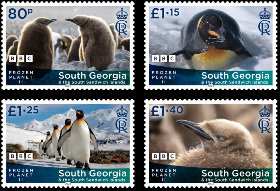
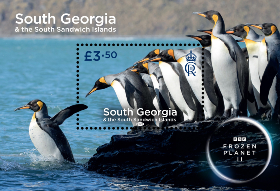
The focus of the South Georgia episodes was king penguins. This spectacular and instantly recognisable species, with its shimmering black and white feathers and golden neck and face markings is widespread on the islands that lie within the polar fount but which remain free from the pack ice. Standing well over 2 ft tall the king penguin is smaller in stature only to the emperor penguin, and like its relative, the king penguin lays a single egg which it holds on its feet during incubation and keeps warm with a specialised fold or skin.
On South Georgia, there are thought to be over 450,000 breeding pairs and huge colonies can be found along the north coast. The largest colony, and one of the sites of filming for the Frozen Planet II series, is at St Andrews Bay where there are thought to be over 150,000 breeding pairs of king penguins. Other significant sites for king penguins which have 10’s of thousands of breeding pairs include Salisbury Plain, Royal Bay and Gold Harbour with numerous other smaller colonies in sheltered bays.
What makes the king penguin unique on South Georgia is that because its breeding cycle takes 14 months from courtship to fledging a chick, there are almost always large numbers of birds ashore at any one time. During the winter months the fluffy brown chicks huddle together in creches to keep warm and wait for their parents to bring them food.
King penguins are known to travel several hundred kilometres to find food, primarily lantern fish, and much of their foraging range falls within a 1.24 million km2 Marine Protected Area (MPA) which was designated by the Government of South Georgia & the South Sandwich Islands in 2012. It is one of the largest MPA’s in the world and strict management measures are enforced in order to protect and conserve the rich marine biodiversity in the region.
During the filming of Frozen Planet II, the crew documented adult king penguins making a mile long march from one of their colonies to get to the ocean, a behaviour filmed for the first time. The stunning images captured during the series, and recreated on this series of stamps share some of the cherished moments experienced by the film crew when on location filming for the series.
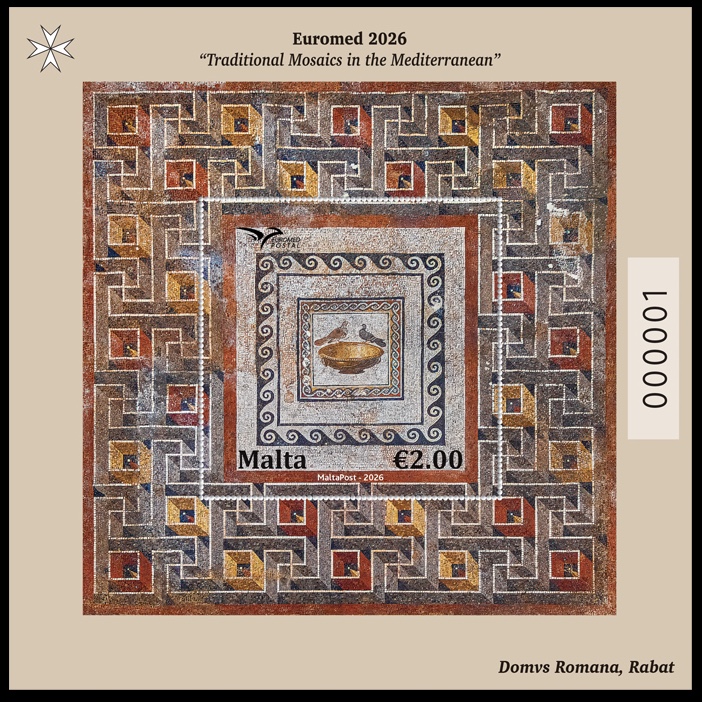
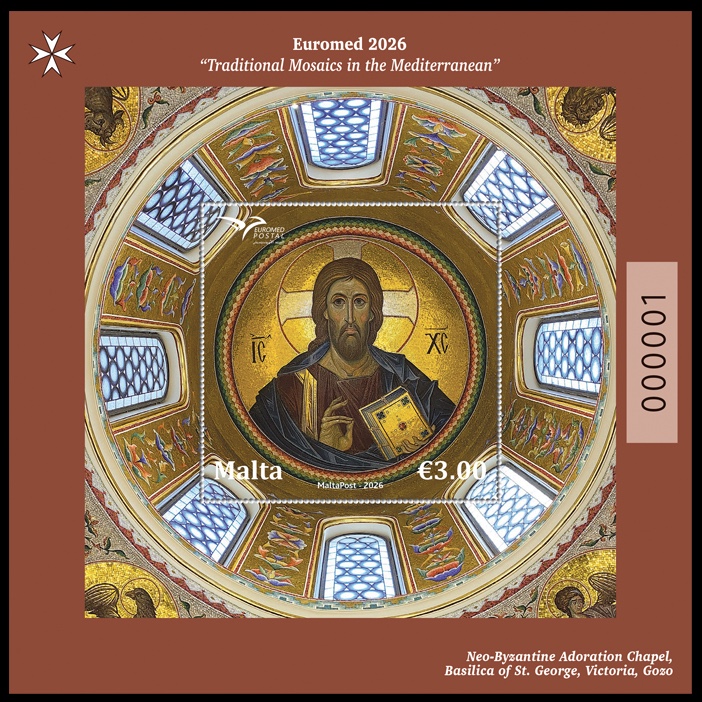
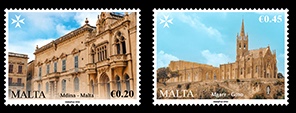
Malta – Year Pack 2022
Issue date: March 10, 2023
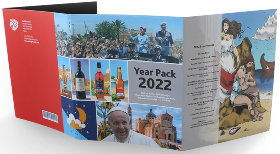
Year Pack 2022
Falkland Islands – The Paintings of Mike Peake Part 3
Issue date: March 6, 2023
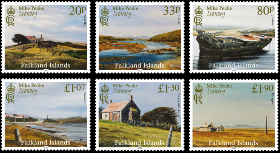

The Paintings of Mike Peake Part 3 – Scenery – 1939 – 15th September 2005
Arthur Peake was born in Pontefract, Yorkshire. Carrying a suitcase in one hand and a guitar in the other he sailed from Britain to the Falklands in 1959, at the age of twenty, to work as an electronics technician at the Radio Space Research Station (RSRS). On the trip down to the Islands, a few of the passengers would gather in the bar each evening. The group had two people named Arthur, and Harry Rowlands decided there could not be two Arthurs. Turning to Arthur Peake he said, ‘You will have to be Mike.’ The name stuck for the rest of his life with Mike even naming his son Michael. He was also the father of Bernadette and Alison and a proud grandfather to Isaac, Cody and Louie.
It wasn’t long after Mike arrived in the Islands that his musical talents were being appreciated by radio listeners. He later formed a small folk group called ‘The Satellites’ who recorded a series of programmes with their songs becoming popular among the locals. Mike also enjoyed football, darts and gave many memorable performances in the Amateur Dramatic Society productions.
From working at the RSRS, Mike then began to work at the European Space Research operation centre (ESRO) at the west end of Stanley. Mike worked there from 1967 to 1973, ending up as the Station Manager. In 1973, Mike began work as a Technician at the Post and Telecommunications Department of Government. He was given the task of installing the new AEL transceivers that replaced the old R/T sets and was proud to say that he had visited virtually every Falklands settlement while on this mission.
Because of Mike’s computer knowledge, when the Computer Section was established in 1986, he was appointed as the first Computer Coordinator. He continued to supervise upgrades and enhancements until his retirement in September 1999.
Mike was passionate about the Islands and within days of arriving he vowed to never live anywhere else. He had an exceptional artistic talent to match this passion. Painting with oils and varnish, Mike was sometimes able to produce breath-taking landscapes in just 30 minutes when something of interest caught his eye.
Following his retirement, Mike made many visits to Sea Lion and Carcass Island, capturing their mood and ruggedness in his paintings. Many of Mike’s paintings can still be found in the islands today whilst others have made their way around the world. Previously Mike designed the UPU Membership Centenary (1979) and the Bridges of the Falkland Islands (2000) stamp issues.
We acknowledge with thanks the help and assistance of Mensun Bound and Chris Andrews.