New Issues and stamp news 911
Faroe Islands – Famous Pilots in the Faroe Islands II
Issue date: February 23, 2026
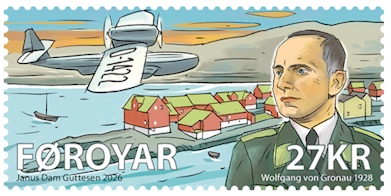
Wolfgang von Gronau – From Tvøroyri to New York (1930)
On 29 August 1928, people in Tvøroyri looked up in amazement as an aircraft flew over the fjord. It was German aviator Wolfgang von Gronau arriving in a Dornier Wal seaplane after an eight-hour flight from Sylt. He later visited the Faroe Islands several times and became friends with locals in Tvøroyri.
Von Gronau believed that transatlantic flights via the Faroes and Iceland would soon become possible. In 1930 he secretly planned such a journey despite lacking official support. After leaving Iceland, he continued west across the Atlantic.
On 26 August 1930, his Dornier Wal landed on the Hudson River in New York after 47 hours of flying with several stops. He was celebrated by crowds in New York and later received by U.S. President Herbert Hoover.
Von Gronau visited the Faroes again in 1931 before continuing his aviation career. In 1932 he completed an ambitious flight around the world. Later he served in the German Luftwaffe and as air attaché in Tokyo. He returned to Germany after World War II and died in 1977.
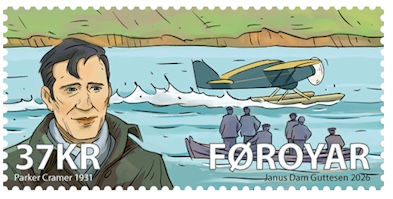
Parker Cramer
At the same time, American aviator Parker Cramer was attempting to establish a North Atlantic air route between the United States and Europe. In August 1931 he flew from Detroit via Greenland and Iceland toward the Faroe Islands.
Due to engine trouble, Cramer was forced to land near Vágur in the Faroes, where locals warmly welcomed him and helped repair the aircraft. After continuing to Shetland, he attempted to fly on to Copenhagen on 9 August.
However, he flew into severe storms and disappeared over the North Sea. Wreckage of his plane was later found, but Cramer and his mechanic were never recovered.
Faroe Islands – Abandoned villages: Skarð
Issue date: February 23, 2026
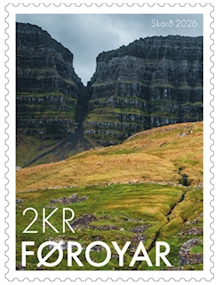
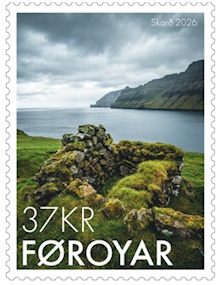
The island of Kunoy is characterized by a continuous high mountain range stretching from south to north. The only exception is the deep mountain gorge, Skarðsgjógv, which gave the settlement its name. Beneath the 800-meter-high mountains on the north-eastern side of the island lies the village of Skarð.
The village is accessible by boat, but the landing site is difficult to reach. However, there are two trails, one of which is very challenging, making the village relatively isolated. From Haraldssund to Skarð is approximately seven kilometres, and this trail is relatively easy to walk. The other trail is more demanding and extremely treacherous. It crosses the mountain gorge all the way to the village of Kunoy on the opposite side. The inhabitants of Skarð used this route when going to church or attending to errands in Kunoy, and they also carried coffins across the gorge to the cemetery in Kunoy.
Surrounded by mountains on one side and the sea on the other, the village of Skarð was closely tied to these powerful natural elements. Here, the residents made a living from whatever the land and sea could provide. People have lived here for centuries, but it is unknown who first settled in Skarð. What is known is that the village’s history ended on January 26, 1919.
From the earliest times, the original settlement was located elsewhere. In 1824, the village was severely damaged by a landslide and a flood. No one was harmed, but the residents were so frightened that they moved the houses about 100 meters further south. In 1801, there were only three houses and 12 inhabitants, but the population grew to 31 people and six houses by the beginning of the 20th century.
The large, green, and fertile valleys surrounding Skarð provided good pastures for livestock, but grain cultivation was difficult because the area was shaded, limiting agricultural yields.
Fishing from Skarð has always been challenging, partly because the population was never very large, but mainly because the high cliffs separate the village from the sea. Skarð is one of the worst surf zones on the Northern Isles.
The village has repeatedly been struck by maritime accidents, and these tragic events highlight the dangers associated with life at sea.
On March 30, 1835, the men of Skarð went out fishing. Near the shore, a gust of wind caught the sail, and the boat capsized. None of the six men were found. Back in the village, four widows were left with eight fatherless and minor children.
In 1872, a large pod of whales was killed in Klaksvík. The men from Skarð also took part in the whaling. After butchering and dividing the whales, they rowed back to Skarð with their share, but near the landing site, there was heavy surf. They tried to reach the shore, but at that moment, a large wave capsized the boat, and all the men ended up in the sea. Some were rescued by holding onto the overturned boat, but three men died in this accident.
The last and largest boating accident in Skarð occurred on Christmas Eve, December 23, 1913. When they went out fishing early in the morning, the weather was good and the sea calm, but suddenly the wind changed direction, and a violent storm with whirlwinds and heavy snow and hail struck the unsuspecting men, who were fishing in small open Faroese boats on the open sea. Three fishing boats did not return that memorable Christmas Eve, and 19 men died at sea: six from the village of Kunoy, six from Norðdepil, and seven from Skarð.
This accident was the death blow for the village of Skarð. Only widows, a 70-year-old man, and a few small boys remained. The village could not afford to lose seven men in their prime. The first residents moved shortly after the disaster, and on January 26, 1919, the last families left the village. Since then, Skarð has been desolate. Most of the former inhabitants settled in Haraldssund.
The high school principal, author, and poet Símun av Skarði was born and raised in Skarð. Among other works, he composed the Faroese national anthem, “Tú alfagra land mítt”, the Christmas carol “Nú ringja kirkjuklokkur”, and the song “Á mønu hjalsins stari”, which was written in connection with the 1913 boating accident.
Faroe Islands – Mythical Creatures
Issue date: February 23, 2026
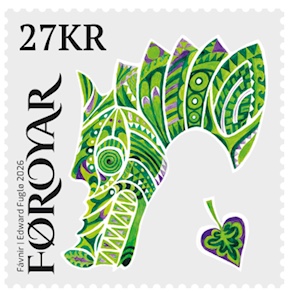
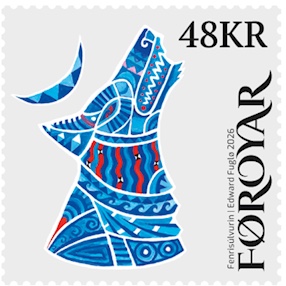
In mythology from all around the world, we find mythical animals with human features that communicate special messages.
The unicorn is often depicted as a white horse with a long, twisted horn on its forehead. It is therefore not surprising that the narwhal’s long protruding tusk was once believed to be a unicorn’s horn. The unicorn was pure and unadulterated – a symbol of purity and innocence and therefore only an innocent virgin could tame it.
The Phoenix has mythological roots back in ancient Egypt, where the sun was worshipped. The bird was described as a large eagle, very beautiful with feathers that shone with gold. It grew old, and when it died, it burst into flames and burned to ashes, only to rise again renewed. It is therefore not so strange that in the Middle Ages the Phoenix also came to symbolise Jesus Christ, who rose from the dead.
In Norse mythology, we find the legend of the Fenris wolf. The Nordic god Loki was its father and a giantess its mother. One of its siblings was the Midgard Serpent, which encircled the whole world. Like its siblings, the Fenris wolf was considered evil and dangerous by the Nordic gods. It was believed that the young wolf possessed hidden supernatural abilities that might later be useful to the Nordic gods. It grew quickly, and in order to control the wolf before it became too powerful, it was bound in chains. Twice it broke free from its chains. The gods then commissioned a dwarf, one of the finest blacksmiths they could find, to forge a third chain. It was thin as silk thread and was named Gleipnir.
The Æsir gods believed that the Fenris wolf could be held, and its special abilities used when the time was right. However, the wolf demanded assurance of the gods’ good faith, and required one of them to place a hand in its mouth as a pledge. It turned out to be the god Tyr, who took on this task. As soon as his hand entered the wolf’s mouth, it began to fight with all its strength to break the chain but failed. Gleipnir held fast, but in the struggle the wolf bit off Tyr’s hand. Later, when the Fenris wolf finally broke free, it attacked and killed Odin during Ragnarok. One of Odin’s sons, Vidar later avenged his father and killed the Fenris wolf with his sword.
The first settlers in the Faroe Islands brought with them Norse cultural heritage and knowledge of Norse mythology. They may also have known stories about the unicorn and the Phoenix. It is reasonable to believe that later Catholic priests were familiar of these mythical creatures and told tales about them.
The stories of Fafner, who guarded the gold at Gnita-heath and whom Sjúrður Sigmundarson stole from or killed, have been known in the Faroe Islands through the ring dance, where the ballad Sjúrðarkvæði was sung. This ballad about Sigurd Fafnirsbane has its motifs from German medieval ballads and legends, known as the Niebenlungenlied. A dwarf, Fafnir, suffered the misfortune of being bewitched into a dragon and tasked to guard his gold treasure at Gnita-heath. His brother, the dwarf and blacksmith Regin, played a part in this. When Sigurd Fafnersbane set out to kill the dragon, he had Regin forge the sword that he would use to kill the dragon. The treacherous brother not only forged the sword but also wanted his share of the gold but also sought to acquire the dragon’s supernatural abilities. The way to obtain them was through the heart of the dragon, which he asked Sigurd to give him. When Sigurd skewered the heart, he himself was the first to eat it and thus he gained the dragon’s ability to see and sense things that others could not. He also gave his wife a piece, granting her the same abilities. The treacherous brother, the blacksmith Regin received nothing, but began instead to drink the dragon’s poisoned blood. Sigurd then struck him down with a fatal blow, so that he died where he stood. Thus ends the story of the dragon Fafnir, though the ballad of Sigurd Fafnir’s Bane continues with many further dramatic events.
In his artwork, artist Edward Fuglø portrays these fabled animals in compositions marked by fragments and mosaics, echoing elements found in classical depictions and medieval manuscripts.
With these stamp images, the Faroe Islands now have their own representations of the Fenris wolf and Fafnir—the guardian of the gold at Gnita-heath in Germany—while the unicorn and Phoenix appear on the First Day Cancel and First Day Envelope, respectively.
Åland – Financial services
Issue date: March 18, 2026
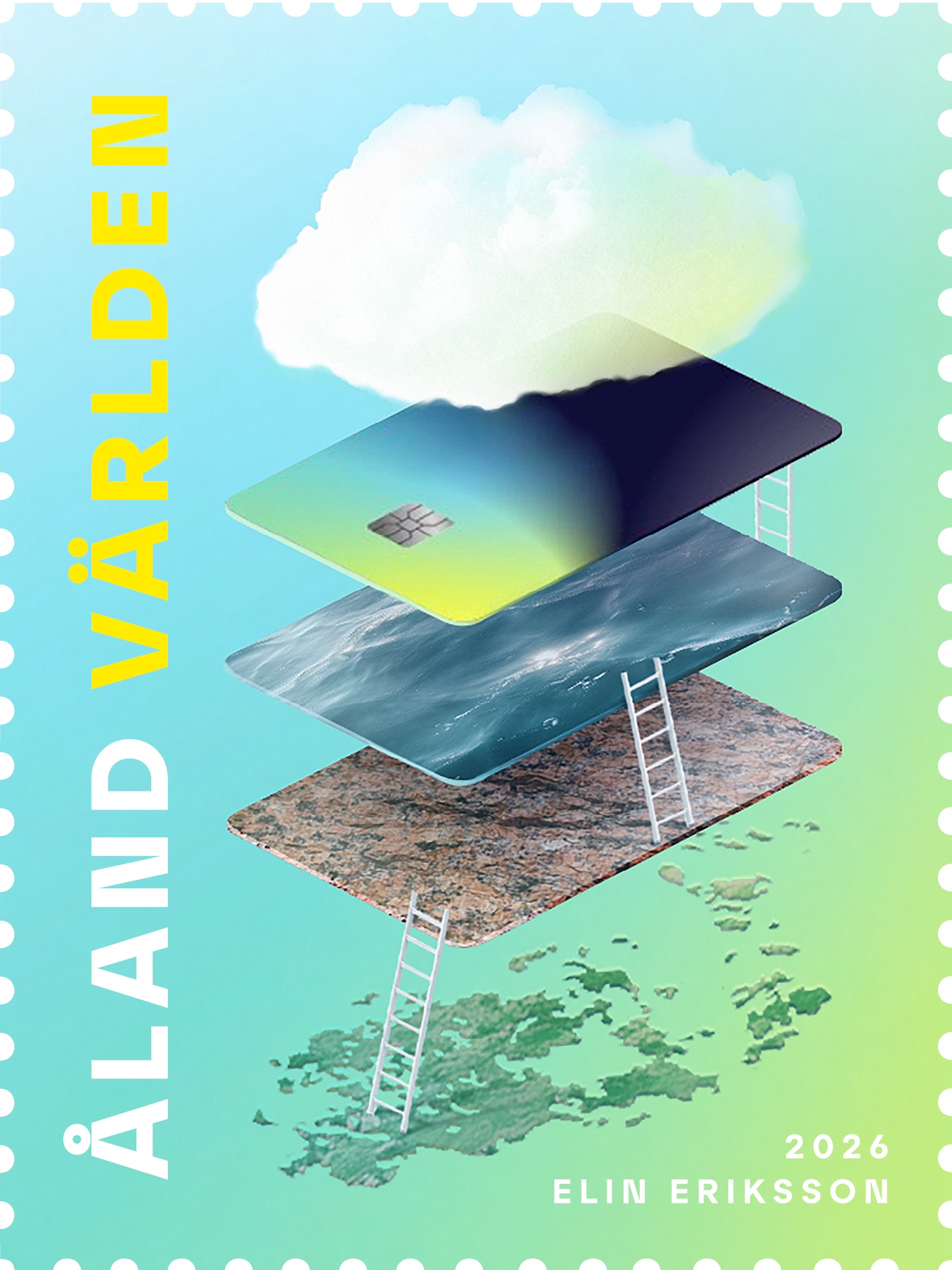
On 18 March, Åland Post launches a new stamp highlighting the financial services sector on Åland. The motif is inspired by the Åland company Enfuce, which in just a few years has grown into an international player in digital payments.
“Our stamps tell stories about Åland. With this stamp, we want to reflect contemporary society and highlight a part of modern Åland business life, showing how innovation, entrepreneurship and international operations can grow out of a small community,” says Johanna Finne, Head of Communications & Stamps at Åland Post Stamps.
Åland illustrator Elin Eriksson took on the challenge of illustrating this abstract business.
“It was inspiring and challenging to translate something so abstract into an image that feels understandable, aesthetic, and interesting – and that works in the small postage stamp format,” I tested different compositions to find an expression that reflected the identity of Enfuce, but where I could also weave my own surrealist style into the design. The result was a motif based on a stylized map of Åland that shows the Åland roots. The layers of red granite, sea, payment card, and the cloud symbolize the way out into the world,” Elin explains.
Enfuce offers cloud-based card and payment services and helps companies issue payment cards, manage transactions and oversee digital payments, among other things.
The company was founded on Åland in 2016 by five industrious entrepreneurs with a vision to change the payments industry. Two of the founders, Denise Johansson and Monika Liikamaa, still lead the company as a CEO duo. In less than ten years, the company has taken the leap from Åland to Europe and become a forerunner in the financial technology industry.
Postal: Åland Post Ab | Website: https://www.alandstamps.com/en
Åland – Summer shimmer
Issue date: March 18, 2026
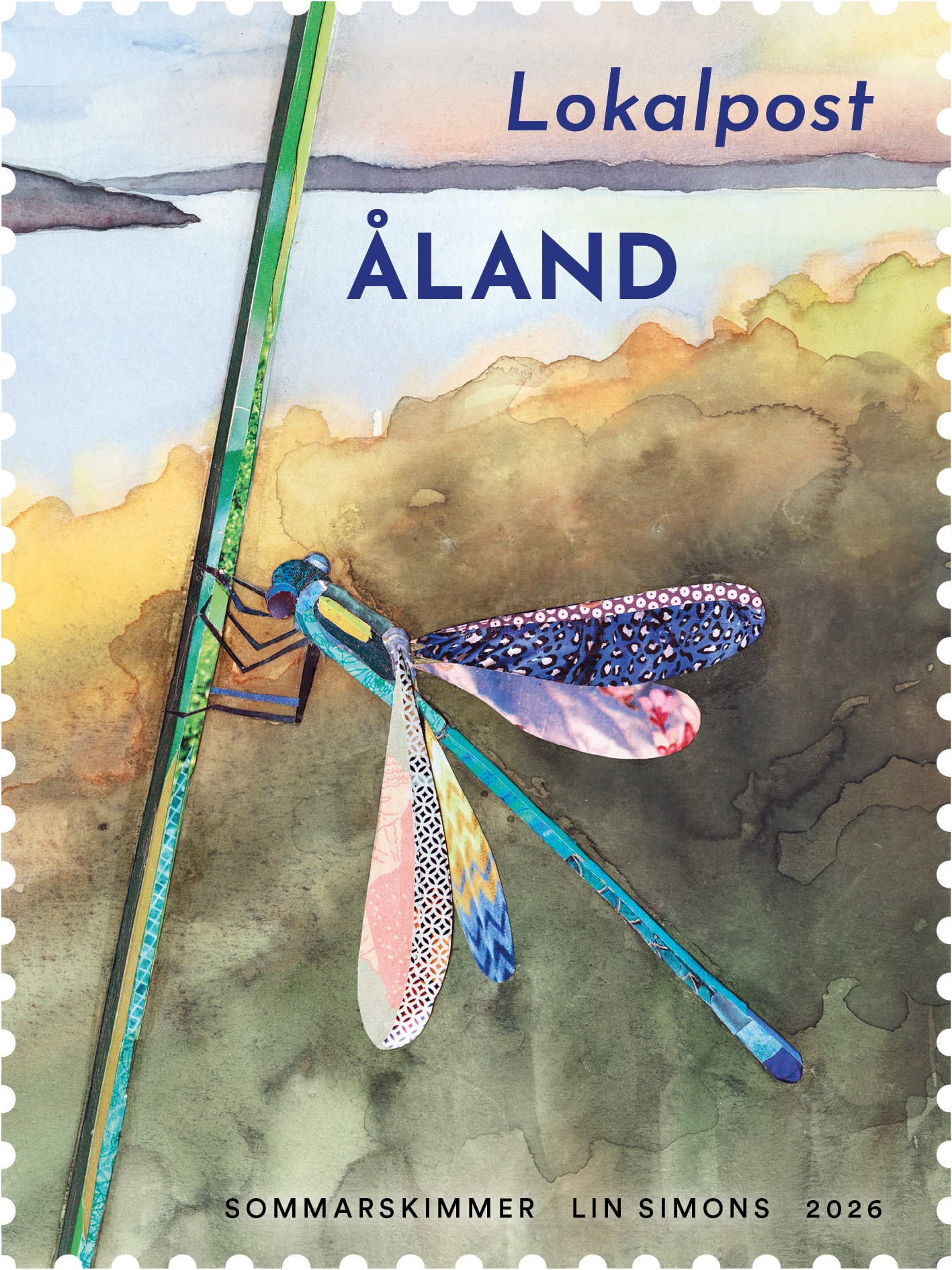
Åland Post presents the fourth issue in the Open edition stamp series, in which an artist is given free rein to create an Åland stamp. Visual artist Lin Simons captures the Åland late summer with a shimmering emerald damselfly (Lestes sponsa).
“The Open edition series offers new perspectives on the image of Åland. Lin Simon’s art is characterized by a strong connection to nature, colour, and rich detail. Her summery motif from the cottage in Åland combines the vibrant effects of watercolour with the intricacy of collage technique, resulting in an expression that is both sensorial and playful”, says Johanna Finne, Head of Stamps & Communications at Åland Post Stamps.
The Summer shimmer stamp shows one of our most common species of dragonflies, the emerald damselfly (Lestes sponsa) on a blade of grass against a stylized background of rolling grass, the sea and an evening sun partially hidden behind clouds. The motif is based on a recurring experience at her summer cottage in northern Åland.
“In the summer, the yellow-brown grass grows on the slope in front of our cottage, and dragonflies are swarming about in the air. I wanted to combine these two impressions: the shimmering dragonflies and the swaying grass in evening light,” Lin explains.
Lin likes to experiment with the collage technique, which she has used for the stamp in combination with watercolour.
“I’ve worked with the collage technique for many years. I create motifs from small pieces of coloured paper that I cut out of various interior design magazines and the like. The pieces of paper are hardly ever completely solid in colour, but shimmer with different patterns and shades of colour – this way the surfaces come alive,” Lin explains.
Alongside her own artistic work, Lin is an art teacher responsible for course planning at the Adult Education Centre in Mariehamn.
Postal: Åland Post Ab | Website: https://www.alandstamps.com/en
Åland – Sepac – iconic landmarks,Pommern
Issue date: March 18, 2026
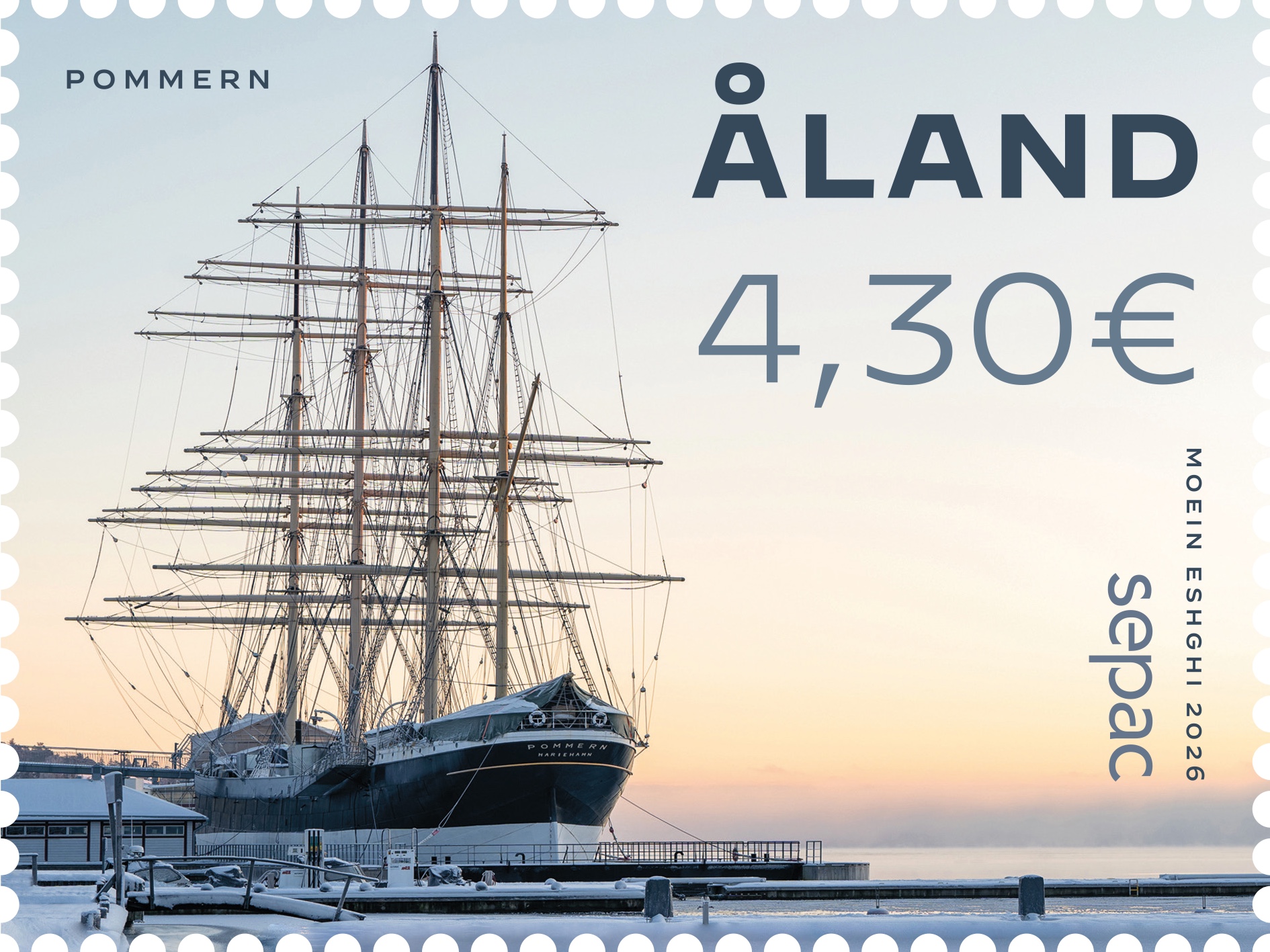
Åland Post issues this year’s stamp in the Sepac series, a joint issue from the small European postal administrations. The motif depicts the museum ship Pommern, a proud symbol of Åland’s maritime heritage. Photographer Moein Eshghi captures the vessel in tranquil winter setting.
“Pommern is one of Åland’s best-known sights and was a natural choice for this year’s Sepac theme, iconic landmarks. This time, we wanted to show the ship in a different setting from the one we are used to during the lively summer season”, says Johanna Finne, Head of Communications & Stamps at Åland Post Stamps.
Sailing ship Pommern is unique in the world as the only preserved four-masted steel barque in its original condition. Built in Glasgow in 1906, she first sailed under German flag as Mneme. In 1923, Åland shipping magnate Gustaf Erikson bought the ship and, as S/S Pommern, she became one of the last sailing ships to carry wheat between Australia and Europe until 1939.
Pommern has been a museum ship since 1953, when she was donated to the city of Mariehamn by Gustaf Erikson’s children. From May to September, the Pommern is open to visitors. Closed during the winter, the ship is far from dormant as important maintenance work is in progress.
The stamp motif was shot by photographer Moein Eshghi, his first assignment for Åland Post.
“I took the photo on a calm and cold winter’s day on Åland. The beautiful contrast between the white snow, the dark lines of the ship and the light blue sky caught my attention. The sense of stillness and serenity in the scene made me press the shutter,” Eshghi says.
Postal: Åland Post Ab | Website: https://www.alandstamps.com/en
Latest issue: 927