New Issues and stamp news 858
Australia – FIFA Women’s World Cup 2023
Issue date: July 11, 2023

The FIFA Women’s World Cup is an international association football competition contested by the senior women’s national teams of the members of Fédération Internationale de Football Association (FIFA), the sport’s international governing body. It has been held every four years since 1991.
The FIFA Women’s World Cup Australia and New Zealand 2023™ is taking place from 20 July to 20 August 2023. It is the first to be held in the southern hemisphere and the first to be hosted by two countries. A record 32 nations are competing for the coveted trophy at venues across Australia and Aotearoa New Zealand. As the host nation’s team automatically qualifies, as co-hosts, Australia’s Matildas and New Zealand’s Football Ferns were included in the 32 national teams.
$1.20 FIFA Women’s World Cup Australia and New Zealand 2023 Featured on the stamp is Tazuni™, the official mascot of the FIFA Women’s World Cup™. Tazuni™ is an energetic, football-loving penguin based on the species endemic to the region, Eudyptula minor, or Little Penguin. The colourful branding elements of the stamp and cover are based on works by Australian and Aotearoa New Zealand artists. The postmark is a schematised rendition of the winner’s trophy.
Malta – Euromed 2023
Issue date: July 10, 2023
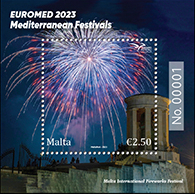
The Postal Union for the Mediterranean (PUMed), is a regional postal community with a mission to promote the collective interests of its members in the Euro-Mediterranean zone. It serves to strengthen network integration and the inter operability of services, including transfer of knowledge and technology.
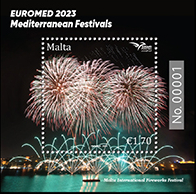
This year, MaltaPost has again joined members of the Euromed Postal Joint Stamp Project in the issue of a new set of stamps bearing a common theme. The Euromed series is an annual commitment that began in 2014 along the lines of the EUROPA stamp issue. The theme for 2023 is ‘Mediterranean Festivals’ and in this regard MaltaPost has launched a new philatelic issue, consisting of two stamps, both related to fireworks activity in the Grand Harbour at Valletta.
Sebio Aquilina’s photograph of a magnificent fireworks display from the annual Malta International Fireworks Festival appears on the first stamp. This shows a breath-taking spectacle of light and colour, reflecting on the sea and emphasising the natural beauty of the Grand Harbour. In Malta, fireworks displays constitute an old tradition, dating back four centuries, tied to traditional religious celebrations.
The Malta International Fireworks Festival also hosts apyro musical competition where firework displays are synchronised to the rhythm of a musical arrangement. Numerous local and international pyrotechnic companies look forward to the annual event and eagerly compete with their impressive displays in the hope of claiming one of the prestigious awards.
The second stamp in the series shows a typical colourful fireworks explosion, taken by photographer Michele Agius. The night sky is lit up to reveal the Siege Bell Memorial perched above the Grand Harbour. This monument symbolises the plight of those who fought and died for Malta during the Second World War.
It was built in 1992 to a design by UK sculptor Michael Sandle R.A., to commemorate the 50th anniversary of the award of the George Cross to Malta in recognition of the bravery and valour shown during the attacks on the Islands in 1940-42.
Tristan da Cunha – 100th Anniversary of St Mary’s Church
Issue date: July 7, 2023
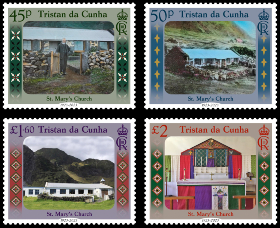
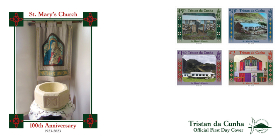
On 8th July 2023 we celebrate 100 years since Tristan’s Anglican Church was dedicated to St. Mary the Virgin.
In the beginning William Glass instituted daily prayer and Sunday public worship. Later services were held in Andrew Hagan’s house, as it was the largest in the settlement.
The first priest to be sent to the island, by the Society for the Propagation of the Gospel (SPG) was Rev. William Taylor, who arrived on 5th September 1851. After Taylor came Edward Dodgson, brother of Lewis Carroll, who was determined to build a church. He gathered stones and started to build, but the progress was so slow he decided to use the stones for a cemetery wall instead. Dodgson’s successor, Graham Barrow, marked out a site, which was not used. It was not until the arrival of Rev. Martyn Rogers, the fourth priest, that the church was finally built.
Rev. Rogers called all the men for a meeting in June 1922 and they decided to start building as soon as winter was over. The foundations were laid for a church 50 feet x 14 feet by the end of October. Under the foundation stone a small box of silver coins was buried. Dodgson’s stones were fetched from the cemetery to be used on the church. HMS Dublin visit made it possible to complete the church as amongst the stores they sent were timber, roofing, window glass, ironmongery and tools – Mrs. Rogers (Lonely Island).
By 5th July 1923 the church was finally completed and was solemnly dedicated to St. Mary the Virgin on 8th July. ‘Everyone felt a personal pride in it,’ says Mrs Rogers, ‘because everyone had done his share to get it completed.’
The Lectern Bible and harmonium had been bought by Rev. Barrow. The altar had seasonal frontals and a crucifix from Oberammergau (given by a lady in England). Stations of the Cross were framed and hung on the church walls. The tiny stone font that washed ashore when Rev. Dodgson arrived is still used in the church today. Two ship’s bells were recovered from the wreck of the Mabel Clark (1878). They were initially hung at either end of the settlement, but were transferred to St. Mary’s Church when she was built.
The first baby to be baptized in the new church was Wilson Glass and sisters Violet and Dorothy Glass, who married Willie Lavarello and Ned Green in July 1924, were the first couples to be married in it.
Over the years there have been further developments. In March 1929 a harmonium arrived aboard the tourist ship Duchess of Atholl, a gift from Queen Mary. Rev. Partridge (1927-33) lengthened the church and painted the East End in bright colours, still a feature of the church today and Rev. Dennis Wilkinson (1949-52) extended the church on the south side, using cement pillars to support the roof.
More recently, a wooden bell tower was added during the chaplaincy of Keith Flint (1963-66), a new corrugated aluminum roof was put on in 1970, the church was extended and redecorated in 1990/91 and the vestry extension was completed in 2002. The ships bell that hung in the bell tower was damaged in the 2001 hurricane and was replaced with a new bell in August 2003.
In 1952 Tristan was transferred from the Diocese of St Helena to the Diocese of Cape Town, although its priests continued to be sponsored by SPG until 1981. Islander Lorna Lavarello-Smith was ordained into priesthood in 2013 and assisted with services during her visit to the island in 2017. In 2019 Rev. Margaret Van den Berg was the first women to take up full time ministry at St. Mary’s Church. 45p – Rev. R. C. Pooley standing outside St Mary’s Church, 1929 (from image distributed by SPG). 50p – St Mary’s Church pictured in 1929 (from image distributed by SPG). £1.60 – St Mary’s Church pictured in 2023 £2 – The altar pictured in 2023 FDC – The stone font that was washed ashore from the schooner Edward Vittery, which ran aground after the Rev. E.H. Dodgson had been landed.
Bahamas – 50th Anniversary of Independence
Issue date: July 6, 2023
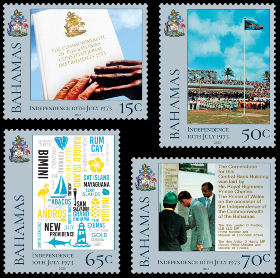
10 July, 1973 marked the culmination of an era of the greatest political advance for the people of The Bahamas since the landfall on these islands by Christopher Columbus in 1492.
After years of struggle by many freedom and justice loving people, Majority Rule had finally come to The Bahamas on 10 January, 1967. It was the point of transition from minority government to Majority Rule and the birth of a modern democracy.
Lynden Pindling of the PLP (The Progressive Liberal Party) became the first black Premier of the Bahamian colony and the drumbeat for independence became louder and louder. In 1968, the title of the position was changed to Prime Minister and a new constitution giving the Bahamas increased control over its own affairs was adopted. Pindling announced that the Bahamas would seek full independence and in 1969 the name Commonwealth of the Bahama Islands was adopted; but upon independence this was changed to The Commonwealth of The Bahamas.
The United Kingdom Government gave the Bahamas its independence by an Order in Council dated 20 June, 1973. The Order came into force on 10 July, 1973, the date that is now celebrated as the country’s Independence Day.
On the night of 9 July, 1973, just before midnight, the Union Jack was lowered and the new gold, black and aquamarine coloured Bahamas flag was hoisted at Clifford Park in front of some 50,000 people. Three hundred years of British rule had ended peacefully.
At mid-morning the following day Prince Charles, now King Charles III, presented Prime Minister Lynden Pindling with the constitutional instruments. Accepting the document on behalf of the Bahamian people the Prime Minister said: ‘This document will be greatly treasured and carefully preserved. It will be publicly displayed as a constant reminder to living Bahamians and Bahamians yet unborn, that the universal principles embodied therein constitute a sure foundation in which to build a stable, orderly, and flourishing society which will function smoothly and efficiently in a self-regulating peaceful evolution and quiet revolution.’
After five days in The Bahamas the Prince sadly set sail aboard HMS Minerva. On leaving he summed up his visit as follows: ‘After five such memorable days in the Bahamas, I find myself leaving Nassau with the utmost reluctance. Wherever I have been in the last few days during the independence celebrations I have met with consistent warmth and kindness from everyone and felt instantly at home among such happy people. I would like you to convey my profound gratitude to all those who worked so hard to make the independence celebrations the success they were. This is a good omen for the future happiness and progress of the new Bahamas and I shall watch with interest and affection the development of the Commonwealth of the Bahamas. Although I have not had time to collect much sand between my toes I leave with enough grains to make me want to return as soon as I can and I also leave with rhythm and warmth in my soul.’
Shortly after independence, Sir Milo Butler was appointed the first Governor-General of The Bahamas (the official representative of Queen Elizabeth II).
Sir Lynden Pindling was Prime Minister of The Bahamas for 25 years. When he was knighted by Queen Elizabeth II in 1983, he was the longest-serving elected head of government in the British Commonwealth.
‘We have not travelled long, we have much further to go. But we know where we are going, and with a united people and a gracious God, we will get there.’ Sir Lynden Pindling, 10 July, 1973.
Jersey – 150 years of the Société Jersiaise
Issue date: July 6, 2023
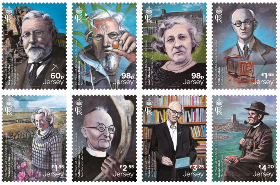
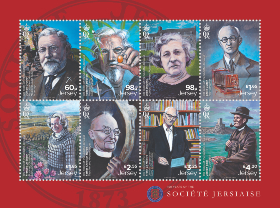
A set of eight commemorative stamps celebrating the 150th anniversary of the Société Jersiaise will be issued by Jersey Post on 6 July 2023.
The Société Jersiaise was founded in 1873 for the study of Jersey archaeology, history, natural history, the ancient language, and the conservation of the environment. 150 years later it continues to fulfil this important role, whilst enabling islanders to connect with Jersey’s past, present and future through research, education and outreach.
The commemorative stamps feature portraits of past members of the Société, each of whom has left a lasting legacy in their specific field of work. The portraits have been painted by Jersey artist Kevin Pallot and incorporate elements relating to each person’s area of interest.
Featured across the stamps are: historian and author Guy de Gruchy; naturalist and cinematographer Roderick Dobson; author of Old Jersey Houses Joan Stevens; photographer Emile Guiton; botanist, ornithologist, and conservationist Frances Le Sueur; teacher and archaeologist Father Christian Burdo; Jèrriais campaigner and lexicographer Frank Le Maistre and marine zoologist Joseph Sinel.
President of the Société Nicolette Westwood comments: “The Société Jersiaise is proud to be celebrating its 150th anniversary with a strong and committed membership. We are extremely grateful to Jersey Post for these commemorative stamps profiling some of the well-known names of the Société. Individuals such as these have been the lifeblood of the society and we are so grateful to have them brought to the public attention in this way. The good work of the organisation continues, changing with the demands of the time.”
The commemorative issue, entitled 150 Years of the Société Jersiaise, will be available to buy from all branches of Jersey Post from 6 July 2023. Philatelic stamp products such as souvenir sheetlets, first day covers, presentation packs and prestige booklets will be available from the Jersey post offices at Broad Street, St Helier and Rue Des Pres, St Saviour and can be ordered now at www.jerseystamps.com or by telephoning the Jersey Philatelic Bureau on: 00 44 (0)1534 616717.
Australia – Concession Post 2023
Issue date: July 4, 2023
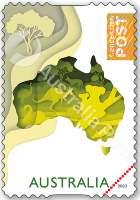
The Concession non-denominational stamp enables eligible concession card holders to receive a reduced rate on domestic postage, up to a certain value each year. A limited number of the refreshed design have been made available to philatelic collectors in the form of a stamp pack.
Concession Post 2023 The new Concession stamp design is inspired by Australia’s bush and waterways as well as our unique flora and fauna.
Australia – Sustainable Future
Issue date: June 27, 2023
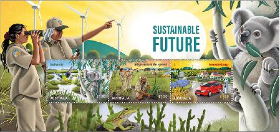
Sustainability is concerned with how we live, environmentally, socially and economically. It’s a goal that seeks to ensure that individuals, businesses and communities are living in a way that meets their needs without comprising the ability of future generations to do so. The three core elements of a sustainable future are economic viability, environmental protection and social equity.
There are international targets and conventions that seek to improve sustainability, to which Australia is a party, including the Convention on Biological Diversity (the Aichi Targets), the Paris Climate Agreement and the Sustainable Development Goals (SDGs), the latter of which were developed by the United Nations in 2015. The Australian government measures against the SDGs, not only in relation to environmental goals but also gender equality, regional stability, security and economic prosperity, (the latter, particularly in the Indo-Pacific region). In 2016, Australia Post was one of the first Australian companies to embrace the SDGs, by using them to underpin our corporate responsibility strategy.
The State of the Environment Report 2021 was released in July 2022 and paints a bleak picture of the current state of Australia’s natural environment and its deterioration over the preceding five years. Pressures include climate change, environmental degradation, invasive species and mining. Some 200 plants and animals have been added to the federal government‘s threatened species list since 2016. The report did also highlight where human efforts are making a difference, including the purchase and management of significant tracts of land for conservation by individuals, NGOs and businesses. One other important finding was the acknowledgement of the importance of Indigenous land practices as part of the way forward in dealing with climate change.
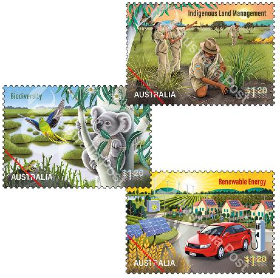
This stamp issue presents three aspect of environmental sustainability that are key to a sustainable future, each presented as an illustrated scene.
$1.20 Biodiversity Biodiversity means diversity both across species and ecosystems and within them (for example, generic variation), both on land and in marine environments. Biodiversity is concerned with the interconnectedness of these systems and how small actions can have big consequences in terms of upsetting a delicate balance. Australia has significant diversity in flora and fauna, including one of the most diverse fish faunas in the world and around 16 endemic plant families, the highest number in the world. However, Australia also has one of the worst records globally when it comes to extinctions.
The biodiversity stamp in this issue presents a stylised scene, inspired by Lake Connewarre, Victoria. That location is the site of a trial to release the Orange-bellied Parrot (while on migration from breeding sites in Tasmania). The planting of gum trees in a corridor next to the lake and wetlands has been implemented to support local Koala populations. Local saltmarsh plants preferred by the Orange-bellied Parrot and the vulnerable Growling Grass Frog (Litoria raniformis) have also been included in the scene.
$1.20 Indigenous Land Management The Indigenous land management stamp seeks to showcase Indigenous knowledge and connection to country, the country they have cared for across generations for around 60,000 years.
Indigenous land management comprises a diverse range of activities, including weed and feral animal control, fire management (such as cool burning), revegetation, management of water supplies, surveying plant and animal species, and the Indigenous Rangers program. The program, first funded in 2007, has created thousands of jobs for Indigenous people in land and sea management. As of April 2021, there were 129 Indigenous ranger groups, and the 2022 federal budget included funding for more than 80 additional ranger groups over six years.
$1.20 Renewable Energy In 2021, some 29 per cent of Australia’s total electricity generation was from renewable energy sources, such as solar, wind and hydro – the highest percentage on record in Australia. Australia has some of the highest uptake of solar in the world, around 32 per cent of households, according to a 2022 Roy Morgan survey.
The renewable energy stamp scene incorporates key examples of renewable energy technologies, such as community solar batteries, electric vehicles (powered by “Green Power” electricity), solar PV fields, wind turbines and sugar cane for bagasse (remnant sugar cane pulp). Combustion of biomass fuels such as bagasse accounts for just under two fifths of all renewable energy consumption in Australia.
Australia – Native Animals
Issue date: June 26, 2023
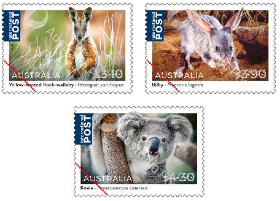
This International issue is a sequel to the domestic-rate Native Animals stamp issue, released on 19 December 2022. It features three threatened marsupial species. Numbers of all the animals featured have declined since European settlement due to a range of factors that include hunting by humans, environmental degradation, competition for food from introduced herbivores, predation by foxes and feral cats, and disease.
$3.10 Yellow-footed Rock-wallaby The agile Yellow-footed Rock-wallaby (Petrogale xanthopus) can be found in scattered populations among rocky outcrops and gorges in semi-arid country in eastern South Australia, western New South Wales and isolated pockets in Queensland. It stands about 60 centimetres in height and is attractively marked with orange-brown stripes on the tail and rich orange to bright yellow forearms, hind limbs and feet.
The stamp photographs is by Julie Fletcher Photography.
$3.90 Bilby The Bilby (Macrotis lagotis) is an ash-coloured, desert-dwelling marsupial around the size of a rabbit. It has a long, pointed snout, long ears, soft grey fur and a striking black and white tail. The Bilby was once widely distributed through arid and semi-arid Australia, but wild populations are now restricted to spinifex grassland in Western Australia and the Northern Territory, and to a small region of south-western Queensland.
The stamp photographs is by Darren Dew © The State of Queensland.
$4.30 Koala The Koala (Phascolarctos cinereus) is a national icon. It is found in eastern Australia from the temperate south to the tropical north. Koalas vary in weight from around 6.5 to 12 kilograms, with northern animals usually smaller than their southern relatives. Inactive for about 20 hours a day, koalas spend most of their lives in Eucalypt trees, the leaves of which provide the animals with virtually their sole source of food.
The stamp photographs is by Yatra4289/Shutterstock.com.