New Issues and stamp news 901
Faroe Islands – Dove of Peace
Issue date: Sep 19, 2025
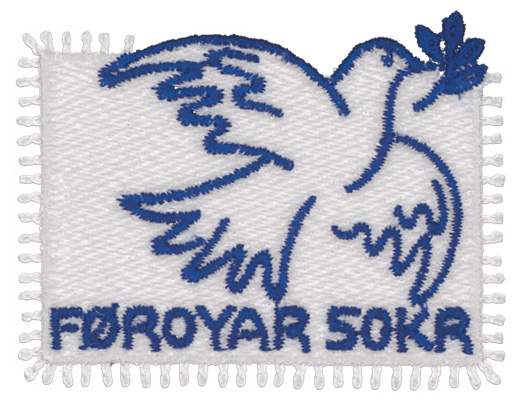
For the first time ever, the Faroe Islands is issuing an embroidered stamp. The stamp is made from recycled polyester yarn and depicts a dove of peace. This is part of the The Dove of Peace Project – a collaboration between European countries, the UN, and the UPU.
Peace, such a meaningful word We all desire to have and live in peace. Personally, peace within ourselves, in our neighbourhood and hopefully in the country where we live. Yet, we all know too well that there often is no peace, and people, nations, and even countries fight against each other.
Embroidered Stamp: “Dove of Peace” What can we do to raise awareness of the value of peace and happiness and send a message to people worldwide? An international initiative launched the project Dove of Peace Project which unites the creation, issuance, and sale of an embroidered postage stamp that depicts a dove of peace symbolising a shared commitment to promoting peace. Its members include postal administrations from various European countries, along with the United Nations, the Universal Postal Union (UPU) and the Austrian embroidery manufacturer Hämmerle & Vogel. This limited-edition stamp is crafted from recycled polyester yarn, making it a unique and meaningful product. A portion of the proceeds from the sale of the stamps supports charitable causes aimed at fostering peace.
“We and our entire postal network stand for peace in the world, which we support through this project and the “Dove of Peace” stamp.” – The Dove of Peace Project
Uniting for Peace … the project transcends borders just like a real dove, unifying postal services to send a global message of peace. This joint effort emphasises that love, tolerance, and understanding are the foundations for freedom and solidarity among people, as well as the diversity of opinions, attitudes and views.
Sending a Strong Message … the Dove of Peace Project is more than just a symbolic gesture. It is a concrete action towards peace. The project highlights that achieving peace begins within ourselves and in our immediate surroundings, urging us to make a daily effort towards harmony and strong communities.
Using a Bright Symbol … the dove of peace, ambassador of peace, featured on the stamp represents the effort required to achieve peace. Just as the elaborate embroidery demands patience and skill, achieving peace requires daily effort, resilience, and care.
Declaring a Compelling Appeal … the stamp serves as a collective, timeless wish and appeal for peace. Whether used as a stamp or as a personal accessory, piece by piece, little by little, the project contributes to the greater good, encouraging a mutual effort towards global peace.
Simple, but not easy … The embroidered stamp, while seemingly simple, involves skilful craftsmanship and represents the complexity of peace. It is both functional and artistic, combining usability, beautiful design, and value with a powerful message. The vast postal network involved in this project itself practices peace every day, turning words into actions. This initiative stands as a testament to the authentic efforts made by individuals and institutions alike to work for a better world.
We cannot stop every war in the world. But we can strive to make peace with those around us, our neighbours, friends, and families. Often it even starts with the peace within ourselves – the kind of peace that probably matters most. So, achieving peace begins with this small symbol – of freedom, pureness, love, tolerance, humanity, happiness, and beauty.
The Dove of Peace stamp is not just a philatelic product. It stands for hope, unity, and peace. Through this project, postal administrations and partners are making a real contribution to the global peace movement, one stitch at a time.
Faroe Islands – Columnar Basalt
Issue date: Sep 17, 2025
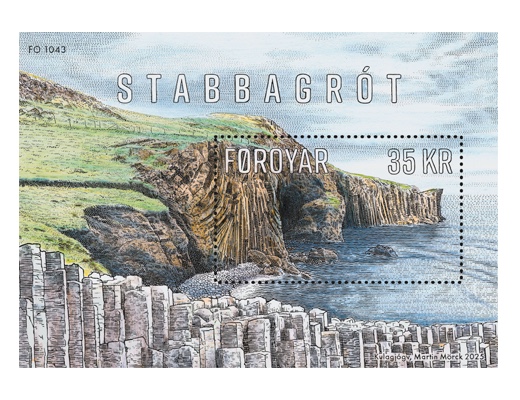
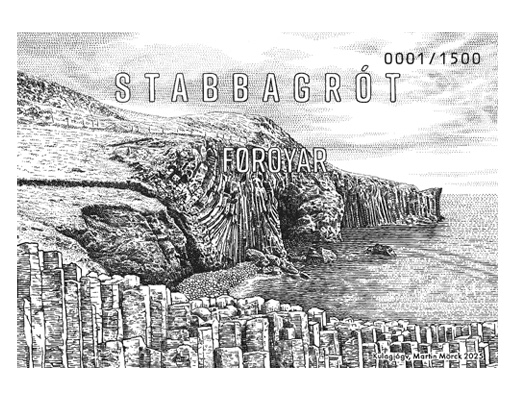
Have you ever stood wondering about a cliff face that looks like long carved columns, as if cut by hand? Why does the wall look like that? These columns are called columnar basalt and resemble true works of art, built directly into nature. In the Faroe Islands, there are many fascinating examples of columnar basalts.
What is columnar basalt and how does it form? Columnar basalt forms, for example, when a lava flow spreads out over the landscape and cools in a very particular way. As the lava cools, it contracts slightly and cracks into regular columns – from the bottom upwards (perpendicular to the cooling surface, which is the substrate).
What is especially fascinating about columnar basalt is the shape of the columns themselves. In most cases, they are hexagonal, meaning the columns have six sides. They look almost unnaturally perfect. And there is a reason for this beautiful shape.
When a lava flow cools and contracts, internal pressure builds up in the lava as it solidifies. This pressure must be relieved, and nature does so most efficiently in the following way: the hot lava cracks at the most stable angle on a surface, namely 120°. When several cracks spread out from a single point, they usually form a hexagonal pattern, where angles of 120° fit perfectly six times around a centre. This is why the hexagonal pattern is the most natural form under these conditions – not only in solidifying lava but also in, for example, honeycombs, dried clay, and soap bubbles.
However, not all columns are perfect hexagons. If the lava is not evenly mixed, if there are impurities in it, or if it does not cool evenly, the pressure will also be unevenly distributed. In such cases, the columns can have fewer or more than six sides. This is a reminder that although physics prefers order, reality is often messy.
Columnar basalt is very common in the basalt layers, such as the Beinisvørð formation, which is found on Suðuroy and Mykines, among other places. In some locations, the columns can be up to 30 metres high. One of the most beautiful examples in the Faroe Islands is found in Kulagjógv on Suðuroy. Here, the columns appear as a large, beautiful fan in the landscape.
Intrusive igneous rocks But that is not the whole story. In the Faroe Islands, there are many types of basaltic intrusions – both irregular ones, as well as dykes and sills. This happens when a lava flow does not quite reach the surface but instead penetrates cracks in the subsurface and solidifies slowly between older lava layers. If these intrusions lie horizontally, they are called sills, and if they stand vertically, they are called dykes.
Collectively, they are known as intrusive igneous rocks. The largest intrusions are the 13 km² Streymoy sill and the 16 km² Eysturoy sill, both very characteristic in the landscape.
In both these sills, you can see beautiful columnar basalt, similar to the columns in the Beinisvørð formation. Besides these, there are several smaller sills, including in Fugloy, Svínoy, and also near Morskranes on Eysturoy.
Since a dyke is vertical and the hot magma cools from both sides, the columns form perpendicular to the dyke’s sides – and are called dyke basalt. In many places in the Faroe Islands, you can see examples of dyke basalt. When hiking in the mountains or driving around the islands, it is easy to spot basalt dykes. In some places, they remain as ridges in the landscape, while in others they have been eroded away, forming narrow gorges. This depends on how resistant the dyke material is compared to the surrounding rocks.
If the material around a dyke is weaker than the dyke material, the dyke remains standing and protrudes in the landscape. In the mountains, this appears as ridges – locally called ”giant fences” because they resemble enormous walls that giants could have built. A good example is found in the mountains of Vágar. If, on the other hand, the dyke material is the weakest, the dyke is gradually eroded away, leaving a gorge. During the preparation of geological maps of the Faroe Islands, over 800 basalt dykes have been recorded.
Stories hidden in stone Columnar basalt is more than just the result of volcanic eruptions. These are also windows revealing stories from when the continental plates broke apart, the North Atlantic opened, and violent volcanic eruptions built up the Faroe Islands. This happened about 60 million years ago in a geologically dramatic period.
Columnar basalt is nature’s way of preserving memories from the past. These geological stories are gradually revealed as the land slowly erodes. Now they can give us a more detailed insight into how this landscape was formed.
So next time you stand beneath one of these impressive columns, take a moment and look closely. You are not just looking at stone – you are looking into a distant past that tells the story of how this land was created.
Two miniture sheets are included, with one in colour and one in black and white
Gibraltar – Medals of Service
Issue date: September 18, 2025
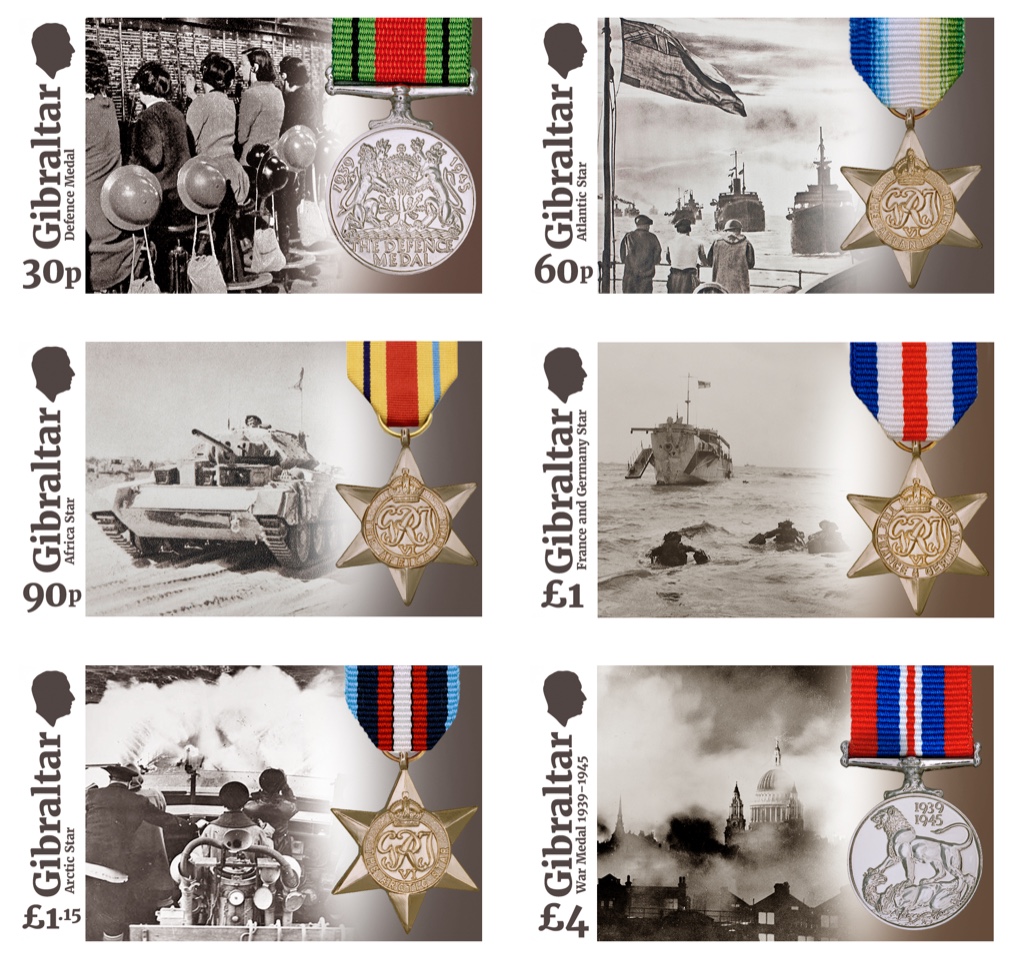
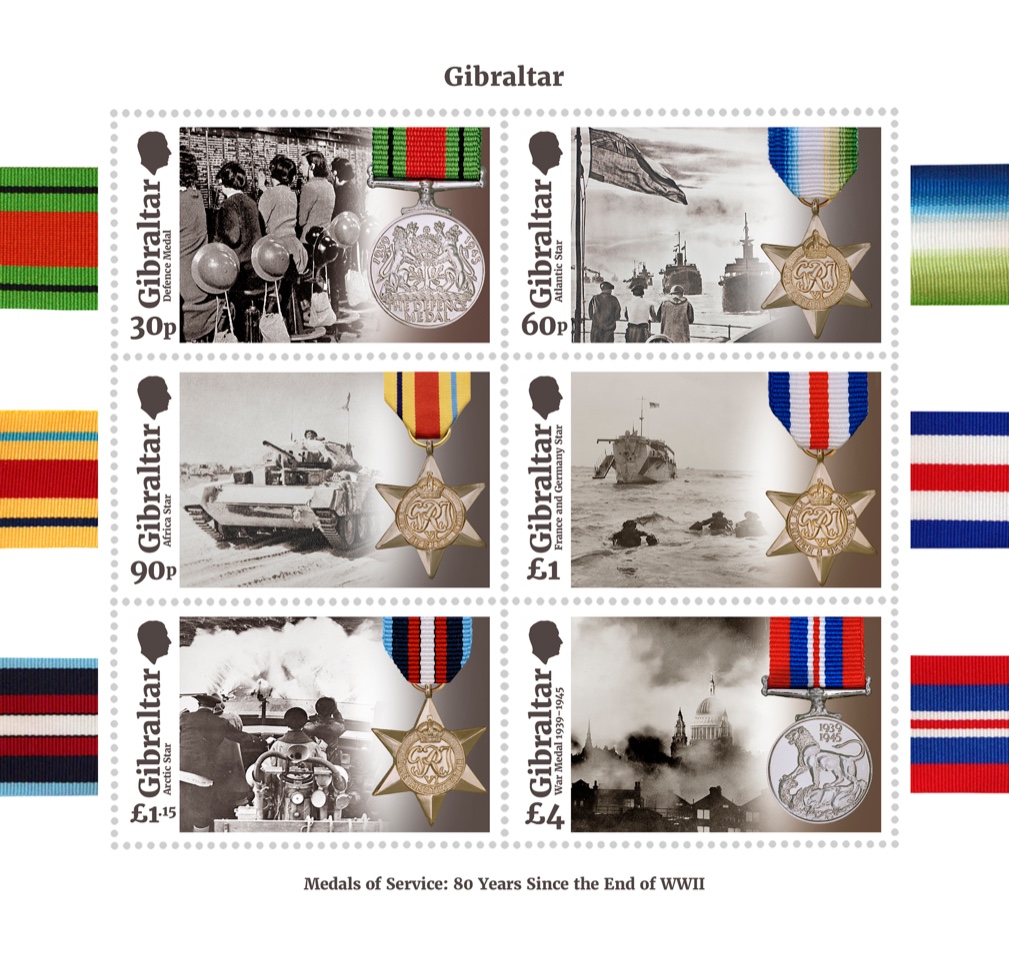
The Gibraltar Philatelic Bureau is pleased to unveil a new stamp issue commemorating the 80th anniversary of the end of the Second World War.
Eighty years after the end of the Second World War, this stamp issue pays tribute to the medals awarded for courage, endurance, and sacrifice. Gibraltar, with its unique strategic role, stood at the heart of Britain’s wartime operations. These medals not only commemorate those who fought across land, sea, and air, but also recognise the vital contributions of Gibraltarians, both military and civilian, in one of history’s defining conflicts.
The artistic vision behind this collection was brought to life by local graphic artist, Mr. Stephen Perera, combining six medals awarded to combatants of the Second World War and photographs of the various conflicts.
The Medals of Service collection is comprised of a set of six stamps, a miniature sheet and accompanying First Day Covers and Presentation Packs.
Gibraltar – SEPAC – Gibraltar Architecture
Issue date: September 16, 2025
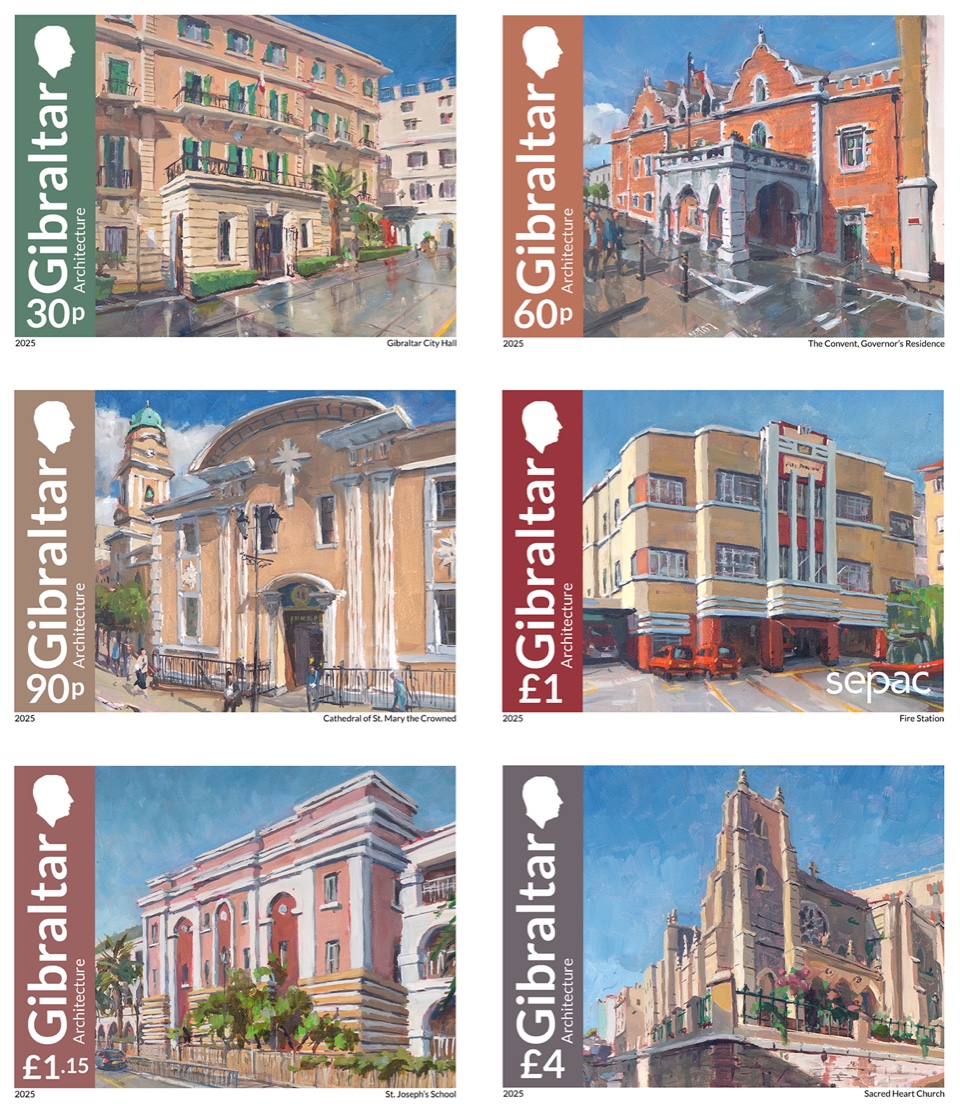
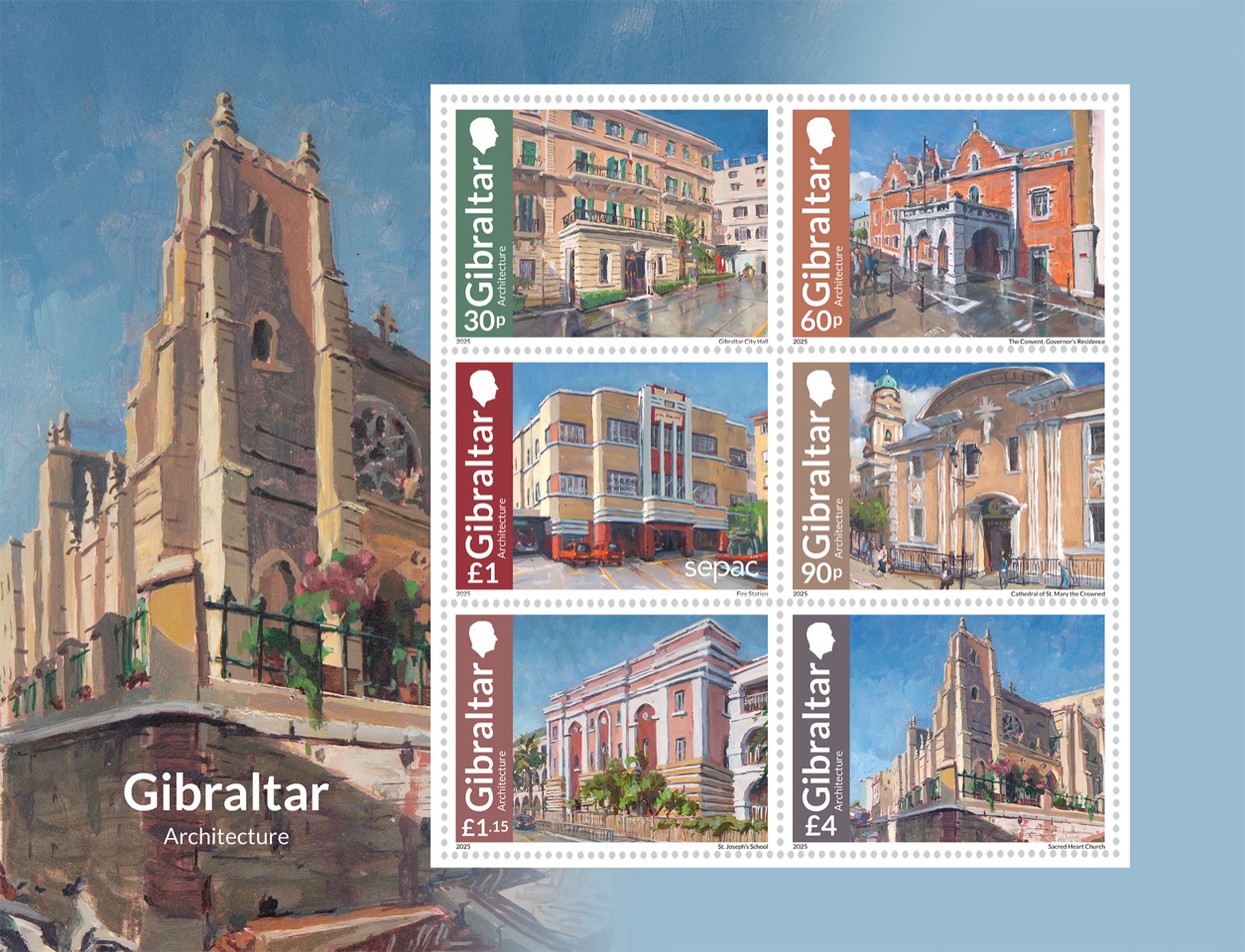
The Gibraltar Philatelic Bureau is pleased to unveil a new stamp issue featuring some of the Rock’s most iconic buildings.
SEPAC stamps are special stamps issued by Small European Postal Administrations and are highly collectible amongst philatelists, having been issued for over fifteen years. Each year a new theme is assigned by SEPAC, participating countries issue stamps reflecting their own interpretation of the theme. For 2025 the theme is ‘Architecture’ and our issue features six stamps and a miniature sheet, highlighting some of Gibraltar’s main architectural landmarks.
The set of six stamps features a diverse selection of buildings in Gibraltar, each a testament to Gibraltar’s rich and layered past forged from centuries of architectural influence.
The artistic vision behind this collection was brought to life by local graphic artist, Mr. Stephen Perera, and features a selection of paintings by renowned local artist Sebastian Rodriguez.
The Gibraltar Architecture collection is comprised of a set of six stamps, a miniature sheet, and accompanying First Day Covers and Presentation.
Gibraltar – A Celebration of Gibraltar’s Philately
Issue date: September 16, 2025
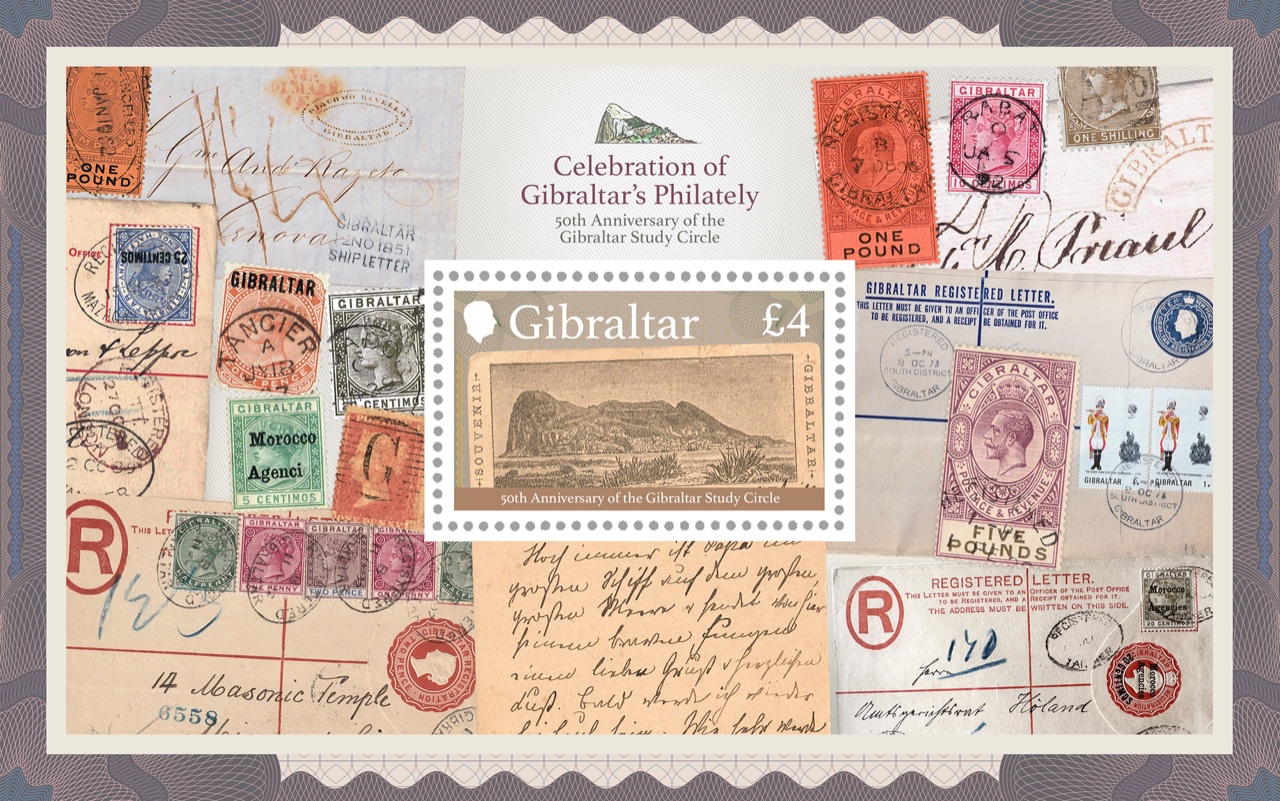
The Gibraltar Philatelic Bureau is pleased to unveil a new stamp issue commemorating the 50th anniversary of the Gibraltar Study Circle.
The Gibraltar Study Circle (GSC) was founded in 1975 to promote, research, and record Gibraltar’s rich postal and philatelic heritage. The design serves not only as a tribute to the organisation’s five decades of dedicated scholarship but also as a visual journey through some of the most evocative items in Gibraltar’s postal history.
The miniature sheet reproduces an early Gibraltar picture postcard showing the Rock of Gibraltar in a detailed monochrome engraving on the £4 stamp, framed by a carefully curated collage of rare and historically significant philatelic items, all sourced from the private collections of GSC members.
The artistic vision behind this collection was brought to life by local graphic artist, Mr. Stephen Perera, in collaboration with the Gibraltar Study Circle.
The Celebration of Gibraltar’s Philately collection is comprised of a miniature sheet of one stamp and accompanying First Day Covers and Presentation.
Malta – Maltese Festa – Series IX
Issue date: September 12, 2025
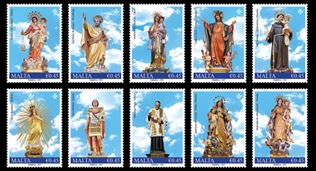
The Festa is an important part of cultural heritage in Maltese villages, uniting families, local communities and outsiders in a celebration of popular religiosity. Apart from liturgical functions, the common factors during Festa Week are the street decorations, band marches, firework displays and lots of church bell ringing.
Balluta – Statue of Our Lady of Mount Carmel Bir¿ebbu- Statue of Saint Peter in Chains Fgura – Statue of Our Lady of Mount Carmel Fontana, Gozo – Statue of the Sacred Heart of Jesus Ghajnsielem, Gozo – Statue of Saint Anthony Mellieha – Statue of Our Lady of the Nativity of the Blessed Virgin Qormi – Statue of Saint Sebastian Swatar – Statue of Saint Preca Victoria, Gozo – Statue of Our Lady of Graces Wardija – Statue of Our Lady of the Forsaken (Il-Madonna tal-Abbandunati)
Finland – National Landscapes III
Issue date: September 10, 2025


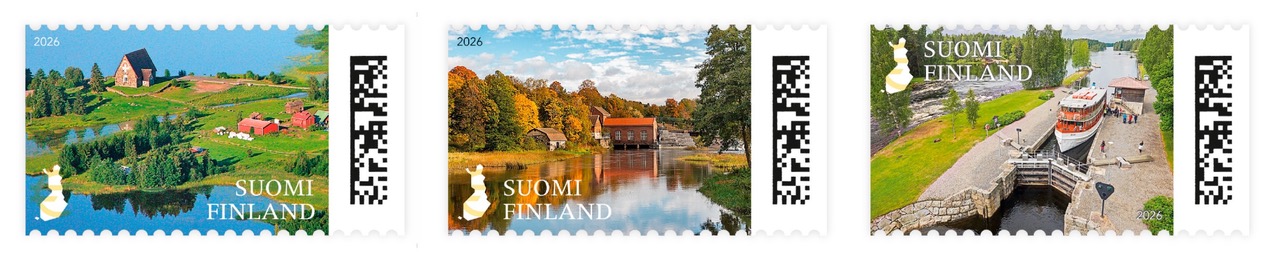
The popular series of roll of stamps featuring national landscapes has progressed to its third part. This time, the stamps designed by Stiina Hovi feature landscapes from Helsinki, Hämeenkyrö, Lake Köyliönjärvi, Väisälänmäki, hilltop villages in North Karelia, Imatrankoski and Olavinlinna in Savonlinna.
“The stamp series presents the stunning national landscapes of our country, which have been admired for generations. Once again, the third series of National Landscapes stamps features both man-made and natural sites – each with its own meaning in the minds of the viewers. National landscapes create a visually diverse image of Finland. Stamps continue to have a strong position in conveying this message,” says Stiina Hovi.
National Landscapes III will be issued as a 100-stamp roll that contains seven different domestic no-value indicator stamp designs.
Finland – Finnish Customs
Issue date: September 10, 2025
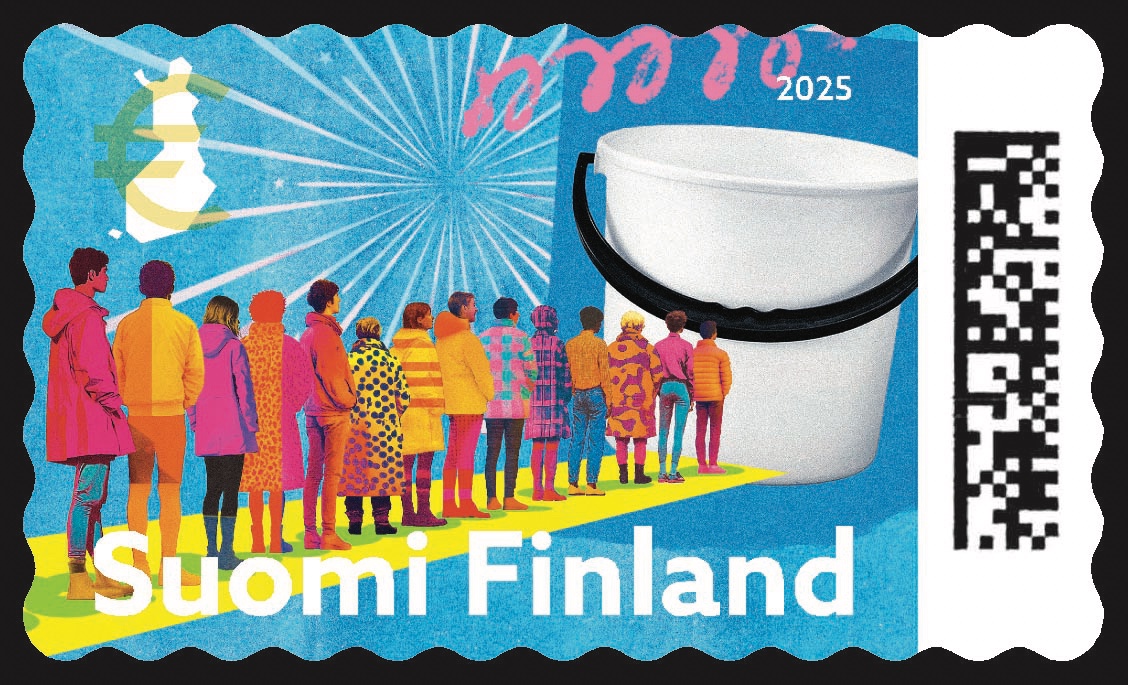
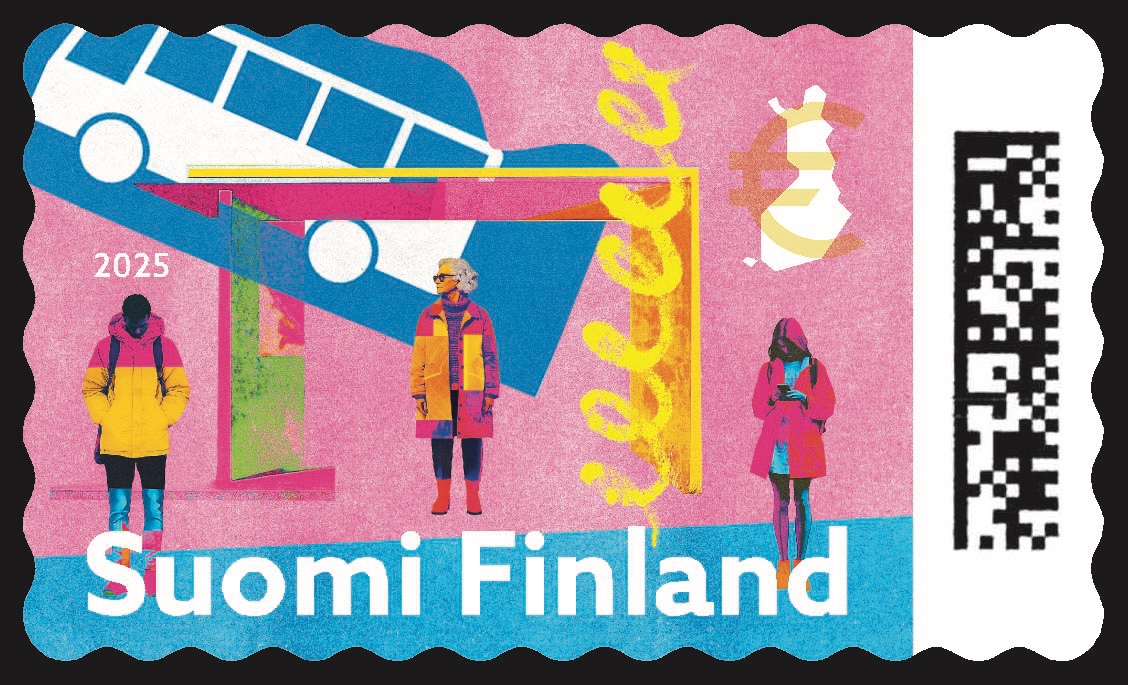
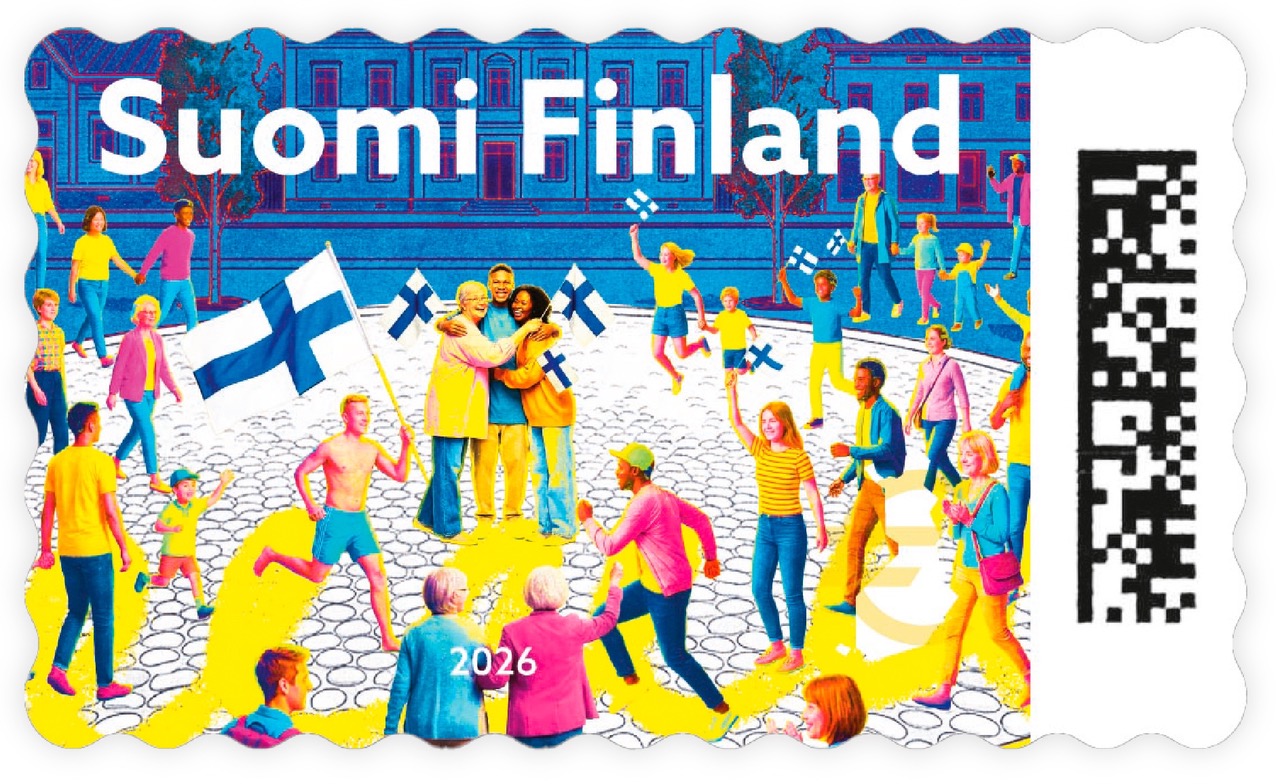
Finns have several national customs, two of which are presented in colorful stamps designed by Miika Saksi. On the first stamp, people are lining up for free buckets, which is a well known way of getting masses of Finns moving. On the second stamp, people are waiting for a bus at a bus stop and, as is common in Finland, they are keeping their distance from other passengers.
According to Saksi, the challenge with the stamp size was how to describe people’s customs without a verbal explanation. The themes and implementation of the stamps were decided after several discussions with Tommi Kantola, Design Manager at Posti.
Saksi used artificial intelligence to find details and graphic elements for the illustrations. “Every tiny element of the illustration, such as characters, clothes and hair, has been brought together with the help of image editing software. The finished illustrations represent the colorful collage technique typical of my work.”
Finnish Customs will be a 10-stamp sheet containing two different domestic no-value indicator stamps.
Finland – Veterans
Issue date: September 10, 2025
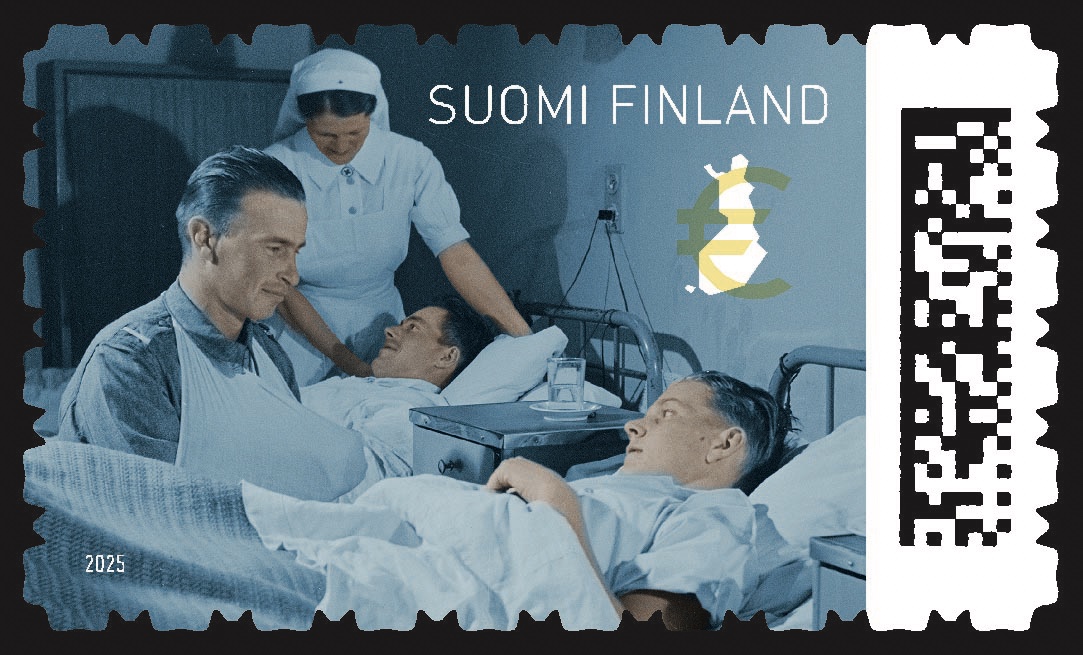
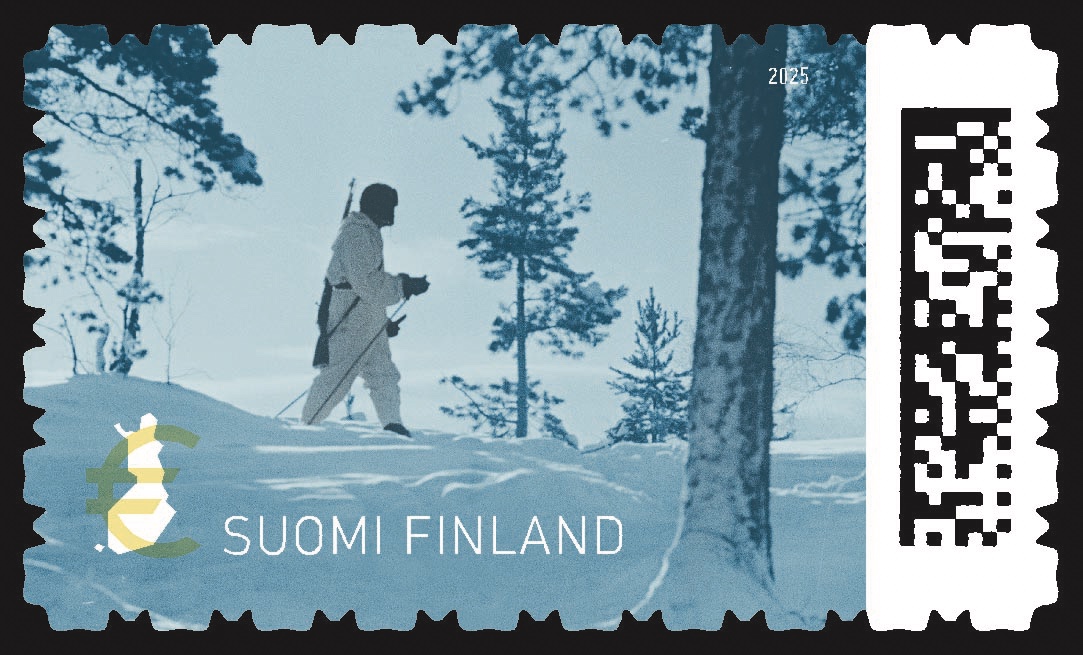
This year marks the 80th anniversary of the end of the Second World War in Finland. At the same time, the youngest age group called up for war service will reach the age of 100. Today, the Tammenlehvän perinneliitto federation cherishes the heritage of our war veterans, and Posti will publish two stamps designed by Klaus Welp. The photographs on the blue-toned stamps feature a soldier on ski patrol and being treated in a hospital.
“Veteran-themed stamps reflect the atmosphere during the Second World War in Finland. Skiing was a cultural and tactical specialty of Finns during the Winter War and the Continuation War. The forested and snowy landscape was part of the environment in which soldiers lived and fought. The hospital image conveys warmhearted care and respect for those wounded in war,” says Pia Mikkonen, Head of Fundraising for the Veterans of the Sotiemme Veteraanit (Our War Veterans) and Sotiemme Naiset (The Women of our Wars) collection.
“The message from veterans to us and future generations is clear: even a small nation can successfully defend its independence and liberty. Our war-time generation believed in peaceful diplomacy between nations, but also had to take up arms to defend Finland’s existence under extreme threat. They laid the foundation for an independent and democratic Finland, and with the release of the war veterans stamps, we want to honor their courage and sacrifice,” says Anna Storm, Vice President, Sustainability and Corporate Affairs at Posti.
Some 1,200 Finnish veterans are still alive. This year, approximately 400 of our war veterans have already reached or will reach the age 100.
Veterans is a 10-stamp sheet with two different domestic no-value indicator stamp designs