New Issues and stamp news 856
Norfolk Island – Botanic Garden
Issue date: June 13, 2023
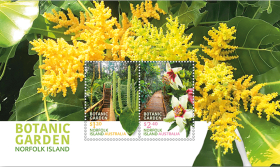
Norfolk Island Botanic Garden was originally a 0.6-hectare private garden cleared and planted by Mrs Annie Moore in the 1950s. After she left the island in 1975, Norfolk Island Administration maintained the gardens until 1986, at which time it became part of the Norfolk Island National Park and Botanic Garden. In 1993 an adjoining 4.9 hectares was purchased to complete the current 5.5 hectares.
Most of the garden’s plant species are native and many are rare and endemic to the Norfolk Island group. The garden also includes a boardwalk trail, subtropical rainforest and Discovery Centre, where visitors can learn more about the island’s precious flora and fauna.
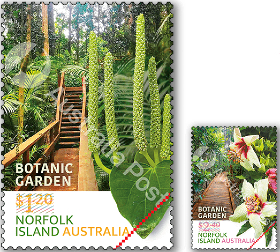
Shown on the stamps, along with a section of the boardwalk trail, are the Pepper Tree (Piper excelsum subsp. psittacorum) and the critically endangered Phillip Island Hibiscus (Hibiscus insularis). The minisheet features Shade Tree (Meryta latifolia, which is an evergreen tree endemic to Norfolk Island).
$1.20 Stamp (Boardwalk trail and Pepper Tree) The subspecies of Pepper Tree shown on the stamp is confined to Lord Howe Island, Norfolk Island, Kermadec Island and some islands off the north coast of New Zealand. Named for its slightly aromatic and peppery leaves, the Pepper Tree produces long spikes that range between 4 and 16 centimetres high, depending on whether they are male or female.
The stamp photographs are by Nigel Greenup (boardwalk) and © M. Fagg, 2005 (Pepper Tree).
$2.40 Stamp (Boardwalk trail and Phillip Island Hibiscus) Pictured with a section of the boardwalk trail is the Phillip Island Hibiscus, a large shrub or small tree that grows to around 2.5 metres high. It produces solitary cream to light green flowers with a dark magenta centre. As they age, the flowers turn a reddish purple colour. This critically endangered plant is confined to three patches on the northern slopes of the island, its numbers greatly reduced by introduced pigs, goats and rabbits, which have since been removed from the island.
The stamp photographs are by Ian Beattie/AUSCAPE/Alamy (boardwalk) and Daryl O’Connor (Phillip Island Hibiscus).
Åland – Bark boat in a jar
Issue date: June 9, 2023

In 2022, for the very first time, Åland Post gave an artist free rein to create a stamp motif. The commission “Open Edition” went to Finnish art photographer Christoffer Relander, who describes his stamp as a preserved childhood memory. Through the stamp he looks back at his Åland roots and childhood summers building wooden boats with this father.
Åland – Summer cottages
Issue date: June 9, 2023
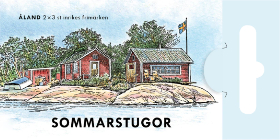
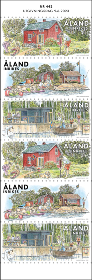
The stamp booklet celebrates Åland cottage life. The stamps portray the three summer cottages that won Åland Post’s photo competition in the summer of 2022. The cottages of Finngrundet, a tiny island of just 1000 square metres, adorn the booklet cover.
The three cottages illustrated on the postage stamps are:
The croft, tailor’s cottage from 1854, Eckerö
Strandskatan, modern summer home, Eckerö
Finngrundet, combined bath cottage/sauna, 1950s, Föglö
Australia – Still-life Paintings Margaret Olley and John Perceval
Issue date: June 6, 2023
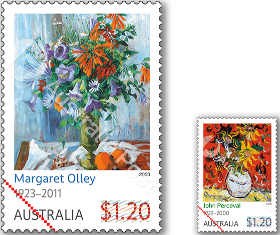
This stamp issue draws together two of Australia’s leading mid–late 20th-century visual artists – Margaret Olley AC (1923–2011) and John Perceval AO (1923–2000) – representing them through still-life paintings. The stamp issue commemorates the centenary of their births and recognises the significant artistic legacy each has gifted to Australia’s cultural heritage.
Still lifes and interior scenes were centre stage in the work of Margaret Olley, who had a career of more than 60 years. Floral bouquets, precisely arranged fruit and ceramic objects, and evocative domestic settings all capture the intimate texture of her everyday life, recorded brilliantly in oils and acrylics. A consummate portraitist, the artist herself can be seen in several of her paintings, perhaps reflected in a mirror or otherwise positioned unobtrusively. Olley’s carefully composed scenes – strikingly coloured and yet calm in their considered expression – have always made her works popular with critics and the public alike. Olley was also the subject of two Archibald Prize winning portraits.
While Olley was primarily a painter of still lifes, John Perceval has greater renown for his landscapes and ceramics, including an intriguing series of ceramic angels, than for his still lifes. In an homage to Van Gogh, however, he painted several iterations of sunflowers, experimenting with colour variation. Recovering from polio as a teenager, Perceval followed his passion for painting by learning from the great European masters through studying their published works in books. Perceval and his likeminded Melbourne contemporaries, including Arthur Boyd, Sidney Nolan, Albert Tucker and Clifton Pugh, rebelled against the traditionalists and were members of the counter-establishment Contemporary Art Society. A leading Australian painter of landscapes during the 1950s and 1960s, Perceval produced his critically acclaimed Williamstown Series and Gaffney Creek Landscapes in the 1950s. In 1960, he was joint winner of the prestigious Wynne Prize for landscape art, with the painting titled Dairy Farm.
$1.20 Margaret Olley, Winter Flowers Margaret Olley, Winter Flowers, 1964, oil on board, 74.8 × 59 cm, private collection, courtesy of Smith & Singer Fine Art. © Philip Bacon Gallery $1.20 John Perceval, Sunflowers John Perceval, Sunflowers, undated, oil on canvas, 46 × 35.5 cm, Jreissati Family Collection. © Celia Perceval. Photo: Don Gathercole
Australia – Extinct Mammals
Issue date: June 1, 2023
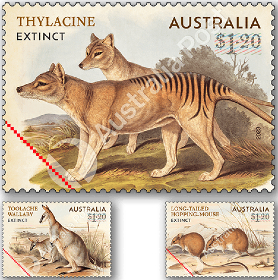
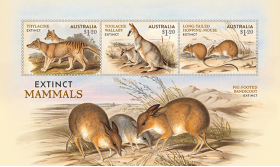
Australia has a very poor record when it comes to extinctions. A recent review coordinated by academics from Charles Darwin University found that the number of formally recognised extinctions since European colonisation of Australia is one seaweed, 38 vascular plants, 10 invertebrates, four frogs, one reptile, nine birds and 34 mammals. The loss rate for mammals is far higher than for any other continent over this period.
Australia’s modern environmental protection legislation was established in 1999. However, that legislation has not necessarily curbed all pressures on threatened species: for example, around 8 million hectares of threatened species’ habitats were cleared between 2000 and 2017. The massively destructive bushfires of 2019/20 burnt at least 10 per cent of the distribution of at least 300 threatened plants and animals.
This stamp issue features three extinct Australian mammals: the Thylacine, the Toolache Wallaby and the Long-tailed Hopping-mouse. The reasons for their extinctions encompass some of the key reasons for mammal extinctions since British colonisation, including hunting by humans, often encouraged by government bounties; introduced species; habitat destruction; and climate change. The illustrations featured are lithographs by HC Richter and John Gould, from John Gould’s significant work, first published in 1863, The Mammals of Australia.
$1.20 Thylacine Perhaps the most famous of Australia’s extinct animals, the Thylacine (or Tasmanian Tiger, Thylacinus cynocephalus) was the world’s largest carnivorous marsupial and the only member of the Thylacinidae family to survive into modern times. It was not a tiger or a wolf but a pouched animal related to kangaroos.
Although the precise reasons for extinction from mainland Australia around 3,000 years ago are not known, the Thylacine appears to have declined as a result of competition with the Dingo and possible hunting by humans. The introduction of dogs by European settlers probably accelerated its extinction from Tasmania, and a distemper-type disease played a role, but the main cause was hunting by humans, encouraged by an official government bounty scheme between 1888 and 1909, introduced due to a misleading perception of the Thylacine as an aggressive pest and claims that it preyed on sheep and poultry (when in reality, it preferred kangaroos and other marsupials, as well as small rodents and birds).
The last known Thylacine is thought to have been killed in the wild in 1930, and the last known surviving animal in captivity died in Beaumaris Zoo, Hobart, in 1936. Although there was a conservation movement pressing for the Thylacine ‘s protection since 1901, protection didn’t come into force until around two months before the last known animal died in captivity, in 1936. A recent research study suggests that the Thylacine may have lasted longer in the wild, but not all view this as likely or credible.
The stamp image is from the collections of the National Library of Australia.
$1.20 Toolache Wallaby Originally named Grey’s Wallaby, after explorer and South Australian governor Sir George Grey (1812–98), the Toolache Wallaby (Notamacropus greyi) was an elegant, slender wallaby, with prominent black markings from the nose to the eye and on the toes: it was considered the most beautiful of Australia’s kangaroos and wallabies. Sadly, its beautiful fur made it a target for hunting. Habitat decline was also a major factor in its extinction; much of its habitat was cleared and converted to pastoral land in the 1880s.
At the time of European settlement, the Toolache Wallaby occupied areas in south-eastern South Australia and into western Victoria. By 1910, populations had been reduced to a few scattered colonies in areas along the South Australian coast and near Mt Gambier. By 1924 only one small group was known to survive. An attempt was made to transfer some of the population to a sanctuary on Kangaroo Island, but this failed. The last known survivor died in captivity in Robe, South Australia, in 1939.
The stamp image is from the collections of the State Library of South Australia.
$1.20 Long-tailed Hopping-mouse Australia has many native rodents, including a distinctive suite of ten hopping-mice, all characterised by long tails, long back legs, and a rapid hopping gait. Five of these are now extinct. The Long-tailed Hopping-mouse (Notomys longicaudatus) was one of the largest, weighing around 100 grams.
The Long-tailed Hopping-mouse was formerly distributed across much of inland Australia, in arid and semi-arid regions in Western Australia, New South Wales and the Northern Territory, where habitat included wattles, eucalypts, low shrubs and grasslands. This burrowing species had an ingenious way of collecting water, building layers of excess soil from its burrowing, which collected moisture above-ground.
No living individuals have been recorded since 1901. Introduced predators (cats and foxes) were the main cause of extinction, but other contributing factors may have included habitat alteration due to changed fire regimes and habitat degradation due to livestock.
The stamp image is from the collections of the National Library of Australia.
Malta – Malta 2023 – Games of the Small States of Europe
Issue date: May 29, 2023
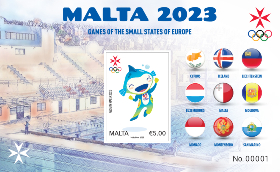
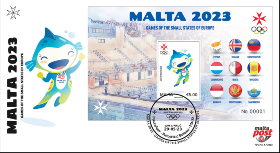
The Games of the Small States of Europe (GSSE) consist of a multi-sport event, organized every two years, featuring the National Olympic Committees of European small states. Instituted during the Los Angeles Olympic Games in 1984, these Games are reserved for athletes hailing from 9 participating countries, these being Andorra, Cyprus, Iceland, Liechtenstein, Luxembourg, Malta, Montenegro, Monaco and San Marino. All countries are independent states and members of the European Olympic Committee (EOC).
Montenegro joined in 2009 and participated for the first time in the 2011 edition. Member countries all have a population of less than one million people, with Cyprus being the only exception, although its population was below one million in 1984. The Games are especially designed to cater for the small size of the participating states.
The first Games took place in San Marino in 1985. In 1993, Malta hosted the 5th Edition of the GSSE which saw the organizational level of the Games develop further due to an increase in the number of sports offered. Malta again hosted the GSSE event between the 2nd and 7th of June 2003, this being the 10th Edition.
Malta 2023 is the 19th Edition of the Games and will see the organization of a total of ten different sports held within eleven different venues between the 29th May and 3rd June 2023. The event will attract contingents of over 1,200 athletes, including the related contingents. The sporting disciplines will consist of athletics, basketball, judo, rugby 7s, sailing, shooting, squash, swimming, table-tennis and tennis. The Games promise to be an exciting, colourful and fun experience.
PUKA is the official mascot of the 2023 Games of the Small States of Europe. The name is a derivative of ‘lampuka’, the dorado fish which is synonymous with the Maltese Islands. The vibrant colours that the lampuka is known for were used as a point of departure during the design stage. The mascot visual brings together elements of Maltese culture, island vibrancy and the friendly nature of the Maltese people. Colourful and dynamic PUKA represents and symbolises the values of the upcoming Games in a sporty and fun way.
Australia – Jellyfish: Underwater Wonders
Issue date: May 16, 2023
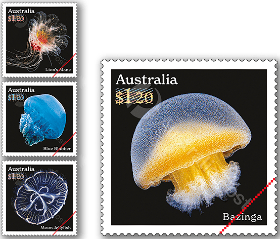

Most of Australia’s jellyfish are neither dangerous to humans nor damaging to other species. There are at least 1,000 jellyfish species drifting on the currents around Australia, a high number of which are endemic. In this stamp issue, we illustrate just four of these wonders of the ocean.
The jellyfish featured in this stamp issue all started life as a tiny daisy-shaped larva known as an ephyra, budded off from a tiny polyp. Jellyfish polyps appear as pale pink fuzz on the undersides of rocks and logs and other natural (or sometimes unnatural) structures. In the right conditions, these polyps release the baby jellies, which grow extremely fast as they gorge on tiny plankton.
Most jellyfish can grow vigorously when food is abundant, or slow down or even “de-grow” when food is scarce, and many are quite tolerant of salinity and temperature fluctuations. Jellyfish can clone in at least 13 different ways, and some species are truly biologically immortal. Jellyfish have no bones, no brain and no heart, and yet they prey on species higher up the food chain than themselves; that is, they will predate the eggs and larvae of fish, crustaceans and molluscs, as well as the plankton that those larvae would eat. In some cases, jellyfish can exploit distressed habitats, acting as both a visible indicator and a driver of further distress.
$1.20 Lion’s Mane At least a dozen different species of Lion’s Mane jellies are endemic to Australia, from the Top End to the tip of Tasmania. They come in a dazzling array of colours and patterns, from solid to speckled to spotted, and covering almost all the colours of the rainbow. One of our most exquisite is common in Port Phillip Bay, Victoria, in the summertime. Cyanea annaskala is distinctive from other Lion’s Mane jellies in its small size and its clear bell, or body, with deep-red oral arms, the frilly structures that hang down between the dozens of fine hairlike tentacles. Admire this one from a distance, however, as its microscopic stinging cells can produce a sharp sting.
The stamp photograph is by David Paul.
$1.20 Blue Blubber One of Australia’s most notorious jellies is the Blue Blubber. It has an unusual distribution pattern, with blue populations in both Victoria and Queensland disrupted by a brown population in New South Wales. The peculiar colour difference of this seasonally abundant jelly is thought to be due to symbiotic algae living in the tissues of the New South Welsh jellies, similar to the symbiosis between corals and their resident algae. The algal symbionts help supplement the jellyfish’s diet, so it can grow very large very fast without having to rely on catching plankton. Catostylus makes its home in semi-enclosed bays and harbours, where sometimes it may be so plentiful that it seems you could walk across them. In these conditions, known as blooms, they can cause problems for sea bathers, net fishermen, power plants, boats and ships.
The stamp photograph is by Paul Starosta/Getty Images.
$1.20 Moon Jellyfish Perhaps the most common jellyfish known across Australia is the Moon Jellyfish, comprising several different varieties around the coastline. The most prevalent, Aurelia coerulea, is found across southern Australia, from the Indian Ocean to the Tasman Sea. Aurelia polyps can be found in just about any marina, often blanketing the undersides of the floating pontoons. In the right conditions, the baby jellies budded off from these polyps can grow from the size of a sesame seed to as broad as a dinner plate in a matter of weeks. Towards late summer, as Aurelia matures, vast rafts of them may be found shoaling towards the surface, often around mid-morning and mid-afternoon, and is possibly related to their breeding or feeding behaviour. Although Aurelia can look formidable in these sorts of numbers, most people are unaffected by its sting.
The stamp photograph is by Alexander Semenov/Science Photo Library.
$1.20 Bazinga Quite possibly Australia’s most delightful jellyfish is Bazinga. It was named in honour of the television sit-com Big Bang Theory, where the word “bazinga” was often used to mean “ha, ha, fooled you!”. The name was given to the jellyfish in reference to its surprise discovery, where it had been hiding in plain sight in the coastal waters around Byron Bay, masquerading as the juvenile of a more common species. In fact, it turned out to be as different from other known jellyfish species as a walrus is from a house cat. Bazinga is the size of a marble at maturity, and it barely stings. The Bazinga is a lovely golden colour because of symbiotic algae living in its tissues, which it needs due to its habit of pulsating rapidly.
The stamp photograph is by Denis Riek.
Australia – Peacock Spiders
Issue date: May 9, 2023
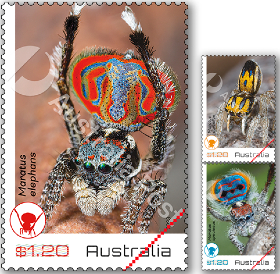
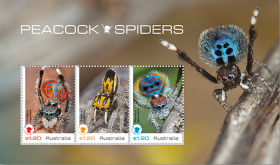
The genus Maratus, commonly known as peacock spiders, currently comprises around 96 species, with 20 known species still to be named. This group is endemic to Australia, with the single exception M. griseus, a synanthrope apparently introduced to New Zealand.
Measuring around just 2–5 millimetres in length, these colourful little jumping spiders are named for the peacock-like display adult males use to seduce potential mates, incorporating an impressive array of dance moves. Adult males come in a dazzling array of colours and patterns, specific to each species. Only under the microscope or macro lens does the spectacular colouring and performance of these little spiders become apparent. Unlike adult males, immatures and females are muted brown and/or grey, which serves to camouflage them well.
Species of Maratus are known to live in tropical areas, but most occur in the southern half of Australia, in the temperate and subtropical south-west and south-east. Some prefer coastal areas, even beaches, while others prefer mountain tops, swamps or even desert-like environments. Individuals live for about a year, emerging from an egg during the summer.
Until 2011, the genus was comprised of only eight little-known species placed in different genera. In recent years, many new species have been named and described. Sydney-based arachnologist Jürgen Otto and his US colleague David Hill have described a great number of species since Jürgen first happened upon M. volans in Sydney in 2005 and became intrigued by the tiny spiders. Little was known of their elaborate courtship behaviour until Jürgen observed, documented and filmed their display in 2008, which became a social media hit. Jürgen Otto’s photographs are featured on the stamps.
$1.20 Maratus speciosus Also known as the Coastal Peacock Spider, M. speciosus is one of the first of the peacock spiders to have been described, in 1874. As its common name suggests, it inhabits plants among sand-dune areas in the south-west coast of Western Australia. The male raises his red-striped, iridescent cobalt-blue abdomen his during courtship dance, but it is the bright orange-yellow fringing of the fan, extended as he lifts his abdomen, that is particular to this species, as well as his asymmetrical semaphore signalling – his long third legs moving independently during this performance.
$1.20 Maratus purcellae Described in 2013 from a spider found in a garden in Canberra and a second one in Grafton, M. purcellae is a tiny spider at just 2.5 to 3 millimetres in length. The individual found in Canberra is known as the “type specimen” and is shown on the stamp. The adult male spider is uniquely coloured, with his head and narrow abdomen deep yellow-gold and black, and three sapphire-coloured spots occurring on his abdomen. He lacks expandable flaps for the fan and is one of the few peacock spiders that doesn’t use its legs for signalling during courtship; these are coloured uniformly grey-brown rather than bearing any flashy markings that may aid in gaining a mate’s attention.
$1.20 Maratus elephans Described in 2015, this species was named from individuals discovered near Tamworth, New South Wales. It takes its name from the pattern evident on the male’s extended abdomen. The red markings on metallic mauve and bronze outline nothing so much as an elephant’s head, when viewed front on. His fan is large and appears more so due to the long hair-like setae that fringe it during courtship. Having none of the male’s colouring, the female has pale brown underparts and a black back.
Christmas Island – Caves
Issue date: May 9, 2023

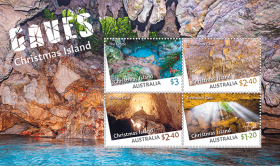
Christmas Island’s myriad caves are the result of its geological history. The island first appeared around 60 million years ago, when the peak of a volcanic basalt seamount rose from the ocean floor. Through several subsequent geological uplifts, coral reefs built up on the basalt core, creating a soft limestone cap over the island. The limestone has slowly eroded, creating a karst landscape that includes many hidden caves and underground streams and pools. The island’s caves are popular with speleologists and are an important habitat for fauna including the Christmas Island Swiftlet and rare, endemic cave species.
Two Commonwealth Government agencies currently administer the caves on the Island. Parks Australia North manages the caves found within the National Park and the wildlife in all caves while Christmas Island Administration is responsible for all caves outside of the Park. The Grotto and Freshwater Cave are the most frequently visited by local people as swimming holes and social gathering destinations, particularly The Grotto.
$1.20 Freshwater Cave Freshwater Cave is popular with cave explorers and lies on the south coast within Christmas Island National Park. It is estimated to be about 700 metres long, featuring interconnected collapse chambers, some of which contain remains of original spongework (limestone rock that has a sponge-like appearance, due to small dissolution pits created by acidic water).
The stamp photograph is by Kirsty Faulkner of Faulkner Photography
$2.40 Daniel Roux Cave Accessible from the mainland, Daniel Roux Cave is a complex of two separate caves, located on the northern coast of Christmas Island just beyond Smith Point. The complex consists of two very different cave systems; the upper being a large multi-chamber non-technical cave that is relatively well decorated with stalagmites, stalactites, shawls, pools and helictites, and the lower cave being a deep subterranean technical cave that is has an entrance that opens into the ocean. Discovered only as late as July 1960 by a local fisherman, the cave complex was not named after its discoverer but in memory of the dead son of a Swiss draftsman who worked on the island for many years.
The stamp photograph is by Yvonne McKenzie of Wondrous World Images.
$2.40 Bishops Cave Further to the west, also on the north coast is Bishops Cave, first recorded in 1969. It is named after speleologist Roy Bishop, who explored and mapped Christmas Island caves in the 1960s. Around 400 metres long, this cave comprises a large collapse dome and lower solutional passage (formed by acidic water seeping into and dissolving rock).
The stamp photograph is by Rauleigh Webb.
$3 The Grotto The Grotto is on the north-east point of the island. It can be accessed via Golf Course Road, a short drive from Settlement. It’s a small, picturesque cave, around 20 metres in length, with a pool fed by both fresh water and seawater. The beautiful crystal-clear pool is popular with swimmers and tourists.
The stamp photograph is by Yvonne McKenzie of Wondrous World Images.