New Issues and stamp news 887
Faroe Islands – Landscape: Víkar
Issue date: February 24, 2025
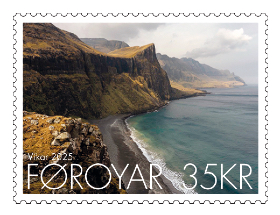
Víkar is located on the northern side of Vágar. The walk from Gásadalur northwards to Víkar is about 15 km.
The route takes you from Gásadalur up to Gresskarð, which is 518 metres high. You then descend into Gresskarðadal and continue to Sniðdal. From there, you reach Neytagjógv, and after making your way down the gorge, you arrive at Víkar.
Around the same time that people settled in Hvítanes and Slættanes (in the 1830s), Jákup Jógvansson from Sørvágur (1792–1885) settled in Víkar in 1833, along with his wife, Sára Sofía Ábramsdóttir, who was from Gásadalur. A few years later, Rasmus Jóannesarson from Gásadalur (1798–1875) and Maria Súsanna Óladóttir from Bø also settled there. Shortly after Rasmus moved to Víkar, Hanus Jóannesarson from Mykines (1808–1888) and his wife, Sigga Pætursdóttir from Vestmanna, joined them. In 1855, the population peaked, with 16 people living in the three houses. However, Hanus and Sigga did not stay and moved away again in the 1860s.
The houses were typical Faroese wooden houses with turf roofs, and where the wind was strongest, they built stone walls for protection. These three houses were situated on a beautiful, flat plain, and each house had its own enclosed field, the remains of which are still visible. Stone walls were built around each field, high enough to prevent sheep from jumping over. The soil at Víkar is fertile, making cultivation relatively easy.
They lived off farming, bird catching, and fishing. They made and sold woollen jumpers. Although grain grew well, they did not thresh much of it, as the area is very exposed to the wind; the gusts often caused significant damage to the potato fields.
The peat conditions were good. You can still see that the peat-cutting areas were located both east and west of the village, slightly higher up than the houses. A lot of digging was required to reach the peat. Each house had a peat store in the outfield, and at least one had a peat house.
It is remarkable how much these men built. They also constructed two boathouses, and the third boathouse was used for smaller boats. They even made a long row of wooden logs to help pull the boats up. There is a landing place, but launching a boat is difficult, and pulling it back up is a tough task. However, the village was well-positioned for boat fishing, and the men of the first two generations were hardworking fishermen. They sold fish. The third generation did not fish much locally; they went to sea instead.
Life in Víkar was harsh, and this small village had only a short lifespan. The population slowly but steadily decreased, and by 1910, only three men remained from the third generation. By the end of the year, they too had left, and the village was abandoned.
Víkar is an incredibly beautiful place. The wide plain, surrounded by towering mountains, is stunning to behold. The view northward over the sea is magnificent, and to the east, you can see the cliffs near Miðvágur to the north, and in the distance, you can catch a glimpse of Streymoy. Many tourists visit the area in the summer.
Faroe Islands – Handball in the Faroe Islands
Issue date: February 24, 2025

The Faroese Handball Association (Hondbóltsamband Føroya) was founded on 19th April 1980, but it was as far back as the 1920s that Faroese people began playing handball.
The Beginnings of Handball in the Faroes It was women who first started playing handball in the Faroe Islands. Girls at the Secondary School in Tórshavn began playing handball in the schoolyard in 1928-29, when a young Danish teacher was working as a substitute in Tórshavn for a short period. She introduced the sport to the Faroese girls. Gradually, the boys joined in, and the first club, Neistin, was founded on 21st March 1931. The interest in the sport quickly spread, and several more clubs were established throughout the 1930s.
After the Faroese Sports Federation (Ítróttarsamband Føroya) was founded in 1939, a national handball tournament was organised. The first Faroese championship tournament took place in 1943, with both women and men participating – seven women’s teams and four men’s teams. For the women, Neistin, Aldan, Ternan, Stjørnan, Vípan, TB, and VB took part. For the men, StÍF, VÍF, and two teams from Tórshavn competed; one comprised scouts, and the other from Havnar Fimleikafelag (Tórshavn’s Gymnastics Association). The following year, participation more than doubled, with 26 teams competing in the 1944 Faroese championship.
Sports Halls and International Membership In the 1970s, several sports halls were built around the islands, which significantly strengthened the sport. The Faroe Islands gained international membership in the International Handball Federation (IHF) in 1972 and participated in international tournaments throughout the 1970s and into the 1980s – a prosperous time when handball flourished.
After a somewhat unstable period with less activity in the late 1980s, 1990s, and 2000s, the sport has once again gained momentum. In 2013, a targeted development plan was implemented to ensure stable and continuous progress, comparable to our neighbouring countries. The aim was to secure better financial, administrative, and sporting support for the activity.
The Faroe Islands at the Highest Level The development has been evident. The Faroe Islands now regularly compete in final tournaments with youth national teams, achieving good results. Both the men’s and women’s national teams have now qualified for the European Championships in 2024, which has given Faroese people a sport to rally around, competing at the highest international level. Faroese professional players are now seen in top handball clubs and leagues across Europe, and they are regularly mentioned in international sports media. They have become role models for Faroese children and youth.
This positive development has boosted interest in playing handball in the Faroe Islands, and today, interest is at a record high. There are 13 clubs, and around 3,100 people play handball, making the Faroe Islands the country with the highest number of handball players per capita – approximately 5 percent, with an equal distribution between genders.
Faroe Islands – Famous Pilots in the Faroe Islands
Issue date: February 24, 2025
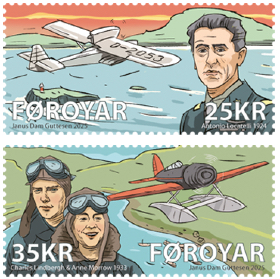
“On Friday evening around 7 o’clock, a distant hum was suddenly heard from the southeast, like that of a large blowfly – and at the same moment, a large crane fly appeared south of Nólsoy.
‘The aeroplane!’ people shouted, staring in awe at the foreign-looking vessel, which now roared as loudly as a motorboat as it flew over the fjord, turned eastwards in an arc right above the watch house hill – and continued over the rooftops out towards the bay, where it skidded across the water at full speed, turned back towards land, and anchored calmly off Tinganes…”
This was how the newspaper Tingakrossur described the event on 15 August 1924, when the Italian air captain Antonio Locatelli and his crew landed their Dornier Wal seaplane in the bay of Tórshavn. The town’s other newspaper, Dimmalætting, reported that “Cows tethered over by Skansavegin were so frightened that they broke loose and galloped around as if they were mad, while seagulls fled swiftly from the church roof, apparently terrified of this new gigantic competitor on the routes where they and other winged colleagues had previously reigned supreme…”
Antonio Locatelli Antonio Locatelli was born in Bergamo, Italy, in 1895. During the First World War, he served in an aviation unit of the Italian army and obtained his pilot’s licence in 1915. He flew 523 missions during the war, distinguishing himself with daring operations, including a solo reconnaissance flight over Vienna in 1918.
After the war, Locatelli spent some time in South America, where in 1919 he set a record as the first pilot to fly over the Andes from Argentina to Chile, reaching an altitude of 6,500 meters on that occasion.
During the interwar period, Locatelli was active in the Fascist Party and briefly served as a parliamentary substitute.
Locatelli’s expedition in 1924 was aimed at exploring possibilities for air routes between Europe and America.
Locatelli’s Mishap The day after arriving in the Faroe Islands, Locatelli continued his journey. A large crowd had gathered at the harbour on Saturday morning, and at 9 a.m. on 16 August 1924, the Dornier Wal aircraft took off again, circled over Kirkjubøreyn, and headed for Iceland, where it arrived in Hornafjörður on the southeast coast at noon.
In Iceland, Antonio Locatelli met American pilots who had crossed the Atlantic a few days earlier. The Americans knew he was on his way to the USA, and this would later prove to save his life.
On 21 August, Antonio Locatelli and his crew left Iceland. But when they did not reach their destination in Greenland, the American pilots raised the alarm – and their escort ship, the cruiser Richmond, began a search for the Italians. Late in the evening of 24 August, Richmond found Locatelli’s seaplane floating about 100 nautical miles off the east coast of Greenland. They had been forced to land on the sea due to thick fog, and the aircraft was so damaged that it could not take off again. By that time, they had drifted at sea for three days. Locatelli and his crew escaped with their lives, but the mission ended with the crash off Greenland.
When Italy invaded Ethiopia in 1936, Antonio Locatelli participated as the captain of a bomber. He was shot down during a bombing raid and died, aged only 41.
Transatlantic Seaplane Route? After Locatelli’s visit in 1924, the Faroe Islands were occasionally visited by aviation pioneers who, due to the lack of airstrips on land, always used seaplanes. Most visits were expeditions to explore the possibilities of establishing a transatlantic air route between Europe and the American continent.
Charles Lindbergh in the Faroe Islands It caused quite a stir when news arrived in 1933 that the best-known of the aviation pioneers, Charles Lindbergh, might make a stopover here. He was conducting an expedition for Pan American Airways to assess the conditions for an air route between New York and Copenhagen.
A few years earlier, in 1927, Charles Lindbergh had completed the legendary solo flight from New York to Paris in the Spirit of St. Louis, securing him a place in aviation history as the most famous pilot ever.
The Taciturn Pilot People in Tvøroyri were eager to see if the famous pilot would actually show up. Eventually, word came that he would arrive on 22 August. But the day came and went without any sign of a plane – so it was assumed that Lindbergh had passed the Faroe Islands and flown directly to the Shetlands.
The next day, on 23 August, a telegram arrived stating that Lindbergh had left Reykjavík and would land in Trongisvágsfjørður. Soon after, the plane appeared over the fjord and touched down on the water right off the town.
It caused quite a bit of surprise when Lindbergh came ashore with his wife, Anne Morrow, who turned out to be the navigator and telegraph operator on the journey. The town council had prepared a big celebration, but the couple excused themselves. The year before, they had experienced the tragedy of their two-year-old son being kidnapped and later found dead – so they were not in the mood for a party so soon after the terrible loss.
Their host, shipowner Gudmund Morten-sen, instead arranged a small dinner with a few guests. Charles Lindbergh was friendly and courteous but very reticent about the purpose of the mission. The later well-known Faroese author, Jørgen Franz Jacobsen, who was then a journalist for the Danish newspaper Politiken, tried to ask about the planned air route to Copenhagen, but Lindbergh politely deflected all questions regarding the expedition.
By noon the next day, Lindbergh and his wife were sailed out to their plane, followed by several boats. They patiently posed for photographs before boarding the aircraft and flying out of the fjord again, heading towards the Shetland Islands.
Åland – Magical island
Issue date: March 19, 2025
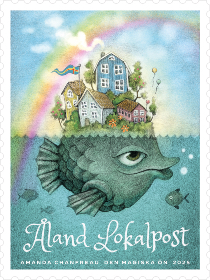
Aland Post’s “Open Edition” stamp series continues with an edition by illustrator and tattoo artist Amanda Chanfreau with roots on Åland. She is the third artist to have had the opportunity to freely create an Åland motif, and the result is an imaginative interpretation of Åland that arouses both curiosity and wonder. “This year’s issue is a visual adventure that captures Amanda Chanfreau’s unique visual world of images. Her ability to balance playfulness and fantasy makes the stamp an inspiring symbol of Åland. It will be a pleasure to send letters with this stamp”, says Johanna Finne, design manager at Åland Post Stamps.
When choosing a motif for her stamp, Amanda Chanfreau decided on a recurring theme in her artistry. “The sea fascinates me, and the relationship between above and below the surface is a theme I like to come back to. When I was given free rein to create a motif, this came spontaneously. I wanted to create something playful and inspiring, an image that arouses curiosity. In the motif, I’ve also included my parents’ house, my childhood home on Åland. I like to draw houses, too, and create small colonies of houses on the backs of animals and in other unexpected places. I hope people will enjoy it and think it’s a fun stamp,” Amanda says.
Born in Helsinki and raised in Mariehamn, Åland, Amanda Chanfreau today lives in Malmö, Sweden, where she is part-owner of the Malört tattoo-studio. Recently, Amanda has focused on children’s book illustrations, a type of assignment that took off after the success of her debut book “Giraffe island”, which she created together with her sister Sofia.
Åland – Magical island
Issue date: March 19, 2025
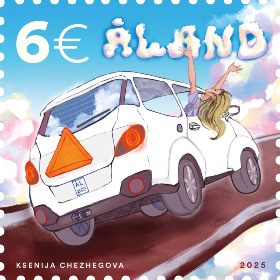
Åland Post releases a stamp highlighting moped cars – a popular means of transport among young people in Åland. “Moped cars are a familiar sight on the Åland roads, with an estimated one in three young people between the ages of 15 and 17 cruising around in these small vehicles. Young local artist Ksenija Chezheghova’s interpretation of the moped car captures the sense of freedom and fellowship evoked by this symbol of youth, and she has created a vibrant and neon-glowing stamp”, says Johanna Finne, design manager at Åland Post Stamps.
Classified as a moped despite its car-like design, the moped car has become a popular means of transport among young people. With two seats and a top speed of 45 km/h, it may be driven from the age of 15. Of a total of 43,200 motor vehicles registered on Åland in 2023, more than 2,500 were mopeds and moped cars.
Ksenija Chezhegova, who recently graduated from Åland Lyceum, makes her debut as a stamp artist with this issue and shares her thoughts on the assignment: “I was very happy and felt a sense of pride and responsibility to be entrusted with the task. I haven’t drawn many vehicles before, so, I was looking forward to the challenge. I first thought of freedom and relationships. A moped car is more than its physical components, and a big part of having a moped car is cruising with your friends. The moped car symbolizes freedom and the social web of relationships formed between young people as they hang out. I wanted to capture that feeling of freedom,” she explains.