New Issues and stamp news 903
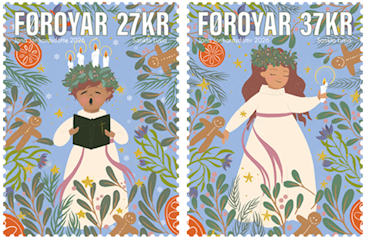
Faroe Islands – The Pixies’ Christmas
Issue date: Oct 20, 2025

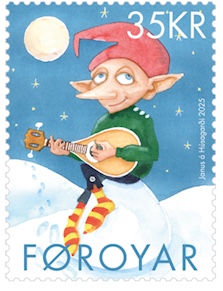
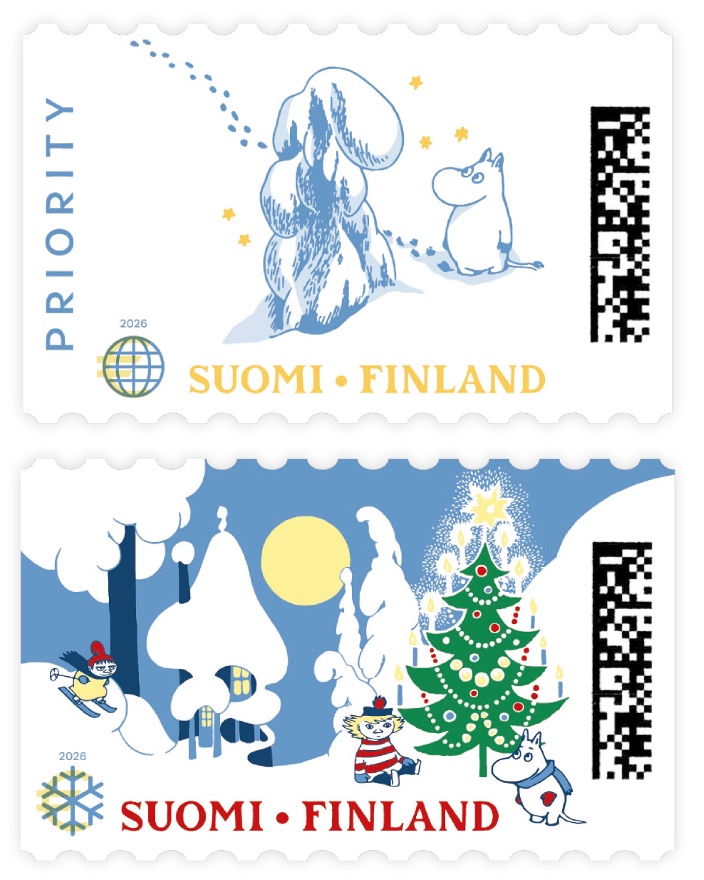
In the Nordic countries, pixies have been known for hundreds of years. The first written mention dates to the 14th century, and the oldest known drawing of a pixie appears in a book by Olaus Magnus from 1555.
Pixies are small-around 20 to 30 centimetres tall-and are usually dressed in green or brown clothing, with a long, pointed hat.
In the Faroe Islands, pixies usually live high up in the mountains, where few people ever go. There, they care for sheep, birds, and hares in distress. They also tend to the plants that grow on the mountainsides.
Some pixies live closer to humans-beneath remote houses or on farms. There, they look after livestock such as sheep, cattle, and horses, and help out with tidying and chores.
If you are lucky enough to have a pixie living nearby, you must take great care not to upset it. It is important not to shout at or annoy the pixie-and above all, to remember to leave out a bowl of porridge at Christmas. In return, the pixie will protect your home and bring good fortune.
In the old days, there were many stories about pixies who were not always so kind. If treated badly, a pixie might play tricks or steal from the household. There were even tales of stable pixies who quarrelled with those on neighbouring farms. Sometimes they would sneak into each other’s barns at night, break tools, and disturb the animals so much they could not work properly the next day. These disputes could become so serious that the pixies had to be separated.
Pixies are difficult to spot, but they are very curious. If you decorate your home for Christmas, a pixie might slip inside to admire the festive ornaments.
Christmas is the highlight of the year for all pixies. They bustle about, bake treats, enjoy themselves, and help Father Christmas deliver gifts to the children.
During the festive season, it is sometimes possible to see pixie footprints in the snow. And if you are up very early, you might be lucky enough to glimpse one darting under a stone or into a hiding place. But if you are patient and very quiet, you might even see two small pixies sitting on a rock, playing Christmas music outside the house where the children are fast asleep.
Faroe Islands – 120 Years of Telecommunication in the Faroe Islands
Issue date: Oct 20, 2025
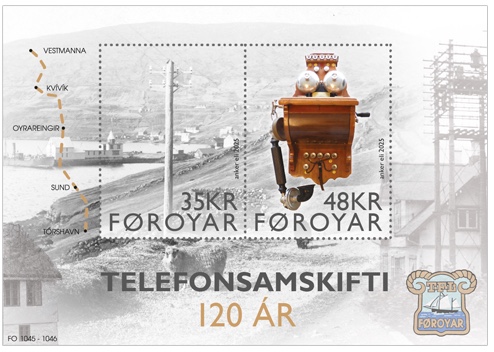
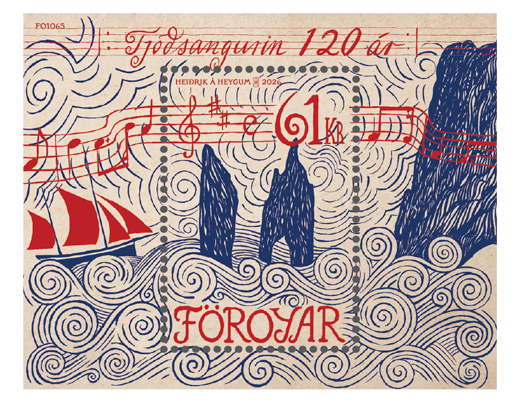
Although Denmark’s first telephone company was founded in 1880, it was not until 1905 that the Faroe Islands had their first telephone connection.
The First Telephone Connection Farmer, shipowner, merchant, and politician Olaf J. Olsen, better known by his Faroese name Ólavur á Heygum from Vestmanna, learned about the advantages of the telephone during a stay in Denmark. As early as 1901 and 1902, he wrote to the Faroese Parliament (Løgting) in Tórshavn, requesting the establishment of a telephone line between Tórshavn and his hometown Vestmanna. He highlighted that Vestmanna was a protected natural harbour, frequently visited by many ships. A telephone connection, he argued, would benefit not only the residents and trade but especially the fishing industry. The Parliament subsequently appointed a commission to consider the proposal.
After several negotiations, sometimes marked by disagreements, Ólavur was granted permission to build and operate the telephone line at his own expense. The line ran from Tórshavn via Sund, Oyrareingir, and Kvívík to his farm á Heygum in Vestmanna.
Ólavur purchased all necessary materials such as poles, wires, and cables in Norway. By 1903, the had been poles delivered to various locations and transported by horses across difficult mountainous terrain to their destinations. The work was partly carried out and supervised by Norwegian specialists. Later, it was concluded that both the materials and the construcion on the new telephone line were of excellent quality.
In 1905, the new telephone connection was officially opened. It quickly became so successful that in 1906 Ólavur applied to the Faroese Parliament for permission to establish and operate all telephone connections in the Faroe Islands. However, the application was met with scepticism and criticism, and Ólavur withdrew his request. The Parliament wished to take over telecommunications matters and to enter negotiations with Danish authorities.
These negotiations in Denmark were successful, and on 7 August 1906, 37 Danish telephone workers arrived in the Faroe Islands on the passenger and freight steamer “S/S Kong Inge” to carry out the necessary work. Since Ólavur’s telephone line was to be integrated into the expanded network, his significant expenses were later reimbursed with interest after prolonged discussions.
International Telegraph Network Meanwhile, the company Det Store Nordiske Telegrafselskab had received an order from the Danish state to lay a submarine telegraph cable from Scotland via the Shetland Islands to the Faroe Islands and Iceland. On 25 July 1906, the cable was landed at Sandagerð, south of Tórshavn. By 1 August, the new telegraph connection was inaugurated, with strong public participation.
In Tórshavn, a telegraph station was established in the upper, then undeveloped, part of Tórsgøta. The Faroe Islands were thus connected to the international transmission of news and important events. Urgent and important goods could now be ordered from abroad, particularly from Denmark and Great Britain, greatly benefiting Faroese trade and fishing.
Carl Hansen and the Telephone Company With the establishment of the Færøernes Amtskommunes Telefonvæsen, the expansion of the telephone network naturally accelerated. Until then, all incoming telegrams reached only the capital Tórshavn; efforts were now made to forward messages quickly to the rest of the country.
Starting in July-August 1906, the Danish workers, led by telephone engineer and foreman Carl Hansen, began extending Ólavur’s telephone lines. First, a connection to the neighboring island Eysturoy reaching Toftir was established, then to Søldarfjørður, Gøta, Fuglafjørður, and Leirvík. The network was expanded to Borðoy, initially to Fagralíð, home of the Faroe Islands’ first folk high school, and later to Klaksvík, the largest town on the Northern Islands.
The same year, connections were also established from Tórshavn to Velbastaður and Kirkjubøur, and from there by submarine cable to Skopun on Sandoy. The line from Vestmanna, the original terminus, was extended to the island of Vágar. In 1907, expansion continued, and on 5 September, the telephone connection from Tórshavn to Suðuroy was officially inaugurated.
The Current Telephone System Much has changed since then. Over the following years, all smaller and remote villages and islands were connected to the telephone network. The national telephone company was named Telefonverk Føroya Løgtings (Telephone Service of the Faroese Parliament), remote lighthouses received telephone connections, and the Faroese fishing fleet was equipped with radiotelephones.
With further technological development, including mobile phones and the Internet, Telefonverk Føroya Løgtings was transformed in 1998 into the joint-stock company Føroya Tele, which today, along with other providers, is the largest telecommunications company in the Faroe Islands.
Alderney – 80th anniversary of Alderney’s Homecoming
Issue date: November 10, 2025
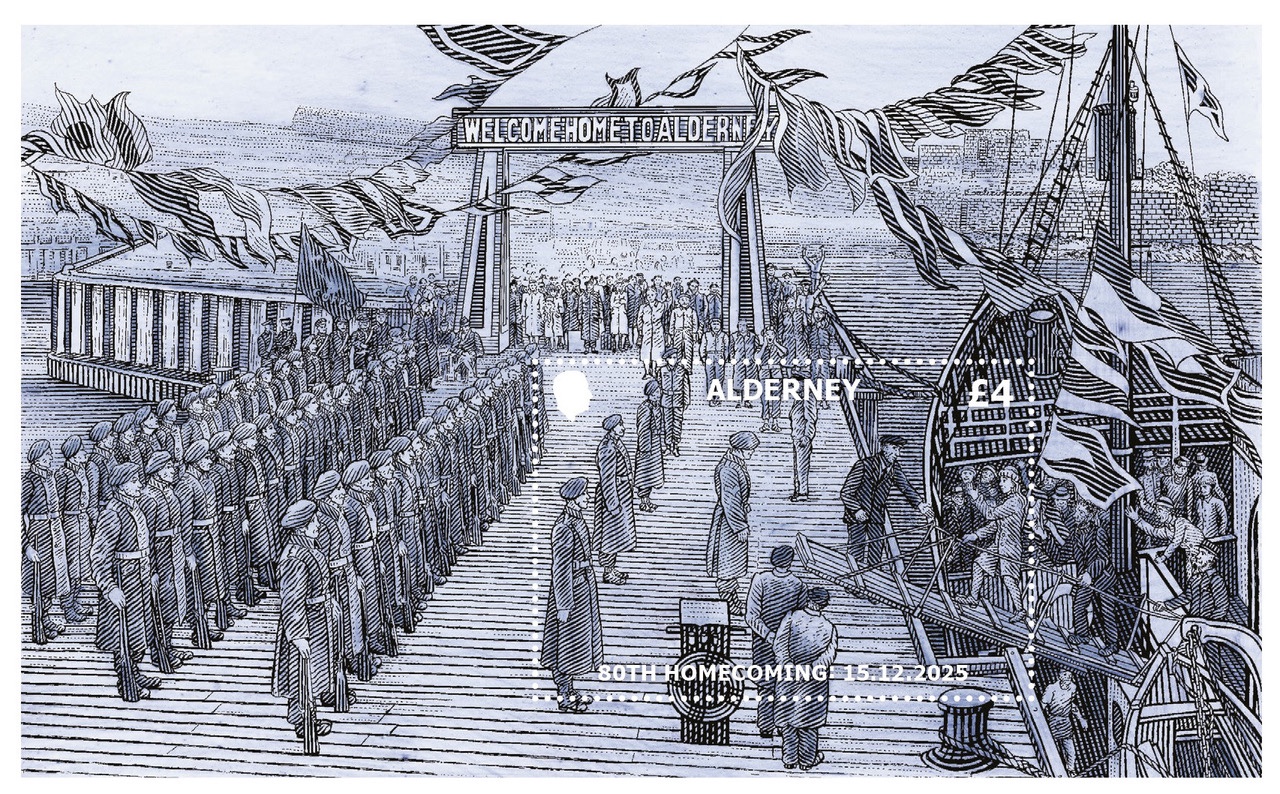
Guernsey Post’s philatelic bureau announces the release of a commemorative miniature sheet to mark the 80th anniversary of Alderney’s Homecoming – the return of islanders after World War Two.
The miniature sheet design depicts the poignant moment when, on 15 December 1945, the first Alderney families, with modest belongings, stepped ashore the wartime ‘German Jetty’ at Braye Harbour after five years in exile.
Greeted by a British Guard of Honour and the newly appointed Lieutenant Governor, their arrival signalled the beginning of a challenging chapter as islanders returned to homes and landscapes profoundly changed by war.
Alderney’s experience was unlike any other in the Channel Islands. In June 1940, almost the entire population of around 1,500 people was evacuated within hours as German forces advanced. During the occupation, the island became one of the most fortified parts of the Atlantic Wall, built largely through forced labour by prisoners from across Europe and North Africa under brutal conditions.
Although the Channel Islands were liberated in May 1945, Alderney’s repatriation was delayed for several months while the island was cleared of mines, ordnance, and military infrastructure. When civilians finally returned in December, they found derelict homes, buildings stripped of furnishings, and landscapes dominated by concrete defences.
Bridget Yabsley, head of philatelic at Guernsey Post, said: – “We are honoured to issue this miniature sheet to commemorate such a significant and emotional milestone in Alderney’s history. The Homecoming was not simply about returning home, but about resilience, endurance, and the determination of a community to begin again in the face of immense challenges.”
Åland – Horse
Issue date: October 23, 2025
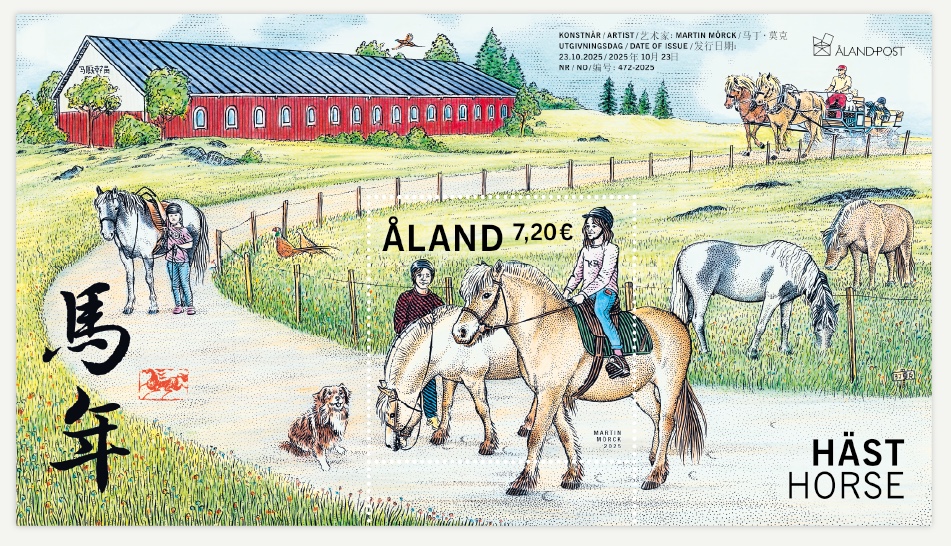
On 23 October, we release the final miniature sheet in the twelve-year stamp series featuring Chinese horoscope animals. With the Year of the Horse, the series comes full circle, and a unique stamp project will be completed. For this issue, artist Martin Mörck has captured horse life at an Åland stable where equine-assisted therapy plays a central role.
Every year since 2014, Åland Post has issued a stamp interpreting a zodiac animal with an Åland twist. The twelfth and final animal, the horse, now completes the series.
“In collaboration with Martin Mörck we have created a unique stamp series combining two cultures. We are pleased that the designs have been appreciated by collectors worldwide,” says Johanna Finne, design manager at Åland Post Stamps.
Martin was inspired by the Stall JoY riding school in Samuelstorp, Hammarland, where hyppotherapist Jeanette Eriksson offers equine-assisted therapy.
“Horses and nature awaken many senses and emotions and can provide physical, psychological, and social support in rehabilitation and habilitation,” Jeanette says.
With this year’s miniature sheet, Martin Mörck finalizes his artistic mission characterized by joy and creative urge.
“The inclusive philosophy of the Åland riding school inspired me, allowing my creativity to flourish. I placed the stables in the background and added a circular bridleway with, among other things, grazing horses and pheasants inside the circle. In this way, I could include different activities along the bridleway, creating both movement and depth. The zodiac series has been a long, wonderful project filled with challenges, creative solutions, joy, and passion,” Martin sums up.