New Issues and stamp news 875
Faroe Islands – HAFNIA 24 – 400 Years of Postal History
Issue date: October 17, 2024
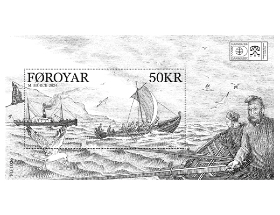
Origins of the Postal Service This year marks the 400th anniversary of King Christian IV introducing regular mail in the Danish kingdom, which paved the way for the Danish postal service. This milestone is celebrated with a Hafnia stamp issue, acknowledging its significance in Posta’s history.
The Danish Postal Service The earliest political initiative for a structured postal delivery system in Denmark is in King Christian II’s Secular Law of 1522, but it never came to fruition. A century later, in 1624, Christian IV’s ‘Ordinance on Mailmen’ formalized the postal system, setting up nine routes. The most important route was between Copenhagen and Hamburg due to key trade connections. Letters, goods, and parcels were delivered via horse-drawn carriages on this route, while the other eight routes, primarily on foot, only carried letters. The main post office was housed in the now-burnt Børsen building in Copenhagen.
Mail to the Faroe Islands In its early days, the Danish Postal Service didn’t include the Faroe Islands, so cargo ships carrying goods for the Royal Monopoly Trade also delivered mail there. After the monopoly ended in the 1850s, various private operators took over. The volume of mail was limited, mostly comprising official letters from Copenhagen to the Faroese government, business correspondence, and occasional personal letters for Danish clergy and officials. The amtmand county governor managed the mail deliveries in the islands, using the ‘skjúts’ system, (conveyance by boat) which enlisted men from various settlements to carry mail, cargo, and passengers by boat or across mountains.
Mail Steamer Diana In 1870, the Danish postal service took over the steamship connection to the Faroe Islands and Iceland via Lerwick in the Shetland Islands or Leith in Scotland. Over several years the mail steamer ‘Diana’ made seven round trips each year between March 1 and the end of November. The United Steamship Company (DFDS) eventually took over this route.
The First Faroese Post Office With Diana’s service, the Danish Postal Service appointed H. C. Müller, a well known Sheriff, as a Faroese postal forwarder in 1869. By 1870, he had established the first Faroese postal expedition at his home in Tórshavn, allowing the public to send and receive letters, parcels, and newspapers at standardized postage rates.
The First Faroese Mailmen After the postal reforms of 1871, three postal routes were created in 1872, each with a dedicated postman. • The southern route: Tórshavn to Kirkjubøur, by rowboat to Skopun on Sandoy, then overland to Sandur, and onward by boat to Skúvoy, Hvalba in Suðuroy, and finally to Trongisvágur. • The western route: Tórshavn to Kvívík, then by boat to Fútaklettur on Vágar, and finally by foot to Sandavágur and Miðvágur. • The northern route: Tórshavn to Søldarfjørður in Eysturoy by boat, then overland to Leirvík, and finally by boat to Klaksvík on Borðoy.
Mail Steamer Smiril In 1895, the private trading company A/S J. Mortensens Eftf. in Tvøroyri commissioned a small steam freighter named Smiril, built at Kochum’s Mekaniska Verkstad in Malmø. It addressed the pressing need for reliable freight, passenger, and mail services between the islands, especially now that the transition from a medieval farming community to a modern fishing nation really set social development in motion. The belief that the political authorities would solve logistical problems and build a functional infrastructure was not present. Especially in Tvøroyri on Suðuroy, where shipping and the fishing industry boomed, impatience was great.
Therefore, A/S J. Mortensens Eftf. decided to build a steamship for cargo, passenger and mail transport and put it into coastal sailing in January 1896 under the name Smiril. Conditions for coastal traffic on the Faroe Islands were difficult at the time.
While ‘Smiril’ was supposed to serve most settlements, it could dock only in a few places. In most places boats had to transport passengers and cargo to and from the ship, making coastal navigation challenging and slow.
But this was, after all, a radical change, especially for postal connections. Despite this, Smiril had its own postal expedition, sorting and cancelling mail, much to the delight of later collectors and philatelists.
Eventually, Smiril’s extensive coastal service was discontinued, with new local operators stepping in. The ship was acquired by the public coastal shipping company in 1917 and used primarily for the Tórshavn-Suðuroy route.
Thus ends this look back at the pioneer days of Faroese postal history. Many more fascinating aspects remain, but those are stories for another time.
Congratulations to the Danish Postal Service on its 400th anniversary. Here’s to many more years!
Faroe Islands – Red Cross Samaritans – Celebrating 25 Years of Service
Issue date: August 30, 2024
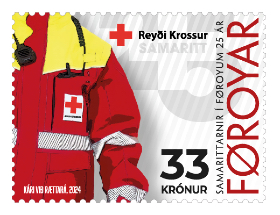
We often see them amidst the crowds, dressed in their signature red uniforms, equipped with small backpacks and the emblematic Red Cross badge on their chests. Whether at bustling concerts, lively festivals, spirited sporting events, community gatherings, or any place where people converge, they stand out as beacons of aid and assistance.
They are the Red Cross Samaritans – individuals hailing from diverse backgrounds, walks of life, and levels of education and occupation. Yet, united by a common altruistic spirit, they dedicate a significant portion of their leisure time to tending to the welfare of others.
In times of mishap, they tend to our wounds, swiftly applying bandages or administering first aid, and if needed, they’re trained to deploy life-saving equipment like defibrillators from their packs.
Should someone overindulge in intoxicating spirits, they extend a helping hand and offer a safe space to sober up. And if a situation demands urgent medical attention, they swiftly guide individuals to healthcare facilities.
For them, there is no discrimination in who they assist or why. Like their namesake, the Good Samaritan, they offer impartial aid to all in need.
The Faroese branch of the Red Cross Samaritans was established in 1999. Over the past quarter-century, they’ve evolved into a proficient voluntary health service. Prospective members undergo rigorous training, including a 30-hour Samaritan course encompassing comprehensive first aid training. Regular drills and education in both physical and psychological first aid ensure they’re adept at addressing a spectrum of injuries, from minor scrapes to severe trauma, with readiness for major emergencies always at the forefront.
In recent years, heightened awareness of potential international crises and their local implications has led to a greater emphasis on contingency planning in the Faroe Islands. The Red Cross diligently identifies risks and strategizes responses, with the Samaritans poised to play a pivotal role in these preparedness efforts.
As they commemorate this milestone of tending to our needs and ensuring our well-being, we extend heartfelt congratulations on 25 years of unwavering service.
We’re immensely proud of your selfless dedication!
Jersey – Wetland Birds: Celebrating Avian Beauty and Biodiversity
Issue date: Aug 6, 2024
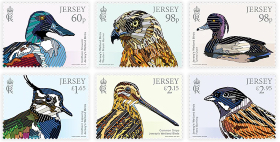
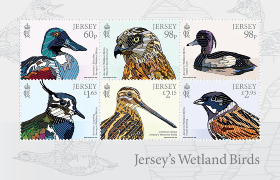
Jersey’s Wetland Birds issue commemorates the variety of wetland birds found on the Island. To ensure the accuracy of the birds included, our team reached out to the local Jersey Birds organisation whose members regularly monitor sightings. From their findings, we were able to select wetland birdbreeds for the artist to illustrate, including the Northern Shoveler, Western Marsh Harrier, Tufted Duck, Northern Lapwing, Common Snipe and Reed Bunting.
Thomas Norman (Elvensø Illustration) was the artist who illustrated the Jersey Wetland Birds issue. Local to Jersey, Thomas uses intricate line details to create bold and distinctive artwork. For the Wetland Birds issue, Thomas has used a bold colour pallet to highlight each of the bird’s features.
Wetland Birds rely on wetlands and waterways for survival and providing respite for many species is an important part of Jersey’s conservation work. A variety of wetland birds can be viewed at the Wetland Centre, a conservation site located in St. Ouen. The centre overlooks La Mare au Seigneur (St. Ouen’s Pond) and is home to a thriving variety of wetland birds, including:
• 60p The Northern Shoveler is a stunning duck species, admired for its unique feedingadaptation and striking appearance. This medium-sized duck, easily recognized by itsdistinctive spoon-shaped bill, thrives in various habitats with a small resident population that breeds annually and welcomes additional visitors during the winter. • 98p The Western Marsh Harrier first nested in Jersey in 2002 the breed has become a prominent across the island. This bird of prey, most seen in its stronghold at St Ouen’s Pond. Distinguished by their long wings and tails, Western Marsh Harriers possess a dark brown plumage accented by a creamy cap, throat, and wing markings. Their graceful flight and striking appearance make them a captivating sight in Jersey’s skies. • 98p The Tufted Duck are a familiar and vibrant presence throughout Jersey, thriving year-round and breeding around the island’s many water bodies. These ducks are easily recognisable by their distinctive colouring: males boast an overall black plumage with bright white flanks and a charming floppy crest, while females are typically dark brown with a shorter crest and lighter flanks. The Tufted Duck’s remarkable appearance and widespread presence make it a beloved resident in Jersey’s avian community. • £1.65 Northern Lapwing a rare yet captivating resident of Jersey. Their presence swells dramatically in winter, seeking refuge from the freezing conditions on the Continent that render their usual feeding grounds inhospitable. These striking birds are easily recognised by their distinctive crests and boldly patterned black and white plumage, which gleams with a beautiful green and multicolored gloss in good light. The Northern Lapwing’s seasonal influx and stunning appearance make them a remarkable and cherished sight in Jersey’s winter landscape • £2.15 Common Snipe are spotted predominately in Jersey from August through April, favouring the edges of reedbeds and ponds or open wet fields, especially in St. Ouen. Renowned for its cryptic plumage, this bird expertly camouflages itself. The Common Snipe’s long, probing bill is perfectly adapted for extracting insects, earthworms, and crustaceans from the mud. Its plumage features a rich brown with patterned gold and black bars, and its head is adorned with distinctive gold and stripy brown markings. Completing its unique look are a straight bill and short greyish-green legs, making the Common Snipe a fascinating and well- adapted visitor to the island’s wetlands. • £2.95 Reed Bunting once a breeding species in Jersey, is now a seasonal visitor, arriving in varying numbers each year between October and April. These sparrow-sized birds’ favour reedbeds for feeding and roosting. In winter, male Reed Buntings sport mostly brown heads, but their distinctive white collar and ‘moustache’ remain prominent, with pale throats showing traces of a dark bib. Female Reed Buntings, on the other hand, have pale throats and ‘moustaches’ set apart by a dark streak extending to the base of the beak. Their streaky brown plumage provid