New Issues and stamp news 880
Faroe Islands – The Salvation Army – 100 Years in the Faroe Islands
Issue date: October 23, 2024
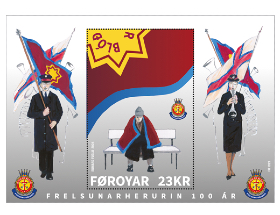
Established on October 23, 1924, The Salvation Army has woven its presence into the fabric of the Faroe Islands over the past century. Today, as we mark this significant milestone, echoes of hymns, brass music, and the Evangel reverberate: “Onward, Christian soldiers, marching as to war!”
The Salvation Army Rooted in London in 1865, The Salvation Army burgeoned into an international evangelical movement, spanning 134 countries. Its ethos is simple yet profound – rooted in the Bible and fuelled by love for God. Recognizable by its distinct uniforms, brass bands, and spirited evangelical songs, The Salvation Army embodies a holistic approach to faith and service. Here, preaching Christianity and social work are intertwined, for both are essential facets of its mission. Guided by the belief that all human life is sacred and belongs to its Creator, The Salvation Army extends its hand far and wide, embracing diverse forms of social outreach tailored to local needs. From hospitals and schools to childcare centres, youth initiatives, emergency services, and support for the homeless – its impact is deeply felt.
The Salvation Army Activities in the Faroes Since its inception in 1924, The Salvation Army congregation in Tórshavn has remained steadfast, nestled in the heart of the city. For generations, its presence has been synonymous with national celebrations, particularly on Ólavsøka, the Faroe Islands’ National Day. With fluttering flags and stirring horn melodies, the congregation marches to outdoor gatherings, where familiar hymns mingle with the open air.
In Vágur, Suðuroy, a church building stands as a beacon of hope since its inauguration on November 9, 1947.
Also in the Faroe Islands, The Salvation Army provides social assistance. An extended hand, a responsive phone, and people receiving help — this has been the practice for 100 years. In recent years, The Salvation Army has also raised funds and raised awareness about poverty under the slogan “Help us help others”. Christmas assistance is provided to around 200 families, and there are also several others who receive assistance throughout the year.
The Salvation Army has also contributed to raising awareness about homelessness issues in the Faroe Islands. The Salvation Army’s homeless shelter opened on April 1, 1998, and today it offers shelter, a warm lounge, and communal living. Society evolves, and so does The Salvation Army’s social work. In June 2017, The Salvation Army opened a treatment home for young substance abusers, Frælsi, in the village of Eiði.
Through it all, The Salvation Army remains a steadfast advocate for the marginalized, amplifying the voices of the vulnerable in society. As we reflect on a century of service, we reaffirm our commitment to be the hands and heart of compassion to those who don’t have a voice or won’t be heard, echoing the timeless call to serve others.
Finland – Christmas stamps depict the northern lights
Issue date: November 06, 2024

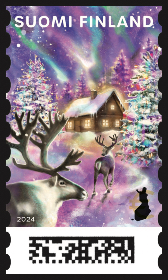
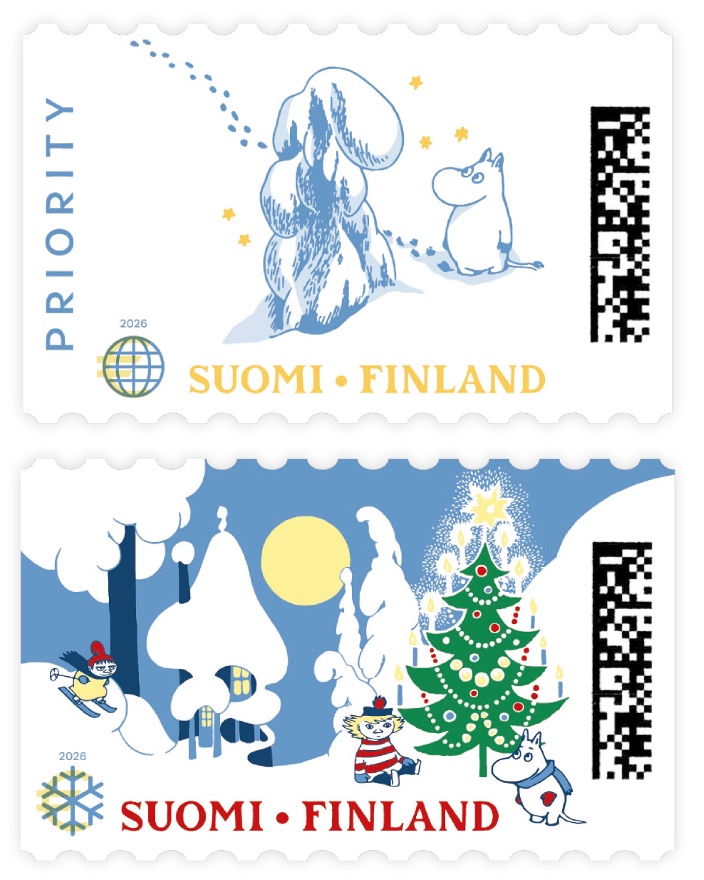
This year, the new Christmas stamps illustrated by Hanna-Maria Mainelakeus feature the bright colors of the northern lights, Christmas trees and reindeer.
“The theme and illustrations of the stamps were inspired by Finnish nature. I wanted to showcase the magic of our winter landscape. The bright colors of the northern lights emphasize the magic of the period waiting for Christmas and the feeling of celebration, and reindeer are clearly part of the northern landscape,” says Mainelakeus.
Mainelakeus first made the stamps traditionally drawing by hand and then finished them by painting digitally. “The colors of the northern lights give the stamps a fantasy-like atmosphere. The northern lights are also reflected on the surface of snow and, as the evening gets darker, the colors come to life.”
Hanna-Maria Mainelakeus appreciates Christmas traditions such as Christmas cards, Christmas food, the Christmas sauna and the Christmas church. “Presents are always handed out on Christmas Eve after the Christmas sauna.”
The no-value indicator stamp for Christmas greetings Christmas Miracle will be issued as a 20-stamp sheet and the domestic non-value indicator stamp Christmas Path will be issued as a 10-stamp sheet.
Malta – Universal Postal Union – 150th Anniversary
Issue date: October 31, 2024
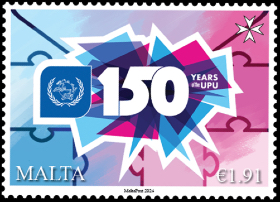
The Universal Postal Union (UPU) is an agency of the United Nations that coordinates postal policies among member nations and facilitates a uniform worldwide postal system. It comprises 192 member states, including Malta, and is headquartered in Switzerland.
The UPU’s theme for its 150th year of operation, “150 years of enabling communication and empowering peoples across nations”, recognises its past accomplishments and reinforces its commitment to serve all peoples for the decades to come.
MaltaPost commemorates the UPU 150th anniversary by issuing a special stamp, carrying a denomination of €1.91, in celebration of the organisation’s rich past and promising future. This special stamp will be issued in a sheet of 10, with each stamp measuring 44mm x 31mm, with a comb perforation of 13.9 x 14.0 and bearing the Maltese Cross watermark. The sheets measure 115mm x 182mm and were produced by Printex Ltd in the offset process. The issue consists of 100,000 stamps of €1.91 each
Finland – Fingerpori
Issue date: November 06, 2024
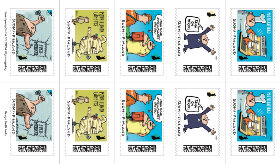
Finland’s most popular comic strip Fingerpori is getting its own stamps. Designing the stamps was an interesting challenge for comic strip artist Pertti Jarla.“The Fingerpori comics are usually comic strips with three images, but in this case, I had to make both a picture and a verbal joke fit into one small stamp. It took me a while to adjust to this. I made about 15 sketches that were used to create the final five stamps,” Jarla says.
The stamps feature the Fingerpori character Heimo Vesa in several roles, and Rivo-Riitta makes a comment in one stamp in her straightforward manner.
The first finished stamp, in which Heimo Vesa is portrayed as a preacher, features the wordplay “Tämä on merkki”, which can mean “This is a stamp” as well as “This is a sign [from God]”.
“That’s when I found out what kind of wordplay could work on a stamp. After all, there is usually no text on the stamps, so these are different from others. Religious topics are generally well-liked and there are no complaints about them from believers,” says Jarla.
It might have been different in 2006, when Fingerpori’s wordplay was brought to life for the first time. The comic strip was initially called Karl-Barks-Stadt, with which Jarla won third place in the strip category of a Nordic comics contest held in the town of Kemi.
Fingerpori has been published in Helsingin Sanomat since February 2007, and it is still published in the newspaper every weekday except Sunday. Today, Fingerpori is also published in many other newspapers and three different Fingerpori strip collection albums are published annually.
Since Fingerpori has been published in newspapers almost continuously for 17 years, it is easy to imagine that there may be a shortage of topics.
“Finding topics is a pain in busy times, but luckily the readers are a big help. They are constantly sending suggestions for strips. The suggestions include a lot of double entendres which the characters Rivo-Riitta and Asko like to say, but I can’t only draw those.”
Fans of Fingerpori – or “those who understand Fingerpori”, as the fan Facebook group “Fingerporin ymmärtäjät” is called – are interested in the characters’ backgrounds and whether they are based on real people.
“Mostly, the characters aren’t based on real people, with the exception of Rivo-Riitta. I studied in Lahti in 2006 and visited the Hiidenkivi pub. There was a bartender who was quite tough and she inspired me to create the character. The bartender’s appearance was different, but otherwise she resembles my cartoon character.”
A highly requested stamp
Design Manager Tommi Kantola, who is responsible for the selection of artists for stamps, says that Fingerpori stamps have been highly requested.
“Now is a good time for them, as comic strip themes have not been published for a while. The Fingerpori comic strips have continuously become more popular, and as a phenomenon they depict the current times. The stamps also do the same,” says Kantola.
According to Jarla, Posti fits well into Fingerpori’s retro-inspired world, and it has been featured in many of the comic strips alongside the police and hospital, for example.
“For humor-related reasons, Fingerpori’s official services usually work quite sluggishly – this also applies to Posti.”
A community of 250,000 fans
The “Fingerporin ymmärtäjät” Facebook group has almost 250,000 members, which is a huge amount for the Finnish-speaking target group. Pertti Jarla is still surprised by the enormous popularity.
“In the early years, I wondered whether this kind of comic strip would be accepted. Nowadays, I’m continuously surprised by how many people enjoy Fingerpori and don’t seem to get tired of it.”
Popular comic strips are constantly circulating on social media. According to Jarla, it is impossible to predict in advance which strip will be a particular hit.
“There’s no way to tell. For example, I made a strip about a responsible CEO, which doesn’t sound like a very interesting topic. However, people really liked it.”
Jersey – The Jersey Dairy Industry
Issue date: October 24, 2024
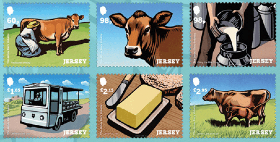
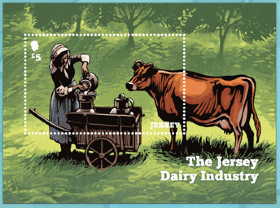
Jersey is known worldwide for producing rich dairy products such as ice cream, butter and of course milk from the Island’s beloved cows. Issued on Thursday 24th October 2024 The Jersey Dairy Industry stamps celebrate the work of Jersey farmers and the Royal Jersey Agricultural & Horticultural Society, with illustrations depicting the products and processes of the dairy industry in Jersey.
The original artwork is designed by British illustrator, Chris Wormell, who created the first two issue of the series; 150 Years of Brewing in Jersey in 2021, and A History of Knitting in Jersey in 2023.
The 60p stamp illustrates the process of traditional hand milking. On average, Jersey milk contains 40% more fat, 18% more protein, 20% more calcium and a higher concentration of minerals and vitamins than milk from other breeds of cows.
A portrait of a Jersey cow has been illustrated for the first 98p stamp. Interestingly, in 1789 the States of Jersey introduced the first legislation to protect the purity of the breed by banning the import of cattle into the Island. That ban still exists and every drop of milk supplied to Jersey Dairy continues to be produced exclusively by pre- breed Jersey who can trace the purity of their lineage.
The second 98p stamp features a milk churn, which was previously used to store milk. Despite the name, milk churns weren’t used to churn milk. In 1974, due to the increase of the Island’s population, the decision was made by the Jersey Dairy to move on to milk tankers to collect a larger supply of milk from Jersey’s farms.
Illustrated on route past Mont Orgueil Castle in Gorey, the £1.65 stamp illustrates a milk float. These vehicles used to be used to transport fresh milk, which would be delivered to the locals doorsteps. Milk floats weren’t particularly large vehicles, making them idea for navigating the narrow and winding roads of Jersey.
Chris Wormell has used distinct colours to highlight the block of butter illustrated in the £2.15 stamp. Butter is the second oldest dairy product, after milk, that the industry has produced. Jersey butter has a distinct yellow colour and can be used for cooking, baking and general use.
For the sixth stamp in the issue a cow and her calf have been illustrated. Jersey cows are a smaller breed of cow and are often viewed as a docile and undemanding breed. The cows are tolerant of high temperatures and produce a large quantity of milk in relation to their size and demand for food.
The miniature sheet features a milkmaid, wearing a sun bonnet, a headdress developed in the 19th and early 20th centuries to ensure protection from the sun when out doing tasks in the field. The Jersey sun bonnet was built over a structure of canes which supported its shape and was then tied with a ribbon under the chin.
The Jersey Dairy Industry has undergone various changes throughout the years, but something that has remained strong within the industry is the importance of preserving Jersey cows. The bovine is a beloved part of the Jersey’s heritage and continue to produce rich milk for islanders.