New Issues and stamp news 917
Faroe Islands – The Faroese Red Cross Celebrates 100 Years
Issue date: May 26, 2026
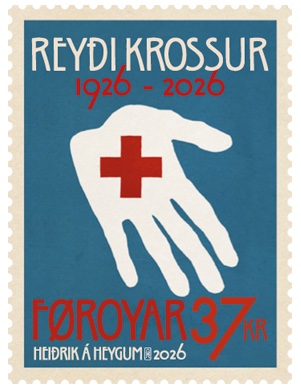
2026 will be a very special year for the Red Cross in the Faroe Islands, as the humanitarian organisation celebrates its 100th anniversary.
The Faroese Red Cross is part of the world’s largest humanitarian organisation, with approximately 17 million volunteers in nearly every country worldwide. The Faroese Red Cross has close to 500 volunteers who carry out its mission: to help whenever the need arises.
This year has also been designated by the UN as the International Year of Volunteers. The Faroese Red Cross fully supports this, as the organisation experiences every day the difference it makes when volunteers come together to help. Voluntary work creates a ripple effect, and its positive impact can be felt both in the Faroe Islands and across the world.
The Faroese Red Cross was founded on 2 April 1926, as there was a recognised need for voluntary efforts to support people in difficult life situations – particularly in the areas of health and emergency preparedness.
The organisation was established with two main objectives:
To provide care for the sick and injured in connection with accidents or epidemics, and to deliver emergency relief in the event of disasters.
To promote knowledge of care and nursing for infants and the sick at home, and to ensure that the sick and injured in wars and accidents affecting the country receive proper care and assistance.
One of the first initiatives undertaken by the organisation was the installation of lifebuoys. The first lifebuoys were installed in Tórshavn as early as 1927.
Much has changed over the past hundred years, but the need for assistance and voluntary work remains significant, and the activities of the Faroese Red Cross have grown considerably in recent years.
During the COVID-19 pandemic in 2020, the Red Cross stood ready to assist as many people suddenly needed support. A telephone helpline was established, offering psychosocial support and practical assistance, for example with grocery shopping. Volunteers delivered food and essential supplies to residents who were unable to leave their homes. During this period, many new volunteers joined.
When the war in Ukraine broke out in the spring of 2022, and refugees sought safety in other European countries – including the Faroe Islands – the Faroese Red Cross once again stepped in, working in cooperation with the Faroese authorities. Volunteers welcomed the refugees in a dignified and humane manner and helped them establish themselves in Faroese society. The efforts included both practical support, such as assistance with housing and banking, and human care for people who had experienced loss and trauma.
In total, the Faroe Islands received 250 refugees from Ukraine.
As mentioned, the activities of the Faroese Red Cross have expanded significantly, and the organisation now operates across many areas. These include first aid services, training in first aid and psychological first aid, food and clothing aid, visitor services, camps, and integration activities such as language cafés and Red Cross Friends. A large proportion of volunteers are also engaged in second-hand activities, which contribute significantly to funding the humanitarian work. Today, there are five Red Cross second-hand shops in the Faroe Islands – three in Tórshavn, one in Vágur, and one in Klaksvík. Another shop is planned to open on Sandoy later this year.
Each year, the Faroese Red Cross organises a national fundraising campaign to support its humanitarian work both in the Faroe Islands and internationally. In this anniversary year, special efforts are being made in connection with the campaign, which will also be broadcast live on the Faroese national broadcaster Kringvarp Føroya.
For one hundred years, the Faroese Red Cross has placed people at the centre of its work. That is something worth celebrating.
Faroe Islands – EUROPA Stamps – 70 Years of Cooperation
Issue date: May 26, 2026

2026 marks the 70th anniversary of EUROPA stamps, a philatelic initiative created to strengthen ties between European countries and promote peace and cooperation. The first EUROPA stamps were issued in 1956 by six countries — Belgium, France, Germany, Italy, Luxembourg, and the Netherlands — then members of the European Coal and Steel Community. Today, 53 postal administrations participate in the annual EUROPA programme.
The Faroe Islands and EUROPA
The Faroe Islands joined the EUROPA series in 1979 and issued their first EUROPA stamps on 7 May that year. Since then, Posta Faroe Islands has taken part every year, combining the shared European theme with a Faroese interpretation.
Over the years, the Faroese EUROPA issues have become a long-running series of attractive stamps designed by Faroese artists and photographers. The stamps often draw on everyday life, nature, and cultural references from the islands, showing how an international theme can be expressed through local ideas and imagery. Together, they form a small visual history of Faroese design within a wider European context.
The 2026 Common Design
For anniversary years, PostEurop selects a shared design through an internal competition. The 2026 theme, “70th Anniversary of the EUROPA Stamp: United in …”, invited postal administrations to interpret ideas of communication, cooperation, and common roots. Fifteen proposals were submitted, and 50 postal organizations participated in the vote.
The winning design was submitted by Posti Ltd, Finland. Second place was awarded to Bosnia and Herzegovina, and third to Luxembourg.
Designer Klaus Welp explains that the stamp reflects a need for unity and reliable communication in a changing world. The diagonally ascending dotted line refers both to stamp perforation and to the continued development of European postal cooperation. Seven connected dots symbolize seventy years of shared effort, while the vibrant colour gradients echo the spirit of European unity.
The Designer
Klaus Welp is a Finnish-German visual artist and designer. He has designed more than one hundred Finnish postage stamps and is widely recognised for his work in visual communication, illustration, and cultural projects. His work has received several international awards.
EUROPA Stamps
Since 1956, EUROPA stamps have served as a visual symbol of European collaboration. Issued annually by participating postal administrations, they share a common theme while reflecting national artistic traditions. Since 1993, the programme has been coordinated by PostEurop through its Stamps and Philately Working Group.
Faroe Islands – J.B. Charcot: Travels to the Faroe Islands
Issue date: May 24, 2026
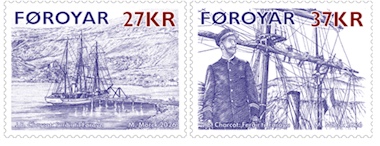
Dr Jean-Baptiste Étienne Auguste Charcot (15 July 1867 – 16 September 1936), known worldwide as “The Gentleman of the Poles”, was a French scientist and polar explorer. He became famous for his expeditions in both the southern and northern waters aboard the ship Pourquoi Pas? (“Why not?”). There were two vessels of the same name: the first a schooner, the second a three-masted barque with a steam engine. The results of his voyages were published in journals and books across the world.
Elderly Faroese remembered Charcot with warm nostalgia, describing him as a kind and sharp-minded man – a true friend of the Faroes. Charcot himself confirms this in Voyages aux Îles Féroé (1934), later published in Faroese as Ferðir til Føroya. Like the German researcher Carl J. Graba, he depicted the islands and their people in consistently positive terms, without reservation.
His accounts are remarkable for their combination of first-hand impressions from 1901 with careful analysis of developments up to 1934. By then, he had visited the Faroe Islands 10–12 times – exceptional for his era.
Charcot first visited the Faroe Islands in 1901, again in 1902 and in 1912, and subsequently returned several times until 1936, with only the First World War interrupting his visits. Despite warnings from France about the harsh conditions, he replied unfalteringly: “Pourquoi Pas?” – the same response he had previously given to his father, the renowned neurologist Jean-Martin Charcot.
On arriving in Tórshavn in 1901, he described a society dominated by fishing, sheep farming, and hunting. Infrastructure was almost non-existent: no quay, no telegraph, limited postal services, and no roads or cars. Only one ship, Smiril, connected the islands. Nevertheless, he highlighted the population as educated, friendly, and industrious.
By 1934, Charcot observed considerable progress: population growth, modernisation, electricity, banks, and improved healthcare. Tórshavn had expanded significantly, and new building materials and commercial goods had transformed the townscape. Despite these changes, he considered the character of the people essentially unchanged.
The Final Voyage and Shipwreck in 1936
Charcot and Pourquoi Pas? visited the Faroe Islands for the last time in the summer of 1936. The ship lay alongside the quay in Tórshavn, where the crew received visitors. On 26 and 27 July, supplies were loaded, including 18 tonnes of water. From there, the voyage continued north via Fuglafjørður and onwards to Greenland.
Newspapers reported that this was Charcot’s final expedition, and he was quoted as saying: “My ship is old and tired – and so am I. But we grow old well together, both of us.” It was to prove a fateful irony.
After stopping in Greenland, the expedition proceeded to Iceland. In Reykjavík, the ship was repaired following a boiler failure and remained there for around two weeks, having been towed in by the Danish inspection ship HDMS Hvidbjørnen. On 15 September 1936, Pourquoi Pas? departed with 40 men on board – fewer than planned, as some had returned home during the stopover.
The following hours proved disastrous for Charcot and his crew. Shortly after leaving Reykjavík, a violent storm broke out; so severe that several vessels were lost. The greatest tragedy, however, was the loss of Pourquoi Pas? near Álftanes. The ship struck a rock while attempting to return to Reykjavík in the severe weather, and the crew had likely confused two lighthouses. Of the 40 on board, only Gonidec, the third officer, survived. His account records the last hours, including the poignant sight of Charcot releasing a tame Greenland gull from its cage on deck; the bird, which had previously stayed close to the ship, flew away into the storm.
The disaster was extensive; 23 bodies were recovered in the first days. In Reykjavík, a memorial service was held with a large congregation, where Gonidec accompanied his deceased shipmates in coffins aboard a French warship, which transported them to Saint-Malo in France, where most were from.
In France, there was profound grief, and an official memorial was held at Notre-Dame Cathedral. The planned celebratory reception for Charcot was instead replaced by national mourning.
The Faroe Islands also mourned deeply the loss of their “Faroese friend” and his crew, and flags were flown at half-mast. At the same time, at least three Faroese vessels had been out in the same storm but reached harbour safely. Many were aware that the outcome could have been different, given the numerous Faroese ships lost over the years along Iceland’s coasts – now sharing a fate with Charcot and his crew.
Faroe Islands – Painted Ships in Storm and Calm
Issue date: May 23, 2026
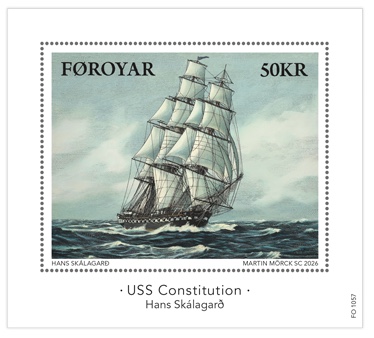
The miniature sheet depicts the frigate USS Constitution, painted by Hans Skálagarð and engraved by Martin Mörck.
Hans Skálagarð gradually gained recognition as one of America’s leading maritime painters. His works portrayed historic vessels from the American Revolutionary War and the War of 1812, including the famous frigate USS Constitution, known as “Old Ironsides”. The ship was built in 1797 and earned its nickname during a battle in 1812, when cannonballs reportedly bounced off its strong oak hull.
Skálagarð’s paintings were acquired by collectors, maritime museums and institutions, including The Pentagon. A version of his painting of USS Constitution is held in the library of the United States House of Representatives.
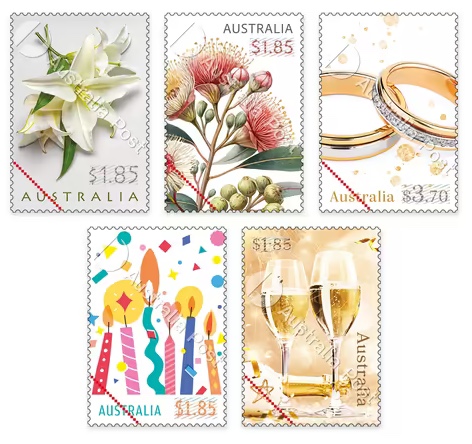
Australia – Dahlias: Australian Cultivars
Issue date: May 19, 2026
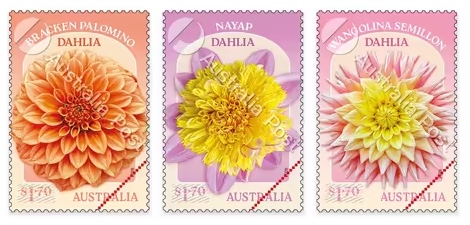
Dahlia is a genus of bushy, tuberous, herbaceous perennial plants native to Mexico and Central America, where they were used for food, medicine and to carry water (in the hollow stems). They are members of the Asteraceae family, along with sunflowers, daisies, chrysanthemums and zinnias. Today the Dahlia is the national flower of Mexico.
The name Dahlia is in honour of Swedish botanist Anders Dahl (1751–1789), a student of the famous taxonomist Carl Linnaeus (1707–1778). From the early 1830s, thousands of new forms were developed in Europe. Dahlias were introduced to Australia from Britain in the early nineteenth century. Today there are Dahlia societies across the country.
Due to Dahlias’ genetic makeup, it is easy to create new cultivars (cultivated varieties, created by selecting for desired traits). This characteristic, their longevity as cut flowers, and the fact that they can grow in a range of climates, makes them popular among gardeners in many parts of the world, including Australia.
Today there are thought to be forty-two distinct species of Dahlia across the world, and some 65,000 registered cultivars, in a vast range of shapes, sizes and colours. Australian enthusiasts and plant-breeders have created many popular and commercially successful Dahlia cultivars, and this stamp issue pays tribute to their efforts.
Postal: Australia Post | Website: https://collectables.auspost.com.au/stamp-issues
Guernsey – Fire Horse Cinderella Miniature Sheet for Macao 2026
Issue date: June 29, 2026
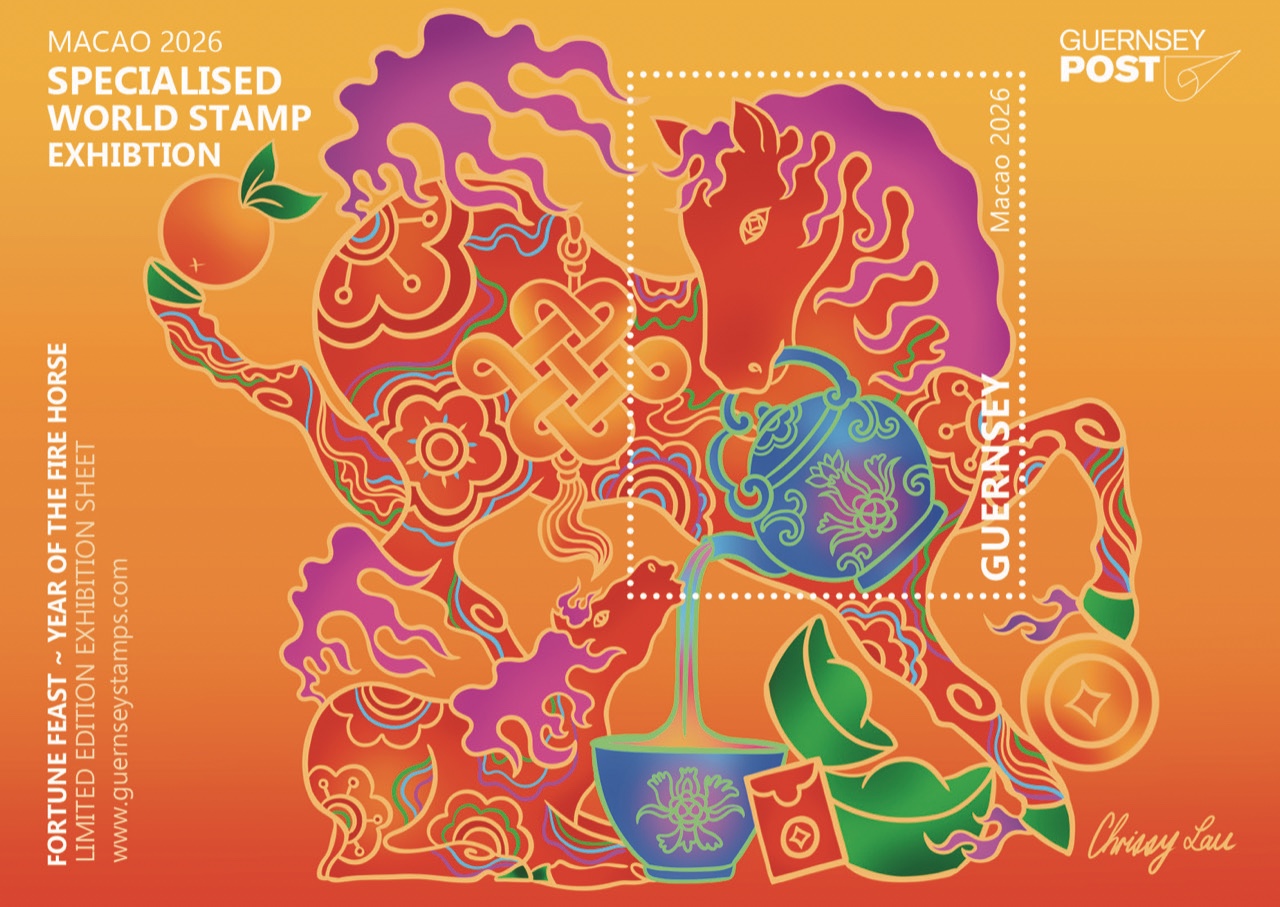
Guernsey Post’s philatelic bureau announces the release of a limited-edition Cinderella miniature sheet celebrating the Year of the Fire Horse. Created for the inaugural Macao 2026 Specialized World Stamp Exhibition, the issue combines traditional Lunar New Year symbolism with themes of prosperity, optimism and transformation.
Inspired by the Year of the Fire Horse 2026, the commemorative issue reflects qualities traditionally associated with the Chinese zodiac sign, including vitality, ambition, creativity and courage. Combined with the fire element, the Horse symbolises energy, forward momentum and new beginnings.
The vibrant miniature sheet, Fortune Feast, reflects these themes through a graceful Fire Horse whose flame-shaped mane and tail subtly evoke the element of fire. The horse pours tea, symbolising harmony, respect and tranquillity, while sharing symbols of prosperity including gold, an ang bao money packet, and an orange. A smaller pony drinks from the offering, representing the passing of blessings and good fortune across generations. Decorative plum blossom motifs throughout the design reinforce themes of resilience, perseverance and hope.
The sheet is contained in a presentation pack, Leap of Fortune, which captures the Fire Horse in motion amid gold coins, auspicious clouds and fireworks. The horse carries a traditional Chinese gourd, or hulu, symbolising protection, harmony, longevity and good fortune, while a gold coin balanced on a back hoof reflects skill, balance and optimism. Flame-like details and plum blossoms further reference the Fire Horse’s enduring strength and spirit.
The issue has been designed by acclaimed artist Chrissy Lau, who created all the designs for Guernsey Post’s 12-year Lunar New Year stamp collection.
Bridget Yabsley, head of philatelic at Guernsey Post, said: “Macao 2026 represents an important moment for international philately and we are delighted to participate in this exhibition with a special Cinderella issue. Chrissy Lau has created a beautifully symbolic and culturally rich design that reflects both the traditions of the Lunar New Year and the spirit of optimism, energy and celebration associated with the Fire Horse.
“Following the announcement of our Paul Revere Cinderella miniature sheet for the Boston 2026 World Stamp Show in May 2026, these special souvenir exhibition issues mark an exciting new chapter for Guernsey Post. Produced for major international philatelic exhibitions and available in limited numbers, we believe they will become highly desirable souvenirs for visitors and sought-after additions for collectors worldwide.”
The miniature sheet will be released as a strictly limited edition of just 3,000, available exclusively Macao 2026 Specialized World Stamp Exhibition.”
Postal: Guernsey Post | Website: https://www.guernseystamps.com/
Latest issue: 927