New Issues and stamp news 853
Australia – Australian Legends of Supercars
Issue date: April 27, 2023
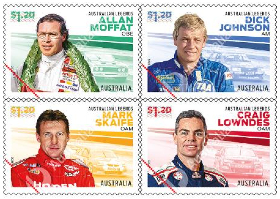
The Australia Post Australian Legends Award is presented annually by Australia Post to honour a living individual or group of individuals who have excelled in a particular field of endeavour. The award recognises outstanding individuals for their part in shaping the social and cultural life of Australia.
Supercars racing is the top category of Australian motorsport. The 2023 Australia Post Australian Legends Award honours four living legends of Supercars racing – Allan Moffat OBE, Dick Johnson AM, Mark Skaife OAM and Craig Lowndes OAM – whose record-setting achievements are inspiring the next generation. Not only have these racing drivers achieved excellence on the track in the Bathurst 1000, the Australian Touring Car Championship (ATCC) and the Repco Supercars Championship, but they have also made significant contributions off the track, through industry involvement, advocacy, education and charity work.
$1.20 Allan Moffat OBE Allan Moffat OBE (b. 1939) moved to Australia as a teenager with his family in the 1960s and went on to become one of the most successful drivers the country has ever seen. He cemented his name as a champion at Bathurst, winning both this famous race and the ATCC four times.
The stamp portrait photograph is from the collections of autopics.com.au. The background of the stamp features Moffat’s Ford XC Falcon from his 1977 Bathurst win.
$1.20 Dick Johnson AM Born and raised in Queensland, in 1945, Dick Johnson AM is one of the most famous faces in the history of Australian motorsport. Johnson won the ATCC and Bathurst 1000 in 1981, and went on to win four further championships (in 1982, 1984, 1988 and 1989) and the Bathurst 1000 two more times (in 1989 and 1994). Johnson retired from full-time V8 Supercar racing at the end of 1999 to focus on running his famous Dick Johnson Racing team.
The stamp portrait is by Tony Burton/autopics.com.au and the car in the stamp background is his Ford XD Falcon, driven during his 1981 Bathurst victory.
$1.20 Mark Skaife OAM Originally from the Central Coast of New South Wales, Mark Skaife OAM (b. 1967) remains one of the most successful drivers in Australian motorsport history. A six-time Bathurst 1000 winner, Skaife won his first Bathurst 1000 in 1991 and backed it up the following year, the same year he also won his first ATCC and the Australian Drivers Championship for open wheelers – a unique treble unlikely to be achieved again. Skaife won the ATCC again in 1994 and won the V8 Supercars Championship three years in a row, from 2000 to 2002.
The stamp portrait is by Robert Cianflone/Getty Images. The car in the stamp background is Skaife’s Holden VX Commodore, from his triumph at Bathurst in 2002.
$1.20 Craig Lowndes OAM Craig Lowndes OAM (b. 1974) is often referred to as the “people’s champion” of Australian motorsport. Lowndes won his first “great race” at Bathurst in 1996, the same year he also won his first ATCC. He won further championships in 1998 and 1999 and cement himself as a V8 Supercar fan favourite. A seven-time Bathurst 1000 winner and six-time winner of the Sandown 500 in Melbourne, Lowndes has also won the Bathurst 12 Hour for GT cars twice, in 2014 and 2017.
The stamp portrait is by Robert Cianflone/Getty Images. The car in the stamp background is Lowndes’ Holden VF Commodore, from his conquest of Bathurst in 2015.
Malta – The Malta Railway – 1883 – 1931
Issue date: April 25, 2023
The proposal to build a railway in Malta was made in 1870 so as to connect the capital city, Valletta to Mdina the ancient capital of Malta. Total travelling time was to be reduced from three hours by horse-drawn carriage to under half an hour. Land acquisition difficulties, the siting of stations and the overall general logistics generated by this modern novelty all led to considerable delays in planning and construction. The line was finally inaugurated on 28 February 1883 when the first train voyage left the Valletta terminus for destination Mdina.
The first two stations, Valletta and Floriana, were underground. The railway extended over a distance of 11 km and connected several platforms and stations at Hamrun, Msida, Santa Venera, Birkirkara, Balzan, Attard and Mdina. Besides the locomotive, the train consisted of various wooden passenger carriages both in First and Third Class. Of particular interest where the mailbags placed on the outside of First-Class carriages to receive mail, thereby incorporating the Malta Railway route into the national postal distribution network.
In 1890, the Malta Railway Company Ltd. went bankrupt bringing the railway to an end. As a result of this, the Government took over the operation, further invested in the infrastructure and reopened for business on 25 January 1892. Three years later, works commenced on an extension of the line to provide a better service to the British soldiers stationed at Mtarfa barracks. A tunnel was dug under Rabat and Mdina and a new station (Museum) was built at the foot of Mtarfa. The extension was opened to the public in 1900. Throughout its operation, the finances of the Malta Railway were a constant challenge. The arrival of the Malta Tramway in 1905, and the gradual introduction of the motor bus network throughout the 1920s, eventually signaled the end of the railway. The train operation was forced to shut down on 31 March 1931.
Fortunately, structures such as train stations, embankments, tunnels and street names survive as reminders of this important part of our heritage. To commemorate the event, MaltaPost, is issuing a sheet of 5 stamps portraying various scenes related to the Malta Railway. One stamp shows the railway route, with three others portraying artworks by John N Scerri, of scenes from the Birkirkara, Hamrun and Mtarfa train stations respectively. One stamp shows the train leaving the tunnel in St. James Ditch, Valletta. This painting is by local artist Richard J.Caruana
Australia – Lest We Forget; The Vietnam War
Issue date: April 18, 2023
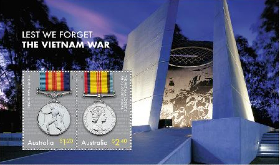
The Vietnam War (1955–75) was fought between South Vietnam (backed by the United States) and the Viet Cong, the communist-led insurgent force supported by the North Vietnamese Army. The Viet Cong sought to unify the country after the partition that resulted from the First Indochina War (1946–54).
Australian support for South Vietnam was in the context of a desire by the United States and other nations to stop the spread of communism in Europe and Asia. While Australia didn’t enter the war until 1962, it was to become our longest conflict of the 20th century. More than 60,000 Australians served in Vietnam, of which 523 were killed and more than 3,000 were wounded.
Australian forces were withdrawn in 1971, with the last arriving home in March of 1972. In January 1973, 50 years ago this year, Australia officially issued a proclamation to mark the end of Australia’s involvement in the war. However, in 1975, due to the fall of Saigon to the communists, elements of the Royal Australian Air Force returned to carry out evacuations and to assist refugees, before embassy staff were evacuated in April 1975.
The war, including the introduction of a selective conscription scheme, was the cause of significant social and political dissent, and many veterans were left with long-term impacts to their health.
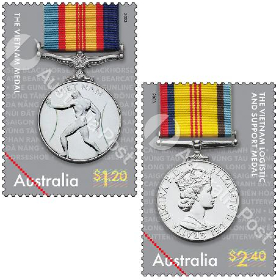
To honour all Australians who served in the Vietnam War, the stamps in this issue present two key campaign medals. In the background of the stamps are locations that were main bases or areas associated with the units and other recipient classes for each medal.
$1.20 The Vietnam Medal Instituted in 1968, the Vietnam Medal was the primary Australian campaign medal of the Vietnam War, until the creation of the Australian Active Service Medal 1945–75, some 30 years later. The Vietnam Medal recognises members of the Australian Defence Forces and members of accredited philanthropic organisations serving in South Vietnam between 29 May 1964 and 27 January 1973.
The medal’s reverse, presented on the stamp, features a male figure struggling between two worlds, a homage to the ideological nature of the Cold War, of which Vietnam proved to be its deadliest incarnation. The obverse, which is shown when the medal is worn, displays the crowned effigy of Queen Elizabeth II. The medal’s ribbon incorporates colours representing the South Vietnamese flag, flanked by two stripes of red (for the Army), a dark blue stripe (for the Navy) and a light blue stripe (for the Air Force). The Vietnam Medal was issued under the Imperial system but was mainly awarded to Australian and New Zealand personnel, around 50,000 of them.
Permission to reproduce the Vietnam Medal (reverse) was granted by the Office of the Official Secretary to the Governor-General.
$2.40 The Vietnam Logistic and Support Medal The Vietnam Logistic and Support Medal was established on 24 February 1993. It was created to provide recognition to the men and women who played a vital support role during the Vietnam War but did not qualify for the Vietnam Medal. This includes certain defence personnel in support roles, as well as entertainers, journalists, civilian surgical and medical teams, Qantas aircrew and embassy couriers.
The stamp shows the obverse of the Vietnam Logistics and Support medal, which features the crowned effigy of Queen Elizabeth II.
Permission to reproduce the Vietnam Logistic and Support Medal (obverse) was granted by the Office of the Official Secretary to the Governor-General.
Australia – Solar Eclipses
Issue date: April 11, 2023
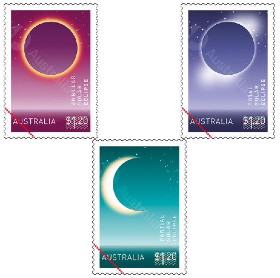

Throughout human history, eclipses – both solar and lunar – have captured the human imagination. Western astronomers have studied total solar eclipses for more than a century, and this has helped shape our knowledge of the Sun’s composition and processes, and it has also deepened our understanding of the Earth and the space environment in which our planet exists.
Eclipses occur when the Sun, Moon and Earth line up, and that alignment can be partial or full. Solar eclipses occur when, in combination with a lunar node (the intersection of the orbital planes of the Sun and Moon), the Moon passes between the Sun and the Earth during a new Moon phase; lunar eclipses occur when the Earth passes between the Sun and the Moon.
This stamp issue presents three types of solar eclipse: partial, total and annular. This issue is being released in the lead-up to a hybrid eclipse (a rare annular–total eclipse), which is due to arrive on 20 April 2023, viewable at 11.29am over a small part of the west coast of Western Australia, the Exmouth peninsula.
$1.20 Annular Solar Eclipse Second-most common is the annular eclipse, which takes place when the Moon is at its farthest point (apogee) from the Earth on its elliptical orbit of our planet. Because it is at this distant point, it appears smaller (by 14 per cent) than it is when it is at its closest proximity (perigee) to the Earth. This makes the Moon appear smaller than the Sun when it crosses its path, meaning it does not fully block the Sun. In a darkened daytime sky, the Moon will appear as a dark disk superimposed on the larger disk of the Sun, resulting in a ring of fire (annulus) as the Sun shines around the Moon’s circumference.
$1.20 Total Solar Eclipse Total solar eclipses happen every 18 months or so, but often they will be visible only from remote locations, meaning they are seen by relatively few stargazers. This type of eclipse occurs when the Moon completely blocks the face of the Sun, and those in the centre of the Moon’s shadow when it hits the Earth will experience the phenomenon of “totality”. The sky will darken as the Moon passes in front of the Sun and only the Sun’s corona (outer atmosphere) will be visible around the black disk of the Moon. This white, hazy celestial zone comprises extremely hot particles ejected at high speed from the Sun’s surface.
$1.20 Partial Solar Eclipse A partial eclipse is the most humble and common of solar eclipses. It occurs when the Moon does not align perfectly with the Sun, so covers only part the Sun. Depending on the “magnitude of eclipse” the sky may darken but day does not turn to night during the event. The magnitude of eclipse refers to the area of the Sun occluded by the Moon: sometimes it appears as if the Moon has bitten just a small piece from the Sun; at other times the occlusion is large, and the Sun appears as a bright, narrow crescent.
Jersey – The Crest of Jersey
Issue date: April 6, 2023
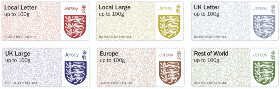
The Crest of Jersey will feature on six new Post & Go stamps to be issued by Jersey Post on 6 April 2023.
The Crest of Jersey first appeared on a set of Jersey Post & Go stamps issued in 2016. The six Post & Go stamps have been redesigned for 2023, bearing the official cypher of His Majesty King Charles III and depicting the Crest of Jersey in a new palette of colours. The names of all twelve of Jersey’s parishes are incorporated within the wave pattern on the left-hand portion of the stamps. Post & Go stamps are self-adhesive stamp labels with the postage printed on demand. They can be bought either as single stamps or in strips of six. As well as being available to vend from the JE02 kiosk at Jersey’s main Broad Street post office and from the JE03 kiosk at Postal Headquarters, Rue Des Pres, The Crest of Jersey Collectors Strips will be available from Jersey Post’s back office B002 kiosk through the Philatelic Bureau.
The Crest of Jersey Post & Go stamps and philatelic stamp products such as First Day Covers and Presentation Packs will be available from the Jersey post offices at Broad Street, St Helier and Rue Des Pres, St Saviour on issue day and can be ordered now at www.jerseystamps.com or by telephoning the Jersey Philatelic Bureau on: 00 44 (0)1534 616717.