New Issues and stamp news 878
Jersey – Jerriais 2
Issue date: Oct 03, 2024

Issued on Thursday 3rd October 2024, ‘Jèrriais 2 – Phrases’ celebrates Jersey’s traditional native language in the second part of the Jèrriais series. Local artist, Ron Mills, who illustrated the 2022 issue ‘Jèrriais – The Traditional Language of Jersey’ returned to use his stylistic illustrations skills to highlight the uniqueness of the Jèrriais language. Jèrriais phrases and words can be found throughout the Island showcasing the significant role the language has played in shaping the Island’s culture and history.
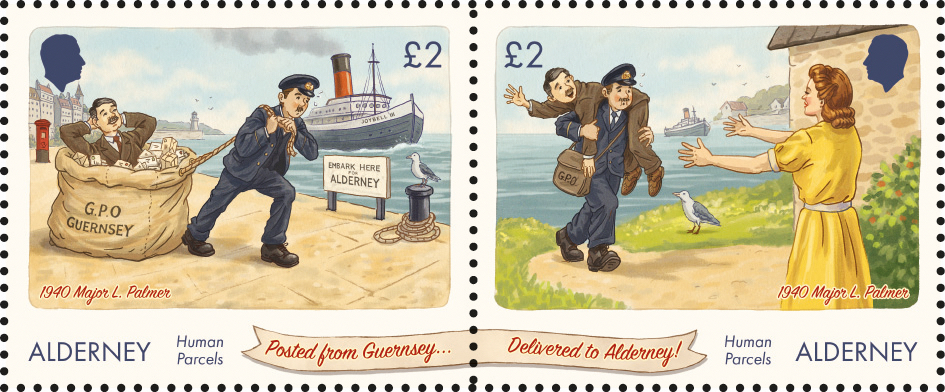
‘Jèrriais 2 – Phrases’ includes a set of six stamps, a souvenir sheetlet and a miniature sheet, which all feature various phrases used within the language. For the 60p stamp, Ron has depicted a woman waving to a ship with the Jèrriais phrase Bouan Viage signifying a wish of a ‘good voyage’ the pronunciation is similar to the French ‘bon voyage’.
Both Jèrriais and Jersey’s fishing industry have existed for a number of years in Jersey. The Jèrriais for a fishing boat has been illustrated in the first 98p as Un baté pêtcheux. Ron Mills, has also included the pronunciation œ̃ bate pe:tʃœ in the left hand corner of the stamp.
The second 98p includes a very fun phrase of referring to someone as a bit hoity toity. Un pithot coêffi pronounced as œ̃ piðo kwe:fi literally translates to a goose wearing a headdress. The connotation is that geese have particularly long necks, but the thought of them looking down at someone while wearing a headdress is a little ridiculous, hence the double meaning of the phrase as hoity toity.
For the £1.65 stamp the Jèrriais term Un mouc á mie translates to a honey fly (bee).The French word for bee is ‘abeille’ but they also have a French translation for a honey fly ‘mouche de miel’, which is more similar to the Jèrriais phrase and most likely used before ‘bee’.
Likely one of the most well-known Jèrriais phrase on the Island, Un crapaud pronounced as œ̃ krapo. Jersey’s local toad is called a crapaud. And previously the phrase Un crapaud was meant to be an insulting way to describe someone from Jersey, however locals took an ironic pride in the name, to the point that in St. Helier a stone crapaud stands proudly on a pillar within an area of the town.
Translated to mean to plough, the £2.95 stamp features the Jèrriais phrase Eune tchéthue, pronounced as œn tʃeðy. The illustration of the stamp features a farmer ploughing a field. Jersey’s rich natural soil has been used to farm an array of fruits and vegetables throughout the years. Ploughing is used in farming to break down and loosen the soil to ensure the area is ready for sowing seeds for planting.
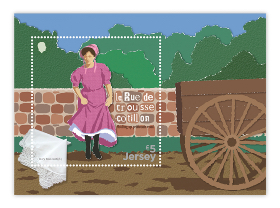
For the miniature sheet, a woman can be seen holding up her petticoat. Prior to the 17th century when an order was placed to ensure the roads were paved, many of the streets in town were narrow and difficult to travel over. As they were unpaved there were no clear paths for pedestrian use and come the winter months traversing the streets was almost impossible and people had to mind their steps.
If you were to look up the Jèrriais translation for many of the road names in Jersey, you’d soon discover that the language was used to give Islanders an understanding of what to expect when traversing them. As such La Rue Trousse Cotillon, which literally translates to ‘holding up petticoats road’, was known to be rather muddy. Therefore, people, particularly women had to mind their steps.
The language is now being taught in schools in Jersey to ensure the language isn’t forgotten. Currently, fluent speakers of the language are in the minority, however, Jersey’s society’s, such as the Société Jersiaise are keen on encouraging the native language of Jersey, holding various social gatherings and online courses which can be accessed both locally and internationally.
Gibraltar – Post & Go – Europa 2024
Issue date: September 30, 2024
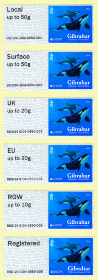
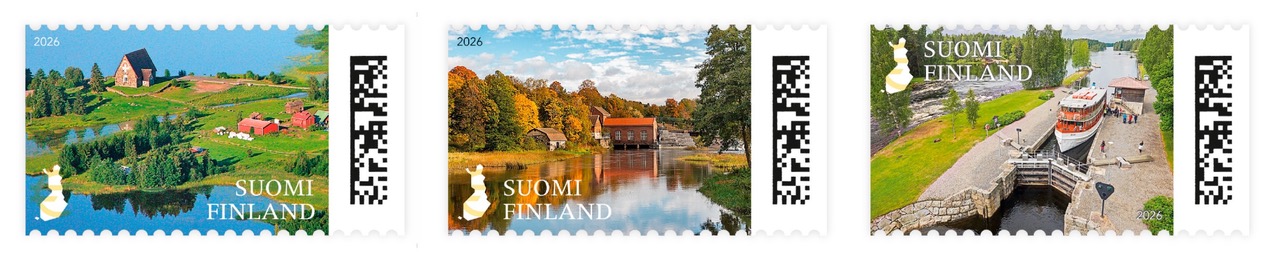
The Gibraltar Philatelic Bureau is pleased to unveil a new set of Post & Go for 2024, featuring the design from this year’s Europa 2024 issue.
Post & Go stamps are variable value postage stamps dispensed by stamp vending machines and produced by several postal administrations. They are typically issued twice a year by the Gibraltar Philatelic Bureau: The first featuring the design of the Chinese Lunar New Year issue, followed by another edition, featuring the design of the Europa issue of the year.
The Post & Go – Europa 2024 collection is comprised of a set of six self-adhesive labels and one First Day Cover.
Gibraltar – Butterflies of Gibraltar II
Issue date: September 30, 2024
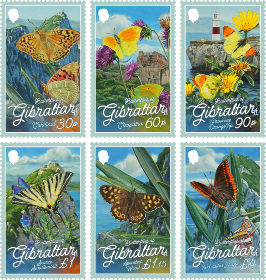
The Gibraltar Philatelic Bureau is pleased to unveil a new stamp issue, a second installment in the Butterflies of Gibraltar series which began in 2023.
Gibraltar boasts an impressive diversity of butterfly species, with a total of 609 species identified to date. This series features six of these butterfly species, complementing the six species featured in the 2023 Butterflies of Gibraltar issue. The set of six stamps for 2024 features the following butterfly species: Cardinal, Cleopatra, Provence Orange Tip, Scarce Swallowtail, Speckled Wood and Two-Tailed Pasha, all set upon landscapes of Gibraltar.
The artistic vision behind this collection was brought to life by local graphic artist, Mr. Stephen Perera, and features a selection of paintings by renowned United Kingdom-based artist Jonathan Pointer.
The Butterflies of Gibraltar II collection is comprised of a set of six stamps, a miniature sheet, and accompanying First Day Covers and Presentation Packs.
Malta – Maltese Festa – Series VIII
Issue date: September 30, 2024
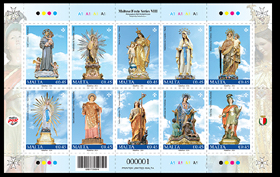
The Festa is an important part of cultural heritage in Maltese villages, uniting families, local communities, and outsiders in a celebration of popular religiosity. Apart from liturgical functions, the common factors during Festa Week are the street decorations, band marches, firework displays, and lots of church bells ringing. This stamp issue is the eighth in the series.
Birkirkara – Statue of Saint Anthony of Padova Gzira – Statue of Our Lady of Mount Carmel Marsa – Statue of the Queenship of Mary(Maria Regina) Paola – Statue of the Blessed Virgin Mary of Lourdes Rabat – Statue of Our Lady of the Holy Girdle(Il-Madonna tac-Cintura) San – Statue of Our Lady of Lourdes San Lawrenz (Gozo) – Statue of Saint Lawrence Sannat (Gozo) – Statue of Saint Margaret Tarxien – Statue of Our Lady of Holy Doctrine (Il-Madonna tad-Duttrina) Victoria (Gozo) – Statue of Saint George
Guernsey – 150 YEARS OF THE UNIVERSAL POSTAL UNION
Issue date: October 09, 2024
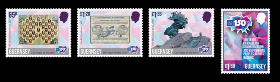
Guernsey Post’s philatelic bureau is to commemorate 150 years of the Universal Postal Union (UPU) with four stamps marking some of the key moments in the organisation’s history (stamp issue date: 9 October 2024).
The UPU’s theme for its 150th year – 150 years of enabling communication and empowering peoples across nations – recognises its accomplishments and reinforces its commitment to serve everyone for the decades and centuries to come.
The 65 pence stamp depicts the founding members of the General Postal Union, which later became known as the Universal Postal Union. Held in Bern, Switzerland in 1874, delegates from 22 countries signed the Treaty of Berne, which unified a complex maze of postal services and regulations.
In 1906, the UPU created the International Reply Coupon (IRC) during the Rome Congress (£1.20 stamp). IRCs may be exchanged between the countries of which the administrations have agreed to participate. Since they became available in 1907, the appearance of the IRC has changed several times, with nine different models and 21 iterations.
Located in Berne, home to the UPU’s headquarters, the UPU Monument Around the World was created by the French sculptor René de Saint-Marceaux (£1.36 stamp). It was inaugurated on October 4, 1909, after de Saint-Marceaux won an international competition in which more than 120 artists participated.
The central image of the monument – the five women passing letters around a globe – was adopted as the UPU emblem several decades ago and symbolises international postal communication.
Finally, the £1.68 stamp features a common design available to all 192 UPU member countries, showcasing the 150th anniversary logo. This stamp is intended for use on First Day Covers (FDCs) and Maximum cards, offering collectors a unique way to commemorate this milestone. In collaboration with Postcrossing, the Fédération Internationale de Philatélie (FIP), and the UPU, this global initiative aims to delight collectors and enthusiasts worldwide through the exchange of these specially designed Maximum cards, celebrating 150 years of international postal cooperation.