New Issues and stamp news 890
Åland – Europa 2025, archaeological discovery
Issue date: May 9, 2025
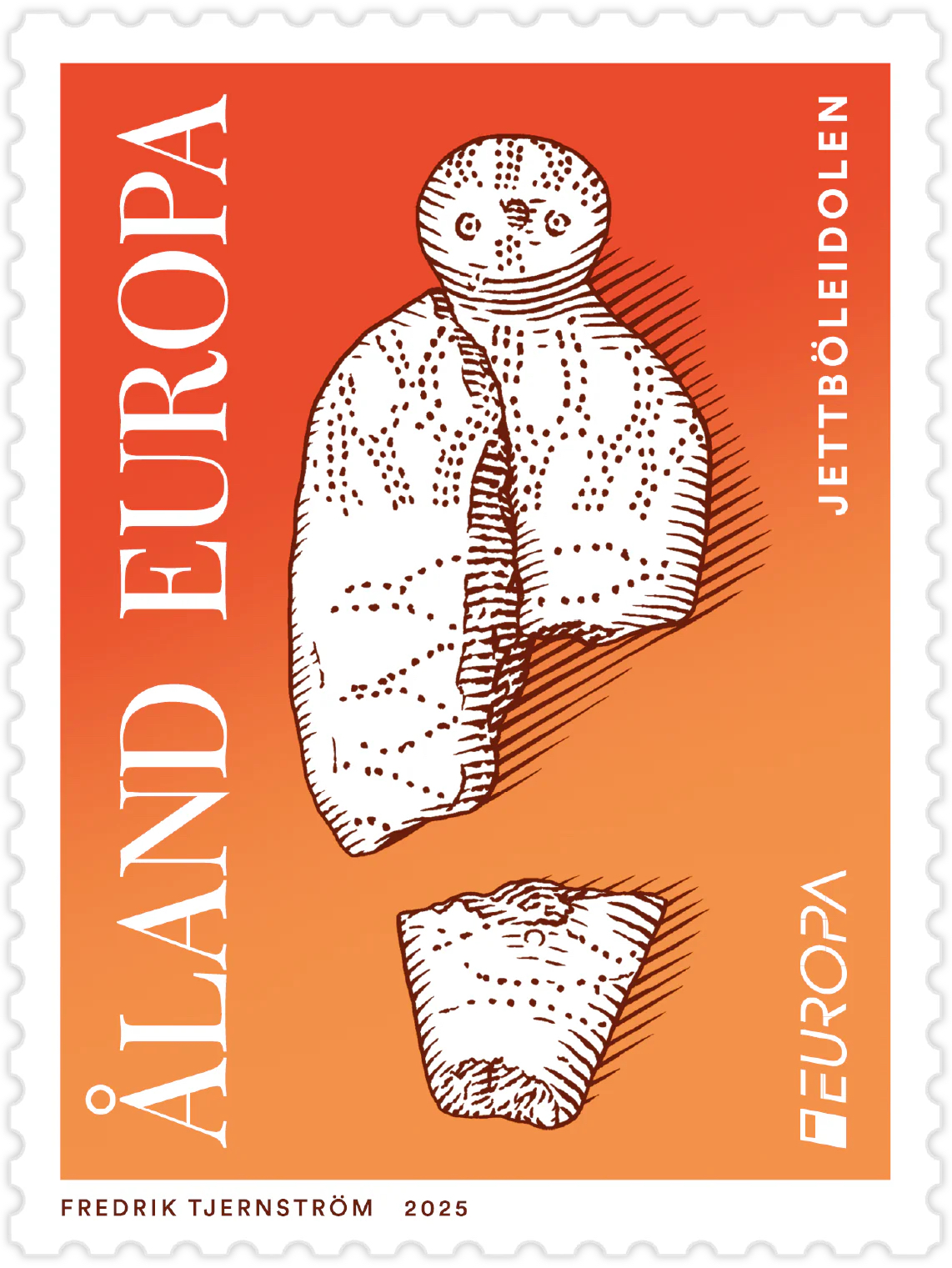
The stamp features the Jettböle idol, one of Åland’s most fascinating archaeological finds which has become a symbol of the Åland Stone Age.
The Jettböle idol was found in 1906 during the excavation of the 5000-year-old Stone Age settlement in Jomala, which had been discovered by chance in 1905. Led by Finnish archaeologist Björn Cederhvarf, the excavations revealed Åland’s first Stone Age settlement that could be linked to the Pitted Ware culture – which had not previously been discovered in Finland.
The Jettböle idol is one of several small burnt clay figures with geometric patterns and markings on the head and body that were found during the excavations. Clay idols of human figures from the Stone Age had not previously been found in Scandinavia. Their significance has been interpreted in numerous ways over the years, including as ritual objects.
The stamp motif was inspired by the collection of artefacts of the Åland Museum and the National Museum of Finland as well as visual material of the Finnish Heritage Agency.
The stamp is an issue in the PostEurop Europa stamp series, the 2025 theme of which is national archaeological discoveries.
The Europa denomination of the stamp indicates a specific postage value when used as postage on a card or letter. The value corresponds to the current postage for a shipment weighing up to 20 grams, sent by Priority from Åland to a Nordic or European country.
Åland – Sepac 2025, architecture
Issue date: May 9, 2025
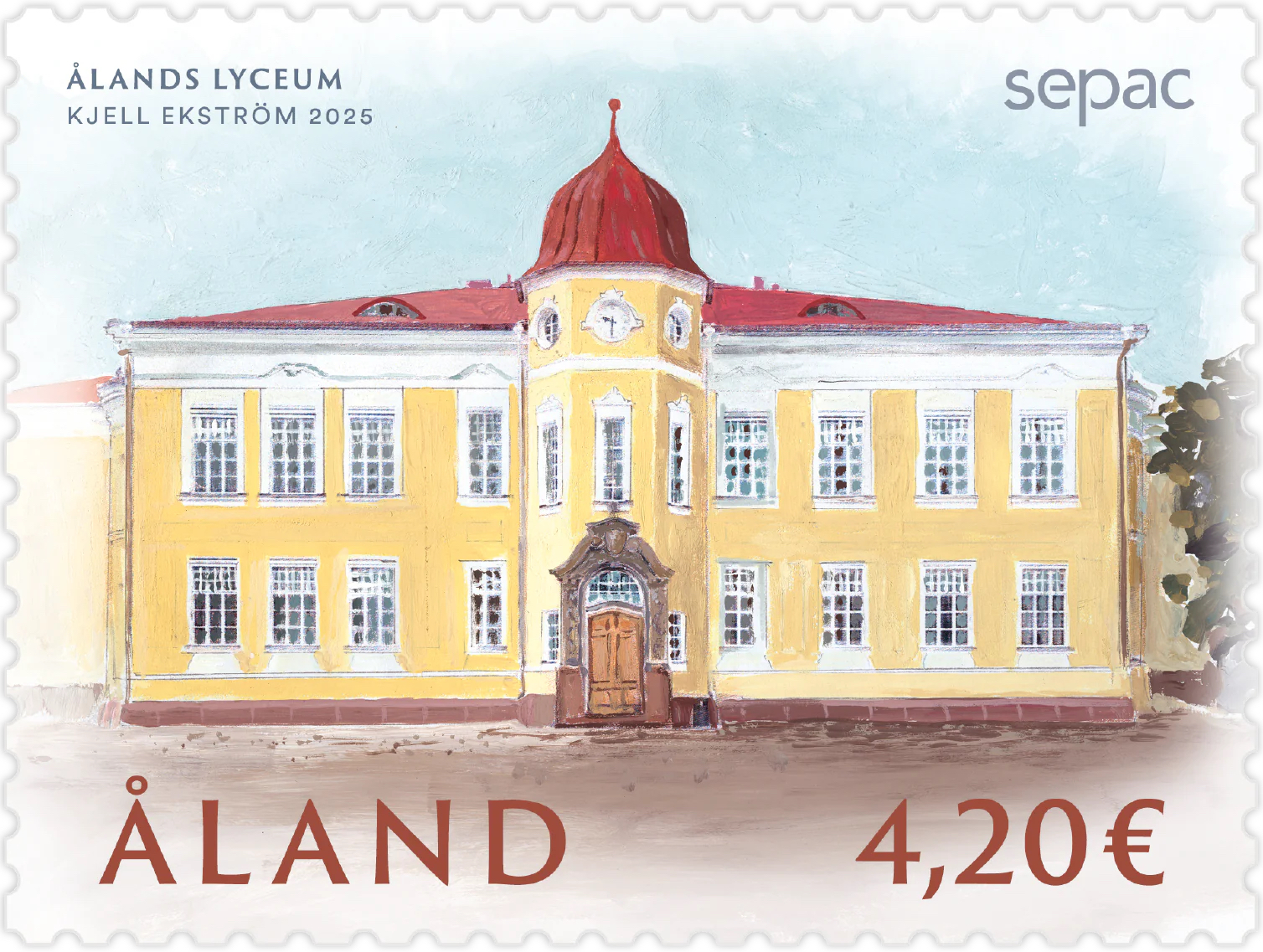
The stamp shows the Åland Lyceum, one of the iconic landmarks of Mariehamn and a beautiful example of early 20th century schoolhouse architecture.
Erected in 1903, the schoolhouse was the first large stone building in Mariehamn. Architecturally, the Åland Lyceum represents Swedish manor house style with tall, wide windows and small panes. From the outset, the building had bright yellow plasterwork, white mouldings, and a red roof. The decorative main entrance at the foot of the tower is framed by a soapstone portal adorned with the town’s coat of arms and water lily motifs, a tribute to the Art Nouveau ideals of the time.
The building was designed by Finnish architects Johan Jakob ”Jac” Ahrenberg (1847–1914) and Sebastian Gripenberg (1850–1925). Excerpts from the original school drawings can be seen on the gutter of the stamp sheet.
Today, Åland Lyceum is a preparatory upper secondary school from which over 100 students graduate each year. Student caps, a symbol of completed studies, can be seen in the corners of the stamp sheet.
The stamp is an issue in the Sepac stamp series issued by the small postal administrations in Europe. Sepac, the Small European Postal Administrations’ Cooperation, has 12 members. The members of the Sepac group annually issue stamps on a common theme that highlight unique motifs from the various regions. The theme for 2025 is architecture.
Guernsey – 80th anniversary of Guernsey’s liberation
Issue date: May 1, 2025
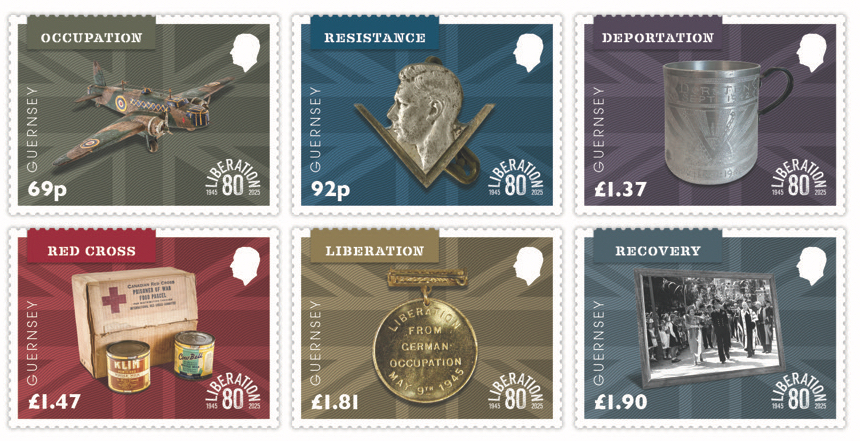
Guernsey Post’s philatelic bureau announces that it will release commemorative stamps to mark the 80th anniversary of Guernsey’s liberation from German occupation during World War Two. The six stamps depict articles across the timeframe of the occupation in 1940 to the liberation and recovery of the island in 1945.
The stamps Occupation: Toy plane – a WW2 era Wellington bomber, home-made in wood during the German occupation.
Resistance: Silver pin badge, ‘V’ with the King’s head; silver (tarnished); a ‘V’ for Victory German Occupation resistance symbol from WWII, made by Alf Williams during the occupation.
Deportation: Aluminium mug – punch-decorated by William (Byll) Balcombe at Biberach Internment Camp, Germany. It is thought Byll decorated this cup when he arrived in Biberach to record their journey.
Red Cross: A Canadian Red Cross Prisoner of War food parcel issued to the civilian population during the German occupation.
Liberation: States of Guernsey liberation brass pin, which was given to children who remained in Guernsey during the German occupation.
Recovery: 7th June 1945, King George VI and The Queen visited Guernsey and Jersey to welcome the oldest possessions of the Crown back to freedom. The Royal couple visited Candie Gardens where a speech was given by the Bailiff.
Bridget Yabsley, head of philatelic at Guernsey Post, said: – “We are honoured to issue stamps to commemorate this poignant milestone. Now celebrated annually, Liberation Day is a reminder of the resilience and courage of islanders during a dark chapter in Guernsey’s history.
“We are grateful to Guernsey Museums for its assistance and for providing the images of the objects depicted on the stamps, which are items in its collections, and also to Simon Hamon for providing the 1945 photograph of the Royal visit.”
United Kingdom – Myths and legends
Issue date: Mar 27, 2025
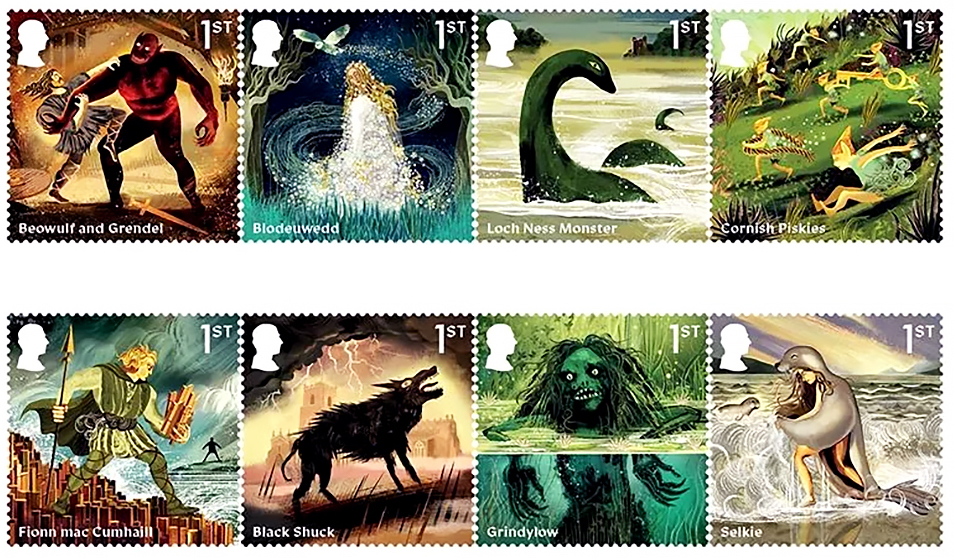
Royal Mail has unveiled a set of stamps featuring mythical creatures and fabled figures from UK folklore.
Designed by London-based artist Adam Simpson, the illustrations include the Loch Ness Monster, Cornish piskies, and Beowulf and Grendel. Other stamps in the Myths and Legends collection depict Blodeuwedd of Welsh mythology, Irish heroic figure Fionn mac Cumhaill, the spectral hound of East Anglia, Black Shuck, selkies and a grindylow.
The set of eight stamps and the stories each represents from different regions across the UK “demonstrate our rich mythological heritage”, Simpson said.
Grindylows are sprites with long arms that lurk in rivers and ponds ready to snatch curious children in folklore from Lancashire and Yorkshire, while selkies are fabled creatures from Orkney and Shetland which shed their seal skins to take human form.
Illustrating stamps is challenging, the designer said, because “the composition needs to work at such a small scale”.
For example, to portray the fight between Beowulf and the monster Grendel, from the Anglo-Saxon poem Beowulf, he had to “figure out how to have two figures in a space that works on a small scale” and “wanted to suggest that Beowulf defeats Grendel by tearing off his arm without the image becoming disturbing”.
Simpson said the project became a “real labour of love” and took more than a year to complete, with the illustrations evolving over time.
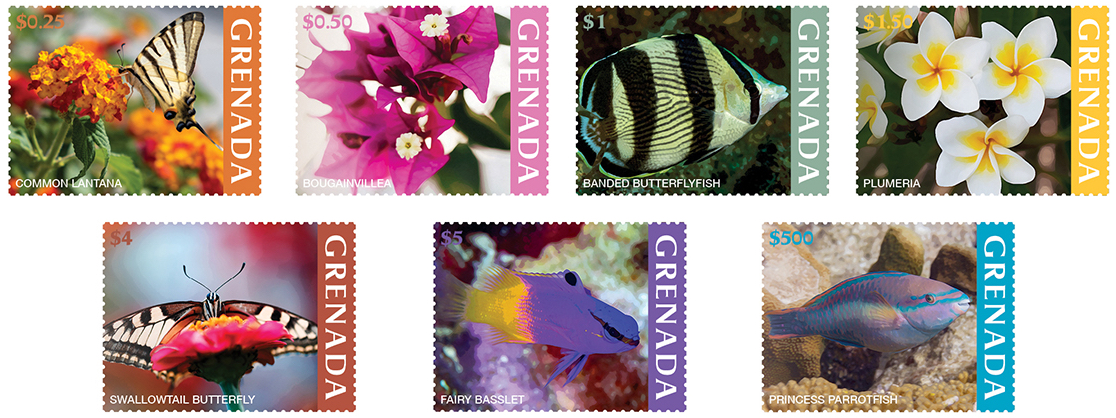
Grenada and Grenadines – Fish and Flower
Issue date: Mar 24, 2025
Israel – India Israel Joint Stamp
Issue date: February 11, 2025
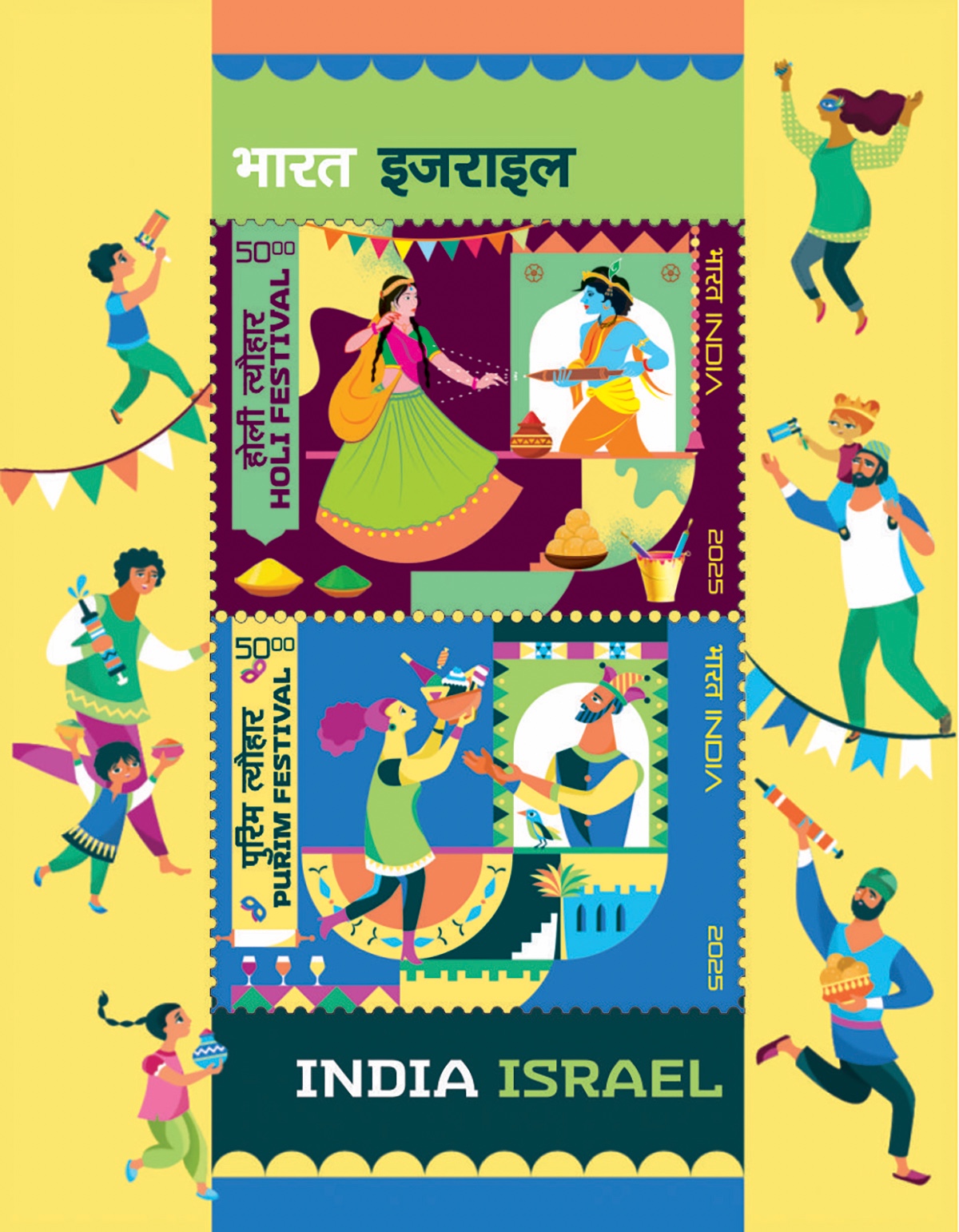
Israel-India cultural relations are expanding day by day. Indian films, cuisine, Ayurveda, and yoga are very popular in Israel, and even International Yoga Day is celebrated with full enthusiasm. Israeli youth often visit India during vacation, and people-to-people contact is a natural result. Incidentally, Hindu and Jewish festivals have the commonality that Diwali and Hanukkah, and Holi and Purim, are being observed on nearly the same date, and both are festivals of survival and victory of good over evil. As India and Israel march forward, their bilateral relationship can only grow stronger. With more trade, more technological collaboration, and more cultural linkages, the two countries are further consolidating a relationship of substance based on mutual respect for each other, shared values, and shared vision of prosperity. The release of a joint postage stamp to commemorate the Holi and Purim festivals is an indicator of the very high level of affinity between the two rich cultures.
Israel – The Textile Industries in Eretz Israel – Printed Fabric
Issue date: February 11, 2025
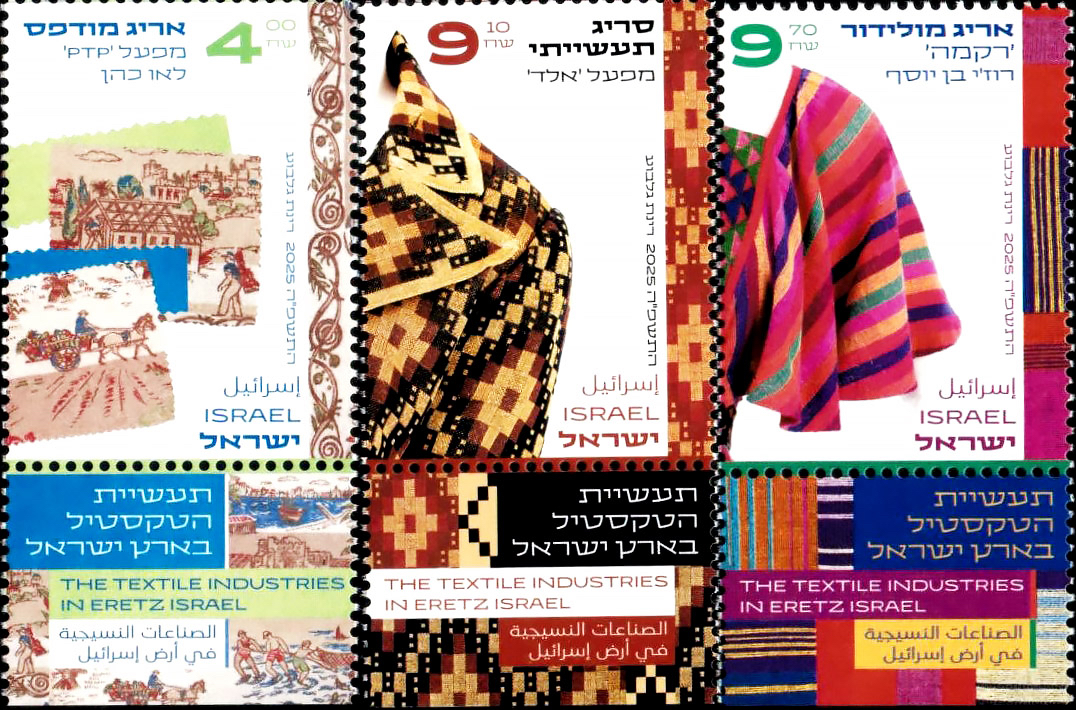
The textile industry in Israel began within frameworks of vocational training and was developed through initiatives by Jewish immigrants who established family-model industries. After the establishment of the State of Israel, the textile industry expanded with the encouragement of state institutions. In the late 19th century, on the eve of Zionist immigration to the Land of Israel, when the old Jewish community numbered approximately 20,000 people, the “Torah and Craft” school was founded. Established in 1889 by the French-Jewish Alliance network, the school operated until 1918. Its goal was to provide vocational training and livelihoods for the Jewish community in Jerusalem. It included a cotton weaving factory equipped with the first 51 mechanical looms in the country, powered by steam, and a workshop for dyeing threads.
The fourth wave of immigration from Europe to the Land of Israel in the 1920s is also known as the “Textile Aliyah.” .Among the factories established were the Palestine Textile Prints workshop by artist Leo Kahn; the Lodzia knitting factory led by Aryeh Shenkar; the ATA complex by the Muller family; the weaving factory Aton under Dr. Paul Horn; and family-run knitting factories such as Eld, Dorina, and others.
By the 1940s, there were over 1,200 textile factories and workshops in the country, operating on a family model that continued to develop until 1955. One of the factory is “Rikma” (1951), which became a fashion brand under the family designer Rozy Ben-Yosef.
By the encouraged of the government knitting factories such as Oman in Ofakim and Gibor in Kiryat Shmona were established, along with weaving factories like Polgat in Kiryat Gat, Bashan for fabric dyeing and printing in Beit Shean, and Kitan in Dimona. The Delta factory for knitting underwear was established in Karmiel in 1975 and continues to operate today.
Until the 1990s, the textile industry was among the leading sectors in the Israeli economy. With the signing of global trade agreements, factories began to close, and today, the industry’s share in the local economy is significantly reduced.
Israel – Technicon Centennial
Issue date: February 11, 2025
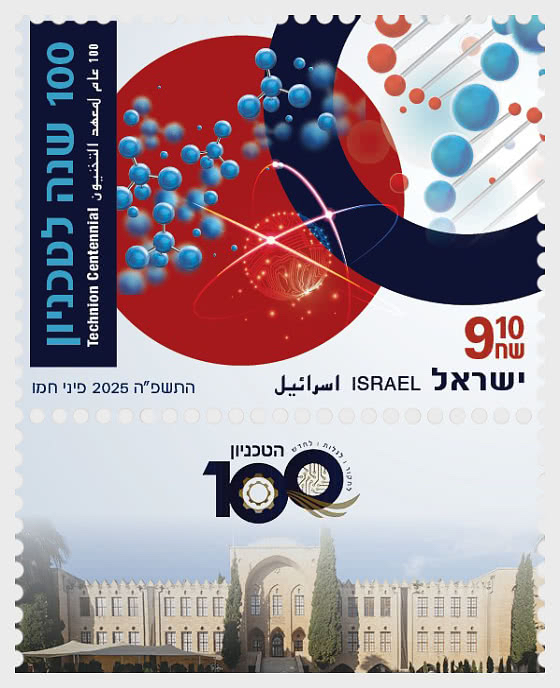
100 years ago, in December 1924, the Technion- Israel Institute of Technology welcomed its first class of 17 students, consisting of 1 women and 16 men. Their studies, mainly focusing on architecture and construction engineering, took place in the now-historic Technion building in Haifa’s Hadar neighborhood. Most of the lecturers were Jewish professors who had recently immigrated from Europe and hardly knew Hebrew, and the teaching infrastructure was extremely limited. Nevertheless, one of the world’s top ten technological research universities evolved from those modest wooden benches of that first class.
The Technion laid the groundwork for the young country and has been closely tied to its development since its establishment. I am not aware of any other university in the world whose influence on the country where it is located matches the Technion’s impact on the State of Israel. As the late Shimon Peres used to say: “Israel is lucky that the Technion preceded the State by a quarter of a century and not the other way around.”
The Technion and its alumni have consistently shouldered the development of Israel’s civil and security infrastructure. During those early days, a unique approach towards research and education was embedded in the Technion, so that in addition to aspiring towards excellence in research and education like all research universities, we also feel a deep sense of responsibility for Israel’s security, economy, and society.
Four Nobel Prize laureates have emerged from the Technion: Distinguished Prof. Avram Hershko, Distinguished Prof. Aaron Ciechanover, Distinguished Prof. Dan Shechtman, and Technion graduate Distinguished Prof. Arieh Warshel.
In addition to the campuses in Haifa, today the Technion also boasts two international campuses in China and New York.
If we were able to accomplish all of this in the first 100 years, just imagine what the future will bring. Prof. Uri Sivan, President of the Technion.