New Issues and stamp news 886
Faroe Islands – 50 Years of Faroese Stamps
Issue date: February 24, 2025
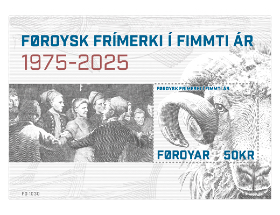
The Faroe Islands issued their first stamps on 30 January 1975. The issue included 14 stamps featuring ancient maps of the Faroe Islands and landscape paintings.
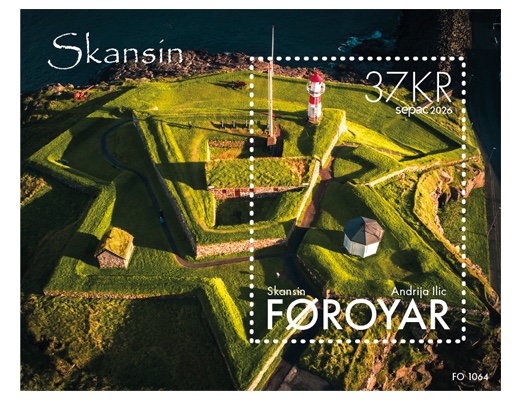
To mark this occasion, a special minisheet will be issued on 24 February 2025, showcasing some of the most iconic Faroese stamps – including the ram and the traditional dance ring both originally engraved by master engraver Cz. Slania.
On December 19, 1895, the Faroese newspaper, Føringatíðindi, reprinted an article from Berlingske Tidende from October 1845 under the headline: “An English Peculiarity”.
It read: In England, sending letters is inexpensive. The postal service sells small square pieces of paper with a picture of the Queen’s head, which are placed on letters to be sent without payment. When the letters arrive at the post office, a black cross is marked over the “stamps” so they cannot be reused. These little Queen’s heads are quite charming, and the English demonstrate one of their peculiarities by collecting these “stamps”. From this, one can see that 50 years ago, the Danes neither had stamps nor knew what they were. Now the boys in Tórshavn are just as “peculiar” as the English once were in collecting stamps.These “boys” were collectors from the beginning when Danish stamps were sold in the Faroe Islands from 1870. It was likely the same “boys” who later wished for Faroese stamps. In the newspaper Dúgvan on May 15, 1909, a letter to the editor appeared with the headline: “A Reform – Knowledge is Power”. It stated that when the bank Føroya Banki was established in 1906, the idea of Faroese banknotes was born – but why not Faroese stamps, it was asked. Several reasons were mentioned, including the fact that “a couple of Denmark’s overseas territories, Iceland and the West Indies”, had their own stamps.
Interest in Faroese stamps became even clearer in Dimmalætting on September 11, 1909, when the newspaper reported on a town council meeting that week. On the agenda was: “From Merchant C.C. Johansen and Trade Assistants Johs. O. Joensen and J. Jensen, a proposal for the introduction of Faroese stamps with local motifs. It was decided to refer the petitioners to the Løgting.”
The issue of Faroese stamps had been discussed in the Løgting in 1906 without result, but it was raised again in the Faroese Løgting: “XXIV – Concerning the Issuance of Special Faroese Stamps”. In addition to the same people who had written to the council, a new one joined, namely H. Wenningsted Tórgarð. The letter was dated Tórshavn on July 28, 1910. Several arguments were made for Faroese stamps: To create awareness of the Faroe Islands, to put the Faroes on the world map, to attract more tourists, financial gain from sales and collectors – it was pointed out that the postal service in the Faroe Islands in 1909 had sold stamps for 19,000 kroner, which could increase significantly with beautiful Faroese motifs on stamps with Faroese text. Enclosed were stamps from “Helgoland”, which had both German and English text – so there was no reason why the Faroe Islands, as an “overseas territory”, couldn’t have their own stamps.
The Løgting held three sessions on the matter. It ended with a decision on August 9, 1910, where 19 voted in favor and none against, that “The petitioners are recommended to address the General Post Office”. The Løgting did not wish to take on any financial risk regarding postal transport between countries, which seemed to be the main reason for this decision.
In the many subsequent years, including two world wars, the Faroe Islands came close to getting their own stamps, but it ended with “provisional” stamps both in 1919 and again during the Second World War – but this time it was close. Germany had occupied Denmark on April 9, 1940, and the situation in the Faroe Islands became critical regarding stamps. In November 1940, the Løgting passed the following proposal: “The parliament recommends that the stamps, which the postal service here will likely have to print due to the war situation, be made with Faroese motifs.” The Faroese Philatelic Association had also submitted a letter to the Løgting about possible Faroese stamps, but it did not help much, as this decision had no significant effect. According to the law on “Provisions for Temporary Government in the Faroe Islands”, the Governor Hilbert had the final say in this matter. His decision was that Danish stamps in the Faroe Islands were to be overprinted to meet the need for stamps. It also helped that stamp packages came from Denmark via the Universal Postal Union in Bern to the Faroe Islands. In 1943, the party Fólkaflokkurin pushed again for Faroese stamps, but Hilbert rejected the idea. One could say that the war was “too short” for the Faroe Islands to get stamps this time, especially since there was a Governor who fought to maintain the status quo in the realm.
In 1948, the Home Rule Act was passed, and under it, the Faroe Islands could take over the postal area. Therefore, a decision was passed in the Løgting in September 1948, allowing the Landsstyre to take over the postal service through negotiations with the Danish authorities. However, these negotiations led to no result, and thus the authorization was “parked”. Therefore, no Faroese stamps were issued at this time, but the Faroe Islands did get their own banknotes around this period.
Luck turns when you least expect it, as the saying goes. In the many years that followed, nothing decisive happened – the issue was revisited at regular intervals, but to cut a long story short, it was only in the early 1970s that discussions began about whether Faroese stamps should bear the inscription DANMARK or, as the Løgting decided in 1973, referring to the decision from 1948: Faroese stamps with FØROYAR. The Løgting stood firm on this.
The Faroe Islands received their first stamps on January 30, 1975, which was the release date – initially issued by P&T, the Danish postal service. Fourteen different stamps were issued – the motifs included maps of the Faroe Islands and landscape images, with painters also participating. I remember the day clearly, as I was very interested in this event as a boy. See the first Faroese stamps here.
The postal service was taken over a year later, on April 1, 1976, and in a naming competition, it was called “Postverk Føroya” – the idea came from a stamp collector, Hanseman Joensen – afterwards, Faroese stamps were issued by the Faroese postal service.
Faroe Islands – Franking Labels 2025: The Ocean’s Depths
Issue date: February 1, 2025

Chance as a Creative Guide Turið, a self-taught artist, embraces spontaneity, curiosity, and the element of chance as the cornerstones of her creative process. “I let my brush wander wherever it desires, allowing chance to dictate the course of each piece, at least for a part of the journey. What began as a playful experiment with various mediums ultimately led to the harmonious union of watercolors and dots, which have since become my artistic language,” she reflects.
A Thousand Dots in Motion Turið’s artwork is primarily inspired by the life and creatures inhabiting the unseen depths of the ocean. Her distinctive style is defined by delicate layers of watercolor, vibrant palettes, and an intricate constellation of dots that breathe life into this submerged, hidden world. “Each painting often consists of thousands of dots. The dots have become my artistic signature, a defining element in my work,” she notes.
The Deeper Meaning Behind the Dots Although the fusion of watercolors and dots initially emerged from a lighthearted and organic process, Turið has refined her approach into a unique artistic vision over time. While chance played a vital role in her early explorations, the conceptual depth behind her creations is anything but random.
“I am drawn to the microscopic landscapes of life—those often-overlooked details that quietly persist beneath the surface. Even though these creatures remain unseen in our daily lives, this parallel universe under the water teems with vitality and beauty. It’s the infinite richness of the minute in the vastness of existence that captivates me. I often contemplate this incredibly diverse realm, which so many of us tend to forget. And I reflect on how all living things, no matter how small, are intricately connected,” Turið explains.
Curiosity as Creative Compass Curiosity is the driving force behind Turið’s artistic practice, and over time, art has become inseparable from her very being. When she is not engaged in the creative process, a palpable emptiness makes itself known.
“Art brings equilibrium to my life. It quickly became an indispensable part of my identity. When I am not immersed in artistic creation—whether through thought or by hand—it feels as though something crucial is missing. The act of creation is both deeply satisfying and nourishing, a state I constantly seek to be in. I’m perpetually curious, always striving to see things anew, to draw inspiration from fellow artists, and to expand upon what I am already exploring. Ultimately, my aim is to craft a vibrant, immersive universe on paper, one that journeys through the viewer’s eye and stirs emotions and thoughts within them. There’s something profoundly fascinating about the idea that, through the simple stroke of a brush, I can evoke such complex feelings and reflections in others,” Turið concludes.
This exploration of chance and meticulous detail invites the viewer not only to look, but to feel, to pause, and to contemplate the unseen worlds that flourish beneath both surface and thought.
Malta – 2025 – The Year of the Snake
Issue date: February 12, 2025
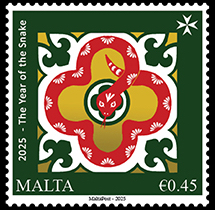
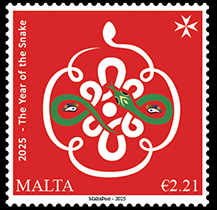
The East Asian lunar calendar consists of a cyclical 12-year pattern, with each year associated with one of the 12 animals from the Chinese zodiac. Originating in the third century BC, this tradition became deeply ingrained in Chinese culture. The sequence of animals in the Chinese zodiac is as follows: rat, ox, tiger, rabbit, dragon, snake, horse, ram, monkey, rooster, dog, and pig. Each animal is believed to possess distinct traits, which are said to influence the personalities of individuals born in that year. The snake is a creature renowned for its sharp wit, calm demeanour, and intelligent nature. The ability to shed their skin, symbolises the process of letting go of the old and embracing the new.
In addition to the 12 animals, each year the Chinese zodiac is also associated with one of the 5 elements – Metal, Wood, Water, Fire, Earth. The Year of the Snake 2025 shall be governed by the Wood element. Wood is typically linked to growth, creativity and a sense of opportunity and new beginning. The Wood Snake is a dynamic combination that blends the snake’s intelligence with the creativity and adaptability of wood. The Year of the Snake is associated with transformation, renewal and spiritual growth. A time for reflection and self-improvement, where one is encouraged to blend the snake’s cunning intellect with the adaptability and growth-oriented nature of wood. People born in this year are likely to be flexible and resourceful, guided by a sense of purpose and innovation, inclined to take bold new steps in their personal and professional lives.
To commemorate the Year of the Snake, which starts on January 29, 2025, MaltaPost shall launch a set of two new stamps, carrying a denomination of 0.45 and 2.21 and designed by Chinese designer Fang Jun and the other by local artist Fabio Agius.