New Issues and stamp news 860
Australia – Australia’s First Olympian: Edwin Flack 1873-1935
Issue date: September 26, 2023
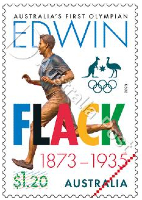
This year we commemorate the 150th anniversary of the birth of Australia’s first Olympian, Edwin Harold Flack (5 November 1873–10 January 1935). Flack was the only Australian athlete to participate in the first Olympic Games of the modern era, held in Athens in 1896, in which he won both the 800 metres and 1500 metres running races, came third in the doubles tennis and competed in the marathon event. Born in London, England, Flack emigrated to Australia with his family in 1874. He attended Melbourne Grammar and was a keen amateur athlete. In 1895, Flack left Australia to work with Price Waterhouse & Co. in London, where he continued his running and decided to compete at the Olympic Games in Athens. On returning to Australia, he joined his father in the accounting firm that became Flack and Flack (now PricewaterhouseCoopers), where he remained until his death, in 1935. Flack’s generous estate was left in trust for charitable purposes in perpetuity. Named for Flack and his sister, the Marian and E.H. Flack Trust was constituted in 1935. It has supported many charities since its inception and continues to do so.
Fiji – Bangladesh 2023 Intl Exhibition
Issue date: September 26, 2023

Åland – My Stamps – Sustainability
Issue date: September 22, 2023


Åland Post highlights the Åland sustainability and environmental work which is coordinated by the barkraft.ax network. Taking the vision of a sustainable, viable and flourishing society as her inspiration, Åland graphic designer and stamp debutante Elin Eriksson has created two personal and hopeful stamps that will be issued as a mini-sheet on 22 September.
The barkraft.ax network was set up in 2016 to coordinate realization and implementation of Åland’s development and sustainability agenda, which is based on the vision “Everyone can flourish in a viable society on the Islands of Peace”. The route to realizing this vision is by means of seven development goals, which include striving for happy people, ecosystems in balance, biological diversity and creating sustainable consumption and production patterns. Åland Post is one of the members of the Bärkraft network.
Graphic designer Elin Eriksson took on the challenge of interpreting the theme on stamps:
“It was tricky to come up with an innovative approach to the theme and not fall back on old clichés relating to future/environment/solidarity, as it’s such a well-worn topic. It just so happened that I was on parental leave with my 1-year-old daughter at the time, so it felt like a natural interpretation of the subject: to think about the next generation and how the world will look to them.
I photographed myself and my daughter in profile, our gazes meeting on the stamps. On the stamp with my profile, a bud can be glimpsed in the background, and the choices I make today will enable that bud to flower in the future. Behind my daughter’s profile the flower can be seen coming into full bloom. I want the stamp design to feel hopeful and to convey a sense of fellowship and warmth,” Elin explains.
Gibraltar – Butterflies of Gibraltar
Issue date: September 22, 2023
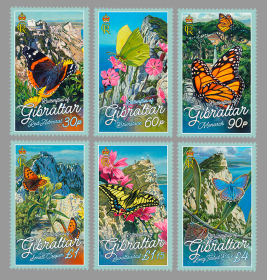
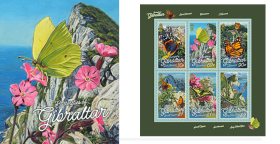
Gibraltar boasts an impressive diversity of butterfly species, with a total of 609 species identified to date. To showcase the natural beauty of Gibraltar and its butterfly population, we have collaborated with renowned UK-based Wildlife Artist, Mr. Jonathan Pointer. His artistic talent and attention to detail are evident in the stunning illustrations depicting the following butterfly species:
• Red Admiral: The Red Admiral butterfly is known for its striking black wings with red bands and white spots. It is a migratory species that can be commonly seen in Gibraltar during the autumn months.
• Brimstone: The Brimstone butterfly is recognised for its vibrant yellow-green wings, which resemble the color of sulfur. It is one of the earliest butterflies to emerge in spring and is often associated with the arrival of warmer weather.
• Monarch: The Monarch butterfly is famous for its orange and black wings, adorned with intricate patterns.
• Small Copper: The Small Copper butterfly features bright orange wings with black spots and borders. It is a small but eye-catching species commonly found in grassy habitats throughout Gibraltar.
• Swallowtail: The Swallowtail butterfly is characterised by its large wingspan and distinctive black and yellow markings. It is considered one of the most majestic butterflies, with a graceful flight and a preference for nectar-rich flowers.
• Long-tailed Blue: The Long-tailed Blue butterfly is a delicate species with pale blue wings and slender tails. It is known for its remarkable ability to migrate long distances and has a particular affinity for coastal areas.
Each stamp features a vibrant illustration of one of these butterflies, accurately capturing their unique characteristics. Additionally, the stamps include a captivating view of the Rock of Gibraltar in the background, symbolising the distinctive landscape and geographical significance of the territory.
Gibraltar – The Coronation of King Charles III
Issue date: September 22, 2023
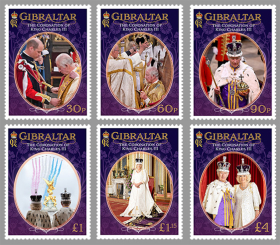
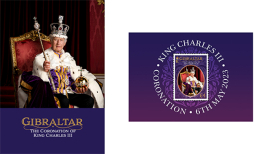
The coronation of King Charles III took place on a momentous day at Westminster Abbey, an iconic venue with a rich history of hosting royal ceremonies.The event was attended by dignitaries, heads of state, and members of the royal family, reminiscent of past coronations that have shaped the course of British history.
As King Charles III emerged in his resplendent regalia, he followed in the footsteps of his predecessors, continuing a tradition that dates back centuries.The coronation procession, a spectacle of grandeur, mirrored the pomp and pageantry witnessed in previous coronations, evoking a sense of continuity and reverence for the monarchy.
At the heart of the ceremony, the Archbishop of Canterbury played a pivotal role. Through the ancient ritual of anointing, King Charles III was symbolically consecrated and granted the divine authority to govern.The crown, a remarkable piece of craftsmanship adorned with precious gems, was then placed upon his head, signifying his ascension to the throne and the continuity of the monarchy.
The congregation, echoing the sentiments of generations past, expressed their elation through applause and acclamation. The pealing of bells resonated throughout the kingdom, heralding the new monarch’s reign. King Charles III, in his inaugural address, acknowledged the weight of history upon his shoulders and pledged to fulfill his duties as a custodian of the nation’s heritage and a unifying figure in a rapidly changing world.
The coronation of King Charles III was a testament to the enduring power and significance of the British monarchy. Rooted in centuries of tradition, the event affirmed the continuity of the institution and its ability to adapt to the demands of the times. As King Charles III assumed his role as the sovereign, he became a part of a living legacy that spans generations, carrying the hopes and aspirations of the United Kingdom into a new chapter of its history.
Australia – Queen Elizabeth II: In Memoriam
Issue date: September 19, 2023
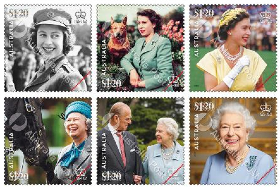

On 8 September 2022, Her Majesty Queen Elizabeth II passed away, aged 96. Born Elizabeth Alexandra Mary on 21 April 1926, Queen Elizabeth reigned as Queen of the United Kingdom and the Commonwealth for 70 years and 214 days, the longest of any British monarch and the longest of any female head of state in recorded history. This issue of six postage stamps honours the life of the late Queen, by showcasing some of the attributes that became hallmarks of her remarkable reign: longevity; a dedication to service, family and the Commonwealth; numerous visits to Australia; and a fondness for dogs and horses.
Ascension Island – Coronation of King Charles III
Issue date: September 7, 2023
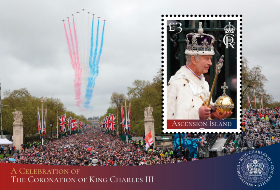
On 6 May 2023, at the age of 73, King Charles III became the oldest monarch to be crowned in British history.
Prince Charles Philip Arthur George was born at Buckingham Palace on 14 November 1948 and became heir apparent (next in line to the throne) at the age of 3 in 1952. He was the first heir to see his mother crowned as Sovereign and went on to become the longest serving Prince of Wales.
He was also the first heir to the throne to earn a university degree. He studied archaeology and anthropology in his first year at the University of Cambridge, switching to history for the remainder of his degree. He also spent a term at the University College of Wales at Aberystwyth (April to June 1969) learning Welsh.
His Majesty obtained his RAF wings as Flight Lieutenant Wales in August 1971 and commanded HMS Bronington in 1976, while serving in the Royal Navy.
As Prince of Wales, His Majesty became President or Patron of over 800 charities and initiatives including more than 20 charities that he established himself. Perhaps the most well-known of these is The Prince’s Trust which he started with his Navy severance pay of just over £7000 in 1976. The charity has now supported over one million young people.
He has been a champion of environmental issues for over 50 years, first speaking publicly about his concerns on pollution and plastics and their impact on the natural world in 1970.
His Majesty is an author and a keen painter; having had a watercolour displayed in the Royal Academy’s 1987 summer exhibition, after it was submitted anonymously. In 1975, His Majesty became a member of the Magic Circle, and has been a keen equestrian throughout his life, playing polo until 2005.
Her Majesty The Queen Consort, Camilla Rosemary Shand, was born on 17 July 1947. The King and The Queen Consort married in a civil ceremony at the Guildhall in Windsor on 9 April 2005. Following her marriage to The King, The Queen Consort has become Patron or President of over 100 charities.
King Charles III succeeded to the Throne on 8 September 2022 upon the death of his mother, Queen Elizabeth II, the longest-reigning British monarch. He was crowned on 6 May 2023 in Westminster Abbey, with The Queen Consort being crowned beside him. Westminster Abbey has been the setting for every Coronation since 1066, when William the Conqueror was crowned on Christmas Day. His Majesty was the 40th Sovereign to be crowned at Westminster Abbey. It was the first time since 1937 that the coronation included the crowning of a Queen Consort.
Whilst the setting for the Coronation has remained unchanged for nearly 1000 years, the form of the Coronation ceremony has varied slightly through the ages. The contemporary form dates from 1902, when King Edward VII was crowned. The main events of the day included a procession from Buckingham Palace (aboard the Diamond Jubilee State Coach) to Westminster Abbey, the Coronation service itself, a procession back to Buckingham Palace, and an appearance by the King and Queen, with other members of the royal family, on the palace balcony for a flypast by the Royal Air Force.
The King was crowned in St Edward’s Chair, made in 1300 for Edward I and used at every Coronation since that time. Equally steeped in history and tradition, the St. Edward’s Crown, made in 1661 for the Coronation of Charles II and used at every coronation since, was placed on the head of The King. It weighs about 2.2kg, and is made of solid gold.
The King and Queen returned to Buckingham Palace in procession aboard The Gold State Coach, an enclosed eight-horse-drawn carriage used by the Royal Family on grand state occasions, such as coronations, royal weddings, and the jubilees of a monarch. It has been used at the coronation of every British monarch since George IV.
Inaugurated by Edward VII and Queen Alexandra in 1902, the finale of Coronation Day has been a balcony appearance from the new monarch and other members of the Royal Family.
‘We now rededicate our lives to serving the people of the United Kingdom, the Realms and Commonwealth.’ A Coronation message from His Majesty The King 8 May, 2023.
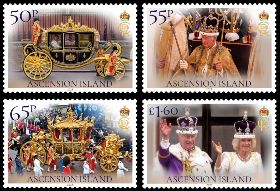
50p King Charles III and Camilla, the Queen Consort, leave Buckingham Palace in the Diamond Jubilee State Coach for their Coronation ceremony. Associated Press / Alamy.
55p King Charles III after being crowned with St Edward’s Crown during his Coronation ceremony in Westminster Abbey. PA Images / Alamy.
65p The King and Queen travel in the Gold State Carriage back to Buckingham Palace after the Coronation. UPI / Alamy.
£1.60 The King and Queen are seen on the balcony of Buckingham Palace following the coronation. glamourstock/Alamy.
£3 S/S King Charles III, wearing the Imperial State Crown, leaves Westminster Abbey following his Coronation ceremony. PA Images / Alamy. The background shows The Red Arrows flying down The Mall and over Buckingham Palace in celebration of the Coronation of King Charles III and Queen Camilla. MB Media Solutions / Alamy.
Bahamas – Coronation of King Charles III
Issue date: September 7, 2023
On 6 May 2023, at the age of 73, King Charles III became the oldest monarch to be crowned in British history.
Prince Charles Philip Arthur George was born at Buckingham Palace on 14 November 1948 and became heir apparent (next in line to the throne) at the age of 3 in 1952. He was the first heir to see his mother crowned as Sovereign and went on to become the longest serving Prince of Wales.
He was also the first heir to the throne to earn a university degree. He studied archaeology and anthropology in his first year at the University of Cambridge, switching to history for the remainder of his degree. He also spent a term at the University College of Wales at Aberystwyth (April to June 1969) learning Welsh.
His Majesty obtained his RAF wings as Flight Lieutenant Wales in August 1971 and commanded HMS Bronington in 1976, while serving in the Royal Navy.
As Prince of Wales, His Majesty became President or Patron of over 800 charities and initiatives including more than 20 charities that he established himself. Perhaps the most well-known of these is The Prince’s Trust which he started with his Navy severance pay of just over £7000 in 1976. The charity has now supported over one million young people.
He has been a champion of environmental issues for over 50 years, first speaking publicly about his concerns on pollution and plastics and their impact on the natural world in 1970.
His Majesty is an author and a keen painter; having had a watercolour displayed in the Royal Academy’s 1987 summer exhibition, after it was submitted anonymously. In 1975, His Majesty became a member of the Magic Circle, and has been a keen equestrian throughout his life, playing polo until 2005.
Her Majesty The Queen Consort, Camilla Rosemary Shand, was born on 17 July 1947. The King and The Queen Consort married in a civil ceremony at the Guildhall in Windsor on 9 April 2005. Following her marriage to The King, The Queen Consort has become Patron or President of over 100 charities.
King Charles III succeeded to the Throne on 8 September 2022 upon the death of his mother, Queen Elizabeth II, the longest-reigning British monarch. He was crowned on 6 May 2023 in Westminster Abbey, with The Queen Consort being crowned beside him. Westminster Abbey has been the setting for every Coronation since 1066, when William the Conqueror was crowned on Christmas Day. His Majesty was the 40th Sovereign to be crowned at Westminster Abbey. It was the first time since 1937 that the coronation included the crowning of a Queen Consort.
Whilst the setting for the Coronation has remained unchanged for nearly 1000 years, the form of the Coronation ceremony has varied slightly through the ages. The contemporary form dates from 1902, when King Edward VII was crowned. The main events of the day included a procession from Buckingham Palace (aboard the Diamond Jubilee State Coach) to Westminster Abbey, the Coronation service itself, a procession back to Buckingham Palace, and an appearance by the King and Queen, with other members of the royal family, on the palace balcony for a flypast by the Royal Air Force.
The King was crowned in St Edward’s Chair, made in 1300 for Edward I and used at every Coronation since that time. Equally steeped in history and tradition, the St. Edward’s Crown, made in 1661 for the Coronation of Charles II and used at every coronation since, was placed on the head of The King. It weighs about 2.2kg, and is made of solid gold.
The King and Queen returned to Buckingham Palace in procession aboard The Gold State Coach, an enclosed eight-horse-drawn carriage used by the Royal Family on grand state occasions, such as coronations, royal weddings, and the jubilees of a monarch. It has been used at the coronation of every British monarch since George IV.
Inaugurated by Edward VII and Queen Alexandra in 1902, the finale of Coronation Day has been a balcony appearance from the new monarch and other members of the Royal Family.
‘We now rededicate our lives to serving the people of the United Kingdom, the Realms and Commonwealth.’ A Coronation message from His Majesty The King 8 May, 2023
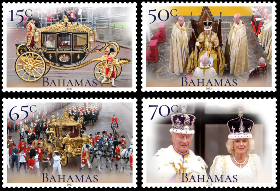
15c King Charles III and Queen Camilla ride in the Diamond Jubilee State Coach from Buckingham Palace to their Coronation ceremony. PA Images/Alamy.
50c King Charles III after being crowned with the St Edward’s Crown during his Coronation ceremony. PA Images/Alamy.
65c The King and Queen travel in the Gold State Coach back to Buckingham Palace after the Coronation. UPI/Alamy.
70c The King and Queen are seen on the balcony of Buckingham Palace following the Coronation. glamourstock/Alamy.
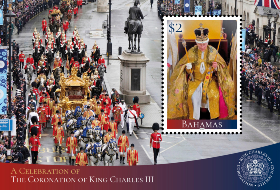
$2 S/S King Charles III receives The St Edward’s Crown during his Coronation ceremony. PA Images/Alamy. The Background shows The King and Queen in the Gold State Coach, as they return along The Mall to Buckingham Palace. Associated Press/Alamy.
South Georgia and the South Sandwich Islands
Coronation of King Charles III
Issue date: September 7, 2023
On 6 May 2023, at the age of 73, King Charles III became the oldest monarch to be crowned in British history.
Prince Charles Philip Arthur George was born at Buckingham Palace on 14 November 1948 and became heir apparent (next in line to the throne) at the age of 3 in 1952. He was the first heir to see his mother crowned as Sovereign and went on to become the longest serving Prince of Wales.
He was also the first heir to the throne to earn a university degree. He studied archaeology and anthropology in his first year at the University of Cambridge, switching to history for the remainder of his degree. He also spent a term at the University College of Wales at Aberystwyth (April to June 1969) learning Welsh.
His Majesty obtained his RAF wings as Flight Lieutenant Wales in August 1971 and commanded HMS Bronington in 1976, while serving in the Royal Navy.
As Prince of Wales, His Majesty became President or Patron of over 800 charities and initiatives including more than 20 charities that he established himself. Perhaps the most well-known of these is The Prince’s Trust which he started with his Navy severance pay of just over £7000 in 1976. The charity has now supported over one million young people.
He has been a champion of environmental issues for over 50 years, first speaking publicly about his concerns on pollution and plastics and their impact on the natural world in 1970.
His Majesty is an author and a keen painter; having had a watercolour displayed in the Royal Academy’s 1987 summer exhibition, after it was submitted anonymously. In 1975, His Majesty became a member of the Magic Circle, and has been a keen equestrian throughout his life, playing polo until 2005.
Her Majesty The Queen Consort, Camilla Rosemary Shand, was born on 17 July 1947. The King and The Queen Consort married in a civil ceremony at the Guildhall in Windsor on 9 April 2005. Following her marriage to The King, The Queen Consort has become Patron or President of over 100 charities.
King Charles III succeeded to the Throne on 8 September 2022 upon the death of his mother, Queen Elizabeth II, the longest-reigning British monarch. He was crowned on 6 May 2023 in Westminster Abbey, with The Queen Consort being crowned beside him. Westminster Abbey has been the setting for every Coronation since 1066, when William the Conqueror was crowned on Christmas Day. His Majesty was the 40th Sovereign to be crowned at Westminster Abbey. It was the first time since 1937 that the coronation included the crowning of a Queen Consort.
Whilst the setting for the Coronation has remained unchanged for nearly 1000 years, the form of the Coronation ceremony has varied slightly through the ages. The contemporary form dates from 1902, when King Edward VII was crowned. The main events of the day included a procession from Buckingham Palace (aboard the Diamond Jubilee State Coach) to Westminster Abbey, the Coronation service itself, a procession back to Buckingham Palace, and an appearance by the King and Queen, with other members of the royal family, on the palace balcony for a flypast by the Royal Air Force.
The King was crowned in St Edward’s Chair, made in 1300 for Edward I and used at every Coronation since that time. Equally steeped in history and tradition, the St. Edward’s Crown, made in 1661 for the Coronation of Charles II and used at every coronation since, was placed on the head of The King. It weighs about 2.2kg, and is made of solid gold.
The King and Queen returned to Buckingham Palace in procession aboard The Gold State Coach, an enclosed eight-horse-drawn carriage used by the Royal Family on grand state occasions, such as coronations, royal weddings, and the jubilees of a monarch. It has been used at the coronation of every British monarch since George IV.
Inaugurated by Edward VII and Queen Alexandra in 1902, the finale of Coronation Day has been a balcony appearance from the new monarch and other members of the Royal Family.
‘We now rededicate our lives to serving the people of the United Kingdom, the Realms and Commonwealth.’ A Coronation message from His Majesty The King 8 May, 2023
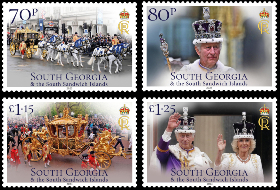
70p King Charles III and Queen Camilla ride in the Diamond Jubilee State Coach past the Palace of Westminster on the way to their Coronation ceremony. Associated Press/Alamy.
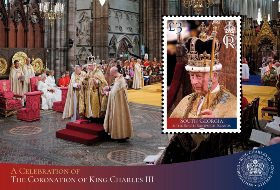
80p King Charles III wearing the Imperial state Crown, carrying the Sovereign’s Orb and Sceptre leaves Westminster Abbey after the Coronation Ceremony. PA Images/Alamy.
£1.15 The King and Queen travel in the Gold State Coach from Westminster Abbey to Buckingham Palace following the Coronation ceremony. Associated Press/Alamy.
£1.25 The King and Queen on the balcony of Buckingham Palace, following the Coronation. PA Images/Alamy.
£3 S/S King Charles III is crowned with St Edward’s Crown during his Coronation ceremony in Westminster Abbey. PA Images/Alamy. The background shows the King, holding The Sovereign’s Sceptre with the Dove (in his left hand) and The Sovereign’s Sceptre with Cross (in his right hand), rising from St Edward’s Chair to receive the Sword of State. PA Images/Alamy.
Tristan da Cunha – Coronation of King Charles III
Issue date: September 7, 2023
On 6 May 2023, at the age of 73, King Charles III became the oldest monarch to be crowned in British history.
Prince Charles Philip Arthur George was born at Buckingham Palace on 14 November 1948 and became heir apparent (next in line to the throne) at the age of 3 in 1952. He was the first heir to see his mother crowned as Sovereign and went on to become the longest serving Prince of Wales.
He was also the first heir to the throne to earn a university degree. He studied archaeology and anthropology in his first year at the University of Cambridge, switching to history for the remainder of his degree. He also spent a term at the University College of Wales at Aberystwyth (April to June 1969) learning Welsh.
His Majesty obtained his RAF wings as Flight Lieutenant Wales in August 1971 and commanded HMS Bronington in 1976, while serving in the Royal Navy.
As Prince of Wales, His Majesty became President or Patron of over 800 charities and initiatives including more than 20 charities that he established himself. Perhaps the most well-known of these is The Prince’s Trust which he started with his Navy severance pay of just over £7000 in 1976. The charity has now supported over one million young people.
He has been a champion of environmental issues for over 50 years, first speaking publicly about his concerns on pollution and plastics and their impact on the natural world in 1970.
His Majesty is an author and a keen painter; having had a watercolour displayed in the Royal Academy’s 1987 summer exhibition, after it was submitted anonymously. In 1975, His Majesty became a member of the Magic Circle, and has been a keen equestrian throughout his life, playing polo until 2005.
Her Majesty The Queen Consort, Camilla Rosemary Shand, was born on 17 July 1947. The King and The Queen Consort married in a civil ceremony at the Guildhall in Windsor on 9 April 2005. Following her marriage to The King, The Queen Consort has become Patron or President of over 100 charities.
King Charles III succeeded to the Throne on 8 September 2022 upon the death of his mother, Queen Elizabeth II, the longest-reigning British monarch. He was crowned on 6 May 2023 in Westminster Abbey, with The Queen Consort being crowned beside him. Westminster Abbey has been the setting for every Coronation since 1066, when William the Conqueror was crowned on Christmas Day. His Majesty was the 40th Sovereign to be crowned at Westminster Abbey. It was the first time since 1937 that the coronation included the crowning of a Queen Consort.
Whilst the setting for the Coronation has remained unchanged for nearly 1000 years, the form of the Coronation ceremony has varied slightly through the ages. The contemporary form dates from 1902, when King Edward VII was crowned. The main events of the day included a procession from Buckingham Palace (aboard the Diamond Jubilee State Coach) to Westminster Abbey, the Coronation service itself, a procession back to Buckingham Palace, and an appearance by the King and Queen, with other members of the royal family, on the palace balcony for a flypast by the Royal Air Force.
The King was crowned in St Edward’s Chair, made in 1300 for Edward I and used at every Coronation since that time. Equally steeped in history and tradition, the St. Edward’s Crown, made in 1661 for the Coronation of Charles II and used at every coronation since, was placed on the head of The King. It weighs about 2.2kg, and is made of solid gold.
The King and Queen returned to Buckingham Palace in procession aboard The Gold State Coach, an enclosed eight-horse-drawn carriage used by the Royal Family on grand state occasions, such as coronations, royal weddings, and the jubilees of a monarch. It has been used at the coronation of every British monarch since George IV.
Inaugurated by Edward VII and Queen Alexandra in 1902, the finale of Coronation Day has been a balcony appearance from the new monarch and other members of the Royal Family.
‘We now rededicate our lives to serving the people of the United Kingdom, the Realms and Commonwealth.’ A Coronation message from His Majesty The King 8 May, 2023
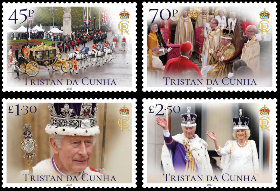
45p King Charles III and Queen Camilla are carried in the Diamond Jubilee State Coach as the King’s Procession passes along The Mall to their Coronation ceremony. PA Images / Alamy.
70p King Charles III is crowned with the St Edward’s Crown and surrounded by faith leaders during his Coronation ceremony in Westminster Abbey. PA Images / Alamy.
£1.30 King Charles III, wearing the Imperial State Crown, leaves Westminster Abbey in central London following his Coronation ceremony. PA Images / Alamy.
£2.50 The King and Queen on the balcony of Buckingham Palace following the Coronation. Abaca Press / Alamy.
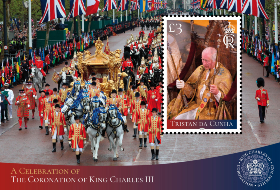
£3 S/S King Charles III holds the Sovereign’s Sceptre with Cross and the Sovereign’s Sceptre with the Dove during his Coronation ceremony. PA Images / Alamy. The background shows the largest military procession since the 1953 Coronation of Queen Elizabeth II, making its way down The Mall towards Buckingham Palace following the Coronation. MB Media Solutions/Alamy.
Finland – Posti´s Art Award 2023
Issue date: September 6, 2023


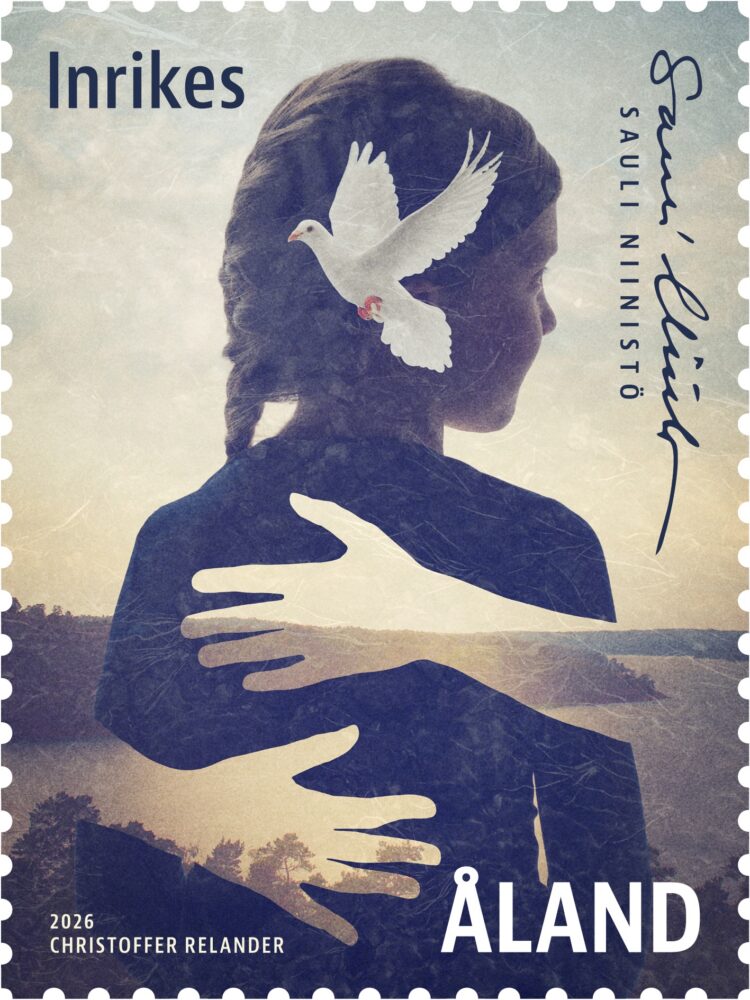
Posti granted the stamp art promotion award for 2023 to Åland-based art photographer Christoffer Relander, who is known in Finland and around the world for his multiple exposure photographs that combine human figures and nature.
Two of Relander’s photographs were selected for the stamps: Perfume and Butterfly Mind II. Both photos are from the series We Are Nature, which Relander started in 2010. “The series still continues today and has become an increasingly personal project over the years. I photographed my own daughter for the new Butterfly stamp,” says Relander.
Relander is fascinated by multiple exposure because it allows photos to be created, not just taken. “Creating a photo is similar to painting and visual design. Training in graphic design provides a good foundation for mastering shapes and silhouettes.”
Nature and forests have been an important part of Relander’s life since childhood. “There is something human about the shapes and patterns of trees, leaves and branches. Deciduous trees and oaks, in particular, are my favorites.”
When photographing people, Relander wants to focus more generally on the human form rather than the individual. “When the people in the photos are anonymous, the viewer has more room for their own interpretation. Identifiable persons would draw too much attention to themselves.”
Presented for the seventh time, this was the first time that Posti’s art award celebrated art photography. With its own art award, Posti wants to raise the status of stamps and art and increase people’s appreciation of them.
Posti’s Art Award 2023 will be issued as a 10-stamp sheet containing two different domestic no-value indicator stamp designs.
Finland – Museums association 100 years
Issue date: September 6, 2023
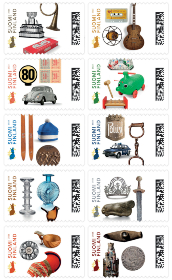
There are more than 1,000 museums in Finland, 151 of which are professionally run. To celebrate the 100th anniversary of the Finnish Museums Association, Posti will issue stamps showcasing 10 different museums and three objects from each of their collections. The stamps present museums from different parts of the country, from Helsinki to Inari.
The museums to receive their own stamps are the Ski Museum, Music Museum Fame, the Automobile and Road Museum Mobilia, Leikki – the Museum of Play, Museum Centre Vapriikki, the Police Museum, Turku Museum Centre, the Finnish Glass Museum, the Sámi Museum Siida and the National Museum of Finland.
“We selected the museums and objects to be included in cooperation with Posti. The stamps showcase significant and otherwise noteworthy gems from the collections of cultural history museums and specialized museums,” says Miisa Pulkkinen, Head of Group Communications at the Finnish Museums Association.
The graphic design of the stamps is by Anssi Kähärä. “The project was challenging due to the multitude of subjects. It was a big puzzle, where the goal was to strike a balance between content and visuality. The clear concept helped me see the big picture at different stages of the design process,” Kähärä says.
The Finnish Museums Association represents, educates and develops the Finnish museum field and helps the museums to succeed. The association is particularly known for its Museum Card service, which has more than 250,000 active users.
“Museums are seeing a boom in visitor numbers after the COVID-19 pandemic. In 2022, museum visits were already close to seven million,” Pulkkinen says.
The Finnish Museums Association 100 Years stamp sheet contains 10 different domestic no-value indicator stamp designs.
Finland – Finnair 100 Years
Issue date: September 6, 2023
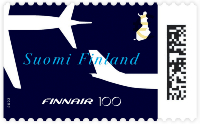
Familiar shades of blue and white on Finnair’s 100th anniversary stamp
Founded in 1923, Finnair is one of the oldest operating airlines in the world. Today, it is a network airline with extensive flight connections to Europe, North America and Asia.
Throughout its history, Finnair has served as a gateway to the world for Finns. “Posti has played an important role in Finnair’s history, as our first flight carried mail from Katajanokka, Helsinki to Tallinn, and we still transport a lot of mail on our flights,” says Päivyt Tallqvist, Senior Vice President, Communications at Finnair.
Finnair’s stamp features beautiful movement and the familiar blue and white color scheme. “The harmonious stamp represents timelessness and simplicity, which Finnair’s brand is also associated with. The stamp is a great addition to our anniversary, which has been visible on our planes, campaigns and social media channels throughout the year,” Tallqvist says.
The 100th anniversary stamp designed by Ilkka Kärkkäinen has a nostalgic touch. “Finnair is one of the icons of Finnishness, and designing an anniversary stamp is a great honor for a graphic designer. I’ve always admired Finnair’s graphic style. Erik Bruun’s posters, in particular, have made a huge impression on me. The Finnair logo designed by Kyösti Varis has also been etched in the mind of every Finn.”
The Finnair 100 Years stamp sheet contains 10 domestic no-value indicator stamps.
Finland – Finland in Nato
Issue date: September 6, 2023

Posti will issue a stamp celebrating Finland’s NATO membership on September 6. Posti turns 385 years old on the publication date.
“The stamp features the color of each NATO country’s flag arranged in colorful stripes, symbolizing the community of NATO countries. Characterized by Scandinavian style, the design of the stamp is simple yet informative and striking,” says Ilkka Kärkkäinen, who designed the stamp.
“The stamp is an image of its time. It can be used to highlight current issues and honor historical milestones. These have been, for example, Finland’s EU membership and the 100th anniversary of Finland’s independence”, says Tommi Kantola, Design Manager at Posti, who is responsible for the selection of the artists and for providing guidance on the artistic work for the stamps.
The design of the NATO stamp started as soon as Finland was accepted as a member in April 2023.
“In this way, we were able to include the stamp in the batch to be issued in September. Stamps are published four times a year”, says Kantola.
Throughout history, each NATO country has issued a stamp of its own accession. Posti will also celebrate Sweden’s NATO membership with a stamp, when the country is accepted as a member. NATO stamps are in demand among collectors worldwide.
The Finland in NATO stamp sheet contains 10 domestic no-value indicator stamps.
Australia – Aussie Big Things
Issue date: September 4, 2023
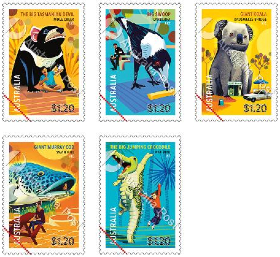
This year, Collecting Month is BIGGER than ever! The range of $1 collectable coins and stamps is all about Aussie Big Things, those larger-than-life landmarks that celebrate our unique vegetation, landscape and wildlife.
From the banana in Coffs Harbour to the jumping crocodile in Adelaide River, there are 10 coins and five stamps to collect. Plus, keep your eyes peeled for our special coloured coin.
Malta – Maltese Festa – Series VII
Issue date: August 31, 2023
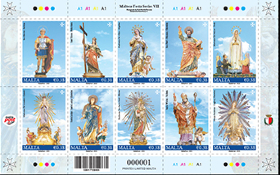
The Maltese love their patron saints and the traditional village festa celebrations held in their honour. Festa season falls during the summer, between May and September. Lots of traditions and customs are associated with these annual events. It all began under the rule of the Knights of St John, specifically during the reign of Grandmaster Emmanuel de Rohan. The key parts of a village festa are religious processions, band marches, traditional sweets, fireworks and the carrying of the patron saint’s statue through the village streets. This stamp issue is the seventh in the serie.
Bahrija – Statue of Saint Martin of Tours, France Birkirkara – Statue of Saint Helen Mqabba – Statue of Our Lady of the Lillies (Madonna Tal -Gilju) Munxar, Gozo – Statue of Saint Paul Shipwrecked Pietà – Statue of Our Lady of Fatima Qrendi – Statue of Our Lady of Lourdes Santa LuGozo – Statue of Santa Lucija Sliema – Statue of Our Lady of the Sacred Heart (Sacro Cuor) Valletta – Statue of Saint Augustine XagGozo – Statue of the Nativity of the Blessed Virgin (Marija Bambina)
Jersey – 100 years of Elizabeth Castle
Issue date: August 22, 2023
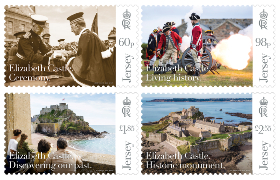
A set of four commemorative stamps, celebrating 100 years of Elizabeth Castle as a historic monument, will be issued by Jersey Post on 22 August 2023.
One of the Island’s most famed landmarks, Jersey’s Elizabeth Castle (Jèrriais*: Lé Châté Lîzabé), was constructed in the 16th century on a tidal islet, near the Parish of St Helier. At the time, the power of the cannon meant the existing castle at Mont Orgueil provided insufficient defence for the Island, and therefore a new stronghold was necessary.
Sir Walter Raleigh, Governor of Jersey between 1600-1603, officially named the castle for Queen Elizabeth I: Fort Isabella Bellissima (The Most Beautiful Elizabeth). Some accounts suggest that he also named the castle after his wife, Elizabeth Raleigh.
Whilst protecting the port of St Helier, the castle also offered safe anchorage for merchant vessels, gave refuge to Charles II in 1645 during the English Civil War, acted as a prison in The Seven Years’ War, became a barracks hospital for British troops in the 19th century, and was re-fortified by German Forces during the Second World War.
2023, marks 100 years since the British Government relinquished Elizabeth Castle to the States of Jersey, for operation as a museum and historic site. A ceremony on 21st May 1923 marked the official transfer, as pictured on the 60p stamp, and the castle has since been cared for by Jersey Heritage as an important monument from the Island’s history.
Today, the castle is host to an enthusiastic group of Jersey Militia re-enactors. These living history actors ‘patrol’ the castle, answer questions about the Island’s military history, and re-enact activities such as firing cannon shot to help create an immersive experience for visitors.
This commemorative issue, entitled 100 years of Elizabeth Castle as a historic monument features photographs, with the first stamp image being from Jersey Archives, and the remaining three stamps featuring contemporary photographs taken by Jersey photographers: Tom Kennedy, Andy Le Gresley, and Marc Le Cornu of BAM Perspectives. It will be available to buy from all branches of Jersey Post from 22 August 2023.
Philatelic stamp products such as first day covers and presentation packs will be available from the Jersey post offices at Broad Street, St Helier and Rue Des Pres, St Saviour and can be ordered now at www.jerseystamps.com or by telephoning the Jersey Philatelic Bureau on: 00 44 (0)1534 616717.
British Antarctic Territory – Coronation of King Charles III
Issue date: August 21, 2023


On 6 May 2023, at the age of 73, King Charles III became the oldest monarch to be crowned in British history.
Prince Charles Philip Arthur George was born at Buckingham Palace on 14 November 1948 and became heir apparent (next in line to the throne) at the age of 3 in 1952. He was the first heir to see his mother crowned as Sovereign and went on to become the longest serving Prince of Wales.
He was also the first heir to the throne to earn a university degree. He studied archaeology and anthropology in his first year at the University of Cambridge, switching to history for the remainder of his degree. He also spent a term at the University College of Wales at Aberystwyth (April to June 1969) learning Welsh.
His Majesty obtained his RAF wings as Flight Lieutenant Wales in August 1971 and commanded HMS Bronington in 1976, while serving in the Royal Navy.
As Prince of Wales, His Majesty became President or Patron of over 800 charities and initiatives including more than 20 charities that he established himself. Perhaps the most well-known of these is The Prince’s Trust which he started with his Navy severance pay of just over £7000 in 1976. The charity has now supported over one million young people.
He has been a champion of environmental issues for over 50 years, first speaking publicly about his concerns on pollution and plastics and their impact on the natural world in 1970.
His Majesty is an author and a keen painter; having had a watercolour displayed in the Royal Academy’s 1987 summer exhibition, after it was submitted anonymously. In 1975, His Majesty became a member of the Magic Circle, and has been a keen equestrian throughout his life, playing polo until 2005.
Her Majesty the Queen Consort, Camilla Rosemary Shand, was born on 17 July 1947. The King and The Queen Consort married in a civil ceremony at the Guildhall in Windsor on 9 April 2005. Following her marriage to The King, The Queen Consort has become Patron or President of over 100 charities.
King Charles III succeeded to the Throne on 8 September 2022 upon the death of his mother, Queen Elizabeth II, the longest-reigning British monarch. He was crowned on 6 May 2023 in Westminster Abbey, with The Queen Consort being crowned beside him. Westminster Abbey has been the setting for every Coronation since 1066, when William the Conqueror was crowned on Christmas Day. His Majesty was the 40th Sovereign to be crowned at Westminster Abbey. It was the first time since 1937 that the coronation included the crowning of a Queen Consort.
Whilst the setting for the Coronation has remained unchanged for nearly 1000 years, the form of the Coronation ceremony has varied slightly through the ages. The contemporary form dates from 1902, when King Edward VII was crowned. The main events of the day included a procession from Buckingham Palace (aboard the Diamond Jubilee State Coach) to Westminster Abbey, the Coronation service itself, a procession back to Buckingham Palace, and an appearance by the King and Queen, with other members of the royal family, on the palace balcony for a flypast by the Royal Air Force.
The King was crowned in St Edward’s Chair, made in 1300 for Edward I and used at every Coronation since that time. Equally steeped in history and tradition, the St. Edward’s Crown, made in 1661 for the Coronation of Charles II and used at every coronation since, was placed on the head of The King. It weighs about 2.2kg, and is made of solid gold.
The King and Queen returned to Buckingham Palace in procession aboard The Gold State Coach, an enclosed eight-horse-drawn carriage used by the Royal Family on grand state occasions, such as coronations, royal weddings, and the jubilees of a monarch. It has been used at the coronation of every British monarch since George IV.
Inaugurated by Edward VII and Queen Alexandra in 1902, the finale of Coronation Day has been a balcony appearance from the new monarch and other members of the Royal Family.
‘We now rededicate our lives to serving the people of the United Kingdom, the Realms and Commonwealth.’ A Coronation message from His Majesty the King 8 May, 2023
74p The Diamond Jubilee State Coach is accompanied by the Sovereign’s Escort of the Household Cavalry in the King’s Procession as it leaves Buckingham Palace for the Coronation ceremony of King Charles III and Queen Camilla. PA Images / Alamy.
80p King Charles III is crowned with St Edward’s Crown during his Coronation ceremony in Westminster Abbey. PA Images / Alamy.
£1.09 The King and Queen are carried in the Gold State Coach, pulled by eight Windsor Greys, in the Coronation Procession as they return along Whitehall to Buckingham Palace, following their Coronation ceremony. PA Images / Alamy.
£1.40 The King and Queen on the balcony of Buckingham Palace following the Coronation of King Charles III and Queen Camilla at Westminster Abbey. PA Images / Alamy.
£3 S/S King Charles III on the balcony of Buckingham Palace following the Coronation. PA Images / Alamy. The background shows King Charles III with the Sword of State during his Coronation ceremony in Westminster Abbey. PA Images / Alamy.
Falkland Islands – Coronation of King Charles III
Issue date: August 21, 2023
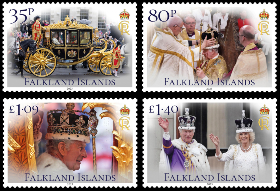
On 6 May 2023, at the age of 73, King Charles III became the oldest monarch to be crowned in British history.
Prince Charles Philip Arthur George was born at Buckingham Palace on 14 November 1948 and became heir apparent (next in line to the throne) at the age of 3 in 1952. He was the first heir to see his mother crowned as Sovereign and went on to become the longest serving Prince of Wales.
He was also the first heir to the throne to earn a university degree. He studied archaeology and anthropology in his first year at the University of Cambridge, switching to history for the remainder of his degree. He also spent a term at the University College of Wales at Aberystwyth (April to June 1969) learning Welsh.
His Majesty obtained his RAF wings as Flight Lieutenant Wales in August 1971 and commanded HMS Bronington in 1976, while serving in the Royal Navy.
As Prince of Wales, His Majesty became President or Patron of over 800 charities and initiatives including more than 20 charities that he established himself. Perhaps the most well-known of these is The Prince’s Trust which he started with his Navy severance pay of just over £7000 in 1976. The charity has now supported over one million young people.
He has been a champion of environmental issues for over 50 years, first speaking publicly about his concerns on pollution and plastics and their impact on the natural world in 1970.
His Majesty is an author and a keen painter; having had a watercolour displayed in the Royal Academy’s 1987 summer exhibition, after it was submitted anonymously. In 1975, His Majesty became a member of the Magic Circle, and has been a keen equestrian throughout his life, playing polo until 2005.
Her Majesty The Queen Consort, Camilla Rosemary Shand, was born on 17 July 1947. The King and The Queen Consort married in a civil ceremony at the Guildhall in Windsor on 9 April 2005. Following her marriage to The King, The Queen Consort has become Patron or President of over 100 charities.
King Charles III succeeded to the Throne on 8 September 2022 upon the death of his mother, Queen Elizabeth II, the longest-reigning British monarch. He was crowned on 6 May 2023 in Westminster Abbey, with The Queen Consort being crowned beside him. Westminster Abbey has been the setting for every Coronation since 1066, when William the Conqueror was crowned on Christmas Day. His Majesty was the 40th Sovereign to be crowned at Westminster Abbey. It was the first time since 1937 that the coronation included the crowning of a Queen Consort.
Whilst the setting for the Coronation has remained unchanged for nearly 1000 years, the form of the Coronation ceremony has varied slightly through the ages. The contemporary form dates from 1902, when King Edward VII was crowned. The main events of the day included a procession from Buckingham Palace (aboard the Diamond Jubilee State Coach) to Westminster Abbey, the Coronation service itself, a procession back to Buckingham Palace, and an appearance by the King and Queen, with other members of the royal family, on the palace balcony for a flypast by the Royal Air Force.
The King was crowned in St Edward’s Chair, made in 1300 for Edward I and used at every Coronation since that time. Equally steeped in history and tradition, the St. Edward’s Crown, made in 1661 for the Coronation of Charles II and used at every coronation since, was placed on the head of The King. It weighs about 2.2kg, and is made of solid gold.
The King and Queen returned to Buckingham Palace in procession aboard The Gold State Coach, an enclosed eight-horse-drawn carriage used by the Royal Family on grand state occasions, such as coronations, royal weddings, and the jubilees of a monarch. It has been used at the coronation of every British monarch since George IV.
Inaugurated by Edward VII and Queen Alexandra in 1902, the finale of Coronation Day has been a balcony appearance from the new monarch and other members of the Royal Family.
‘We now rededicate our lives to serving the people of the United Kingdom, the Realms and Commonwealth.’ A Coronation message from His Majesty The King 8 May, 2023
35p King Charles III and Queen Camilla ride in the Diamond Jubilee State Coach from Buckingham Palace to their Coronation ceremony. SOPA Images Limited/Alamy.
80p King Charles III is crowned with the St Edward’s Crown during his Coronation ceremony in Westminster Abbey. PA Images/Alamy.
£1.09 The King and Queen travel in the Gold State Coach back to Buckingham Palace after the Coronation. PA Images/Alamy.
£1.40 The King and Queen are seen on the balcony of Buckingham Palace following the Coronation. PA Images/Alamy.
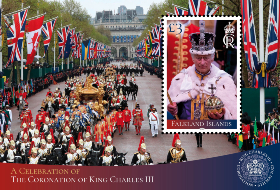
£3 S/S King Charles III departs Westminster after the Coronation ceremony. Jeff Gilbert/Alamy. The background shows the largest military procession since the 1953 Coronation of Queen Elizabeth II making its way down The Mall back towards Buckingham Palace following the Coronation. MB Media Solutions/Alamy.
Malta – Francesco Zahra 1710 – 1773, 250th Anniversary
Issue date: August 15, 2023
Francesco Zahra was Malta’s foremost native painter of the mid-18th century and his style wonderfully captured the spirit of the Late Baroque period.
Zahra was born in Senglea, the son of Pietro Paolo Zahra and Augustina Casanova, and was baptised at the Senglea Parish Church on 15 December 1710. His artistic education began at an early age within his own household. His father, who was one of the most sought-after stone carvers of the time, was his first mentor and employer. While refining his skills as ‘scalpellino’ in his father’s ‘casa bottega’, the young Zahra soon discovered that painting was his life’s passion. Gian Nicola Buhagiar (1698-1752), a very close friend of the Zahra family, and a renowned artist of religious paintings, became Francesco’s art teacher. Zahra lived and worked in his home town of Senglea until his marriage to Teresa Fenech on 26th February 1743 when he then moved permanently to the Knights’ City of Valletta. In the 1740s, his personal style began to mature and develop until he outgrew his tutor Buhagiar. By the mid-1750s, his figures and the atmosphere of his paintings had changed, showing influences from the art scene in Naples, including those of art masters Caravaggio and Mattia Preti.
Francesco Zahra produced a wide range of works including many religious paintings, devotional works of art for altarpieces and church domes, designs for church furniture, silver artefacts, marble floor designs and other objets d’art that still survive scattered in various local churches as well as in private collections and museums. Zahra’s ceiling paintings in the Chapter Hall of the Mdina Cathedral, completed in 1756, are among his most notable creations.
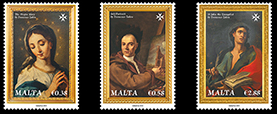
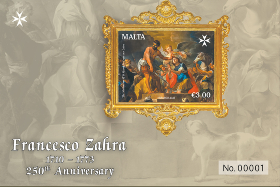
Francesco died on 19 August 1773 at the age of 62. He was buried at the Church of St. Paul’s Shipwreck, Valletta. To commemorate the 250th anniversary of his death, MaltaPost is issuing 3 stamps and a miniature sheet portraying four of his oil paintings. The 0.38 stamp shows a splendid painting of The Virgin Mary while the stamp denomination of 0.58 depicts the only known self-portrait by Zahra. With palette in his left-hand and brush in his gracefully poised right-hand, the painting shows Zahra in his mid-40s at the peak of his artistic career. The 3rd stamp, carrying a denomination of 2.88, shows St. John the Evangelist while the miniature sheet, with a denomination of 3, contains a 4th stamp, depicting the Martyrdom of St. George, a sizeable painting found at St. George’s Basilica in Victoria, Gozo.
Australia – Aussie Bird Count
Issue date: August 15, 2023
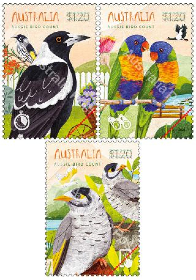

BirdLife Australia has been at the heart of bird conservation for more than a century. One of its most popular initiatives is its annual bird count, a citizen science activity that takes place across the country during National Bird Week, each October, and engages a broad range of bird enthusiasts – newcomers and consummate twitchers alike. This growing army of bird devotees collects crucial data on species diversity and distribution, information that BirdLife Australia then uses to monitor distribution trends and to ascertain which species are thriving and which are not.
In 2022, nearly four million birds were counted by citizen scientists through the submission of 124,430 checklists. The three species whose numbers reigned supreme at the national level were the Rainbow Lorikeet, Noisy Miner and Australian Magpie. To participate, citizen scientists require only a sharp pair of eyes and access to the Aussie Bird Count app (downloadable onto smartphones) or the website (aussiebirdcount.org.au), which includes a handy bird-identification guide. Participants simply observe the bird species evident around them at a single spot for a period of 20 minutes, noting not only what birds they observe but also the number of individuals of that species that they see. In 2023, Aussie Bird Count marks its 10th annual snapshot. Citizen scientists will be counting during 16–22 October 2023.
$1.20 Australian Magpie Heavy-set and powerful, the Australian Magpie (Gymnorhina tibicen) is an imposing black-and-white butcherbird of around 37–44 centimetres in length. Its piercing red-brown eyes and sizable pointed beak combined with its fast flight and noisy wingbeats make for an intimidating presence, and it has something of a reputation for swooping during breeding season. While the Australian Magpie might be a daunting bird, it is, however, also undeniably curious and highly intelligent, and its superb song is rich and melodious.
The Australian Magpie lives in complex social structures and is extremely territorial. It is widespread across the country, being common in city suburbs, townships, farmlands and bushland – wherever trees occur in combination with open areas.
$1.20 Rainbow Lorikeet The Rainbow Lorikeet (Trichoglossus moluccanus) is a bright, bold and brassy character, around 26–31 centimetres in length. With plumage coloured green, blue, yellow and orange, this conspicuous and gregarious species occurs in flocks of noisy, screeching individuals, which can be seen darting and wheeling through the canopy of trees, when they are not hanging upside-down feeding on flower nectar.
The Rainbow Lorikeet is evident in treed areas throughout eastern Australia. It also occurs around Perth, where it is known for its aggressive behaviour in commandeering nesting hollows from competitors.
$1.20 Noisy Miner The Noisy Miner (Manorina melanocephala) might be relatively small at 25–28 centimetres, but what it lacks in size it makes up for in front; this bold bird becomes very vocal when warning loudly of dangers and it will even noisily swoop pets to chase them away. The Noisy Miner has plumage that is largely grey, and a deep-yellow beak and eye-skin area. It is native to Australia and belongs to the honeyeater family, though it is often assumed to be related to the introduced Common Myna.
Usually occurring in colonies, this communal and family-oriented bird is territorial and aggressive with other bird species. While it is not uncommon in urban parkland, its preferred habitat is open woodlands and grassy forest areas right down the eastern seaboard.
Australian Antarctic Territory (AAT) – Antarctic Circumnavigation: 250 Years
Issue date: August 15, 2023
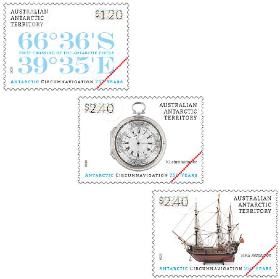
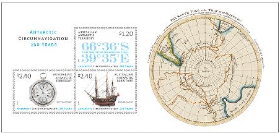
British navigator and maritime explorer James Cook made three voyages to the Pacific in the latter part of the 18th century. This stamp issue concerns his second voyage (1772–75) to the Pacific, during which he circumnavigated the uncharted Antarctic continent.
The second scientific voyage was made with the vessels HMS Resolution and HMS Adventure, the latter captained by Tobias Furneaux. The primary objective of the expedition was to investigate the proposed existence of a great southern land. Through two sweeps of the South Pacific and circumnavigation of Antarctica during this second voyage, Cook would dispel the long-held idea that terra Australis incognita, an unknown southern land, lay in the temperate waters of the globe’s south – a great land mass that would balance the globe’s north.
On setting sail from Plymouth, England, on 13 July 1772, the expedition first saw floating ice on 10 December 1772, and within days encountered a vast sheet of ice that made progress dangerous and slow in the freezing conditions. Warmer days in mid-January allowed the ships to move farther south and, on 17 January 1773, Cook recorded the first crossing of the Antarctic Circle.
Soon after, the ships sailed north-east towards New Zealand, where they set anchor and reprovisioned, spending the winter months exploring the South Pacific before returning to New Zealand.
In mid-December 1773, alone the Resolution headed again into Antarctic waters encountering the same inhospitable, freezing conditions and threatening icebergs. The ship crossed the circle for the second time, on 21 December 1773, and again on 26 January 1774. Four days later, on 30 January, they reached as far south as they could. As historical records go, it was as far south as anyone had sailed at the time. The record held for nearly five decades, with Thaddaeus Bellingshausen’s expedition recognised as the first to see mainland Antarctica, in 1820.
$1.20 First Crossing of the Antarctic Circle During Cook’s second voyage to Antarctica, he crossed the Antarctic Circle a total of three times. The first of these was on 17 January 1773, making his expedition the first known to have crossed the circle. The stamp design shows the latitude (66°, 36’, 30” S) and longitude (39°, 35’ E) of this crossing.
His second crossing occurred on 21 December 1773, and his third and final crossing occurred a month later, on 26 January 1774.
$2.40 K1 chronometer Cook took the K1 chronometer on his second and third voyages. The timekeeper was commissioned by the Board of Longitude and made by watchmaker Larcum Kendall and John Arnold, after John Harrison’s H4 model. The scientific instrument was designed to keep accurate time at sea, making it possible to calculate longitude more easily than the previous method of using lunar distances. The Board of Longitude appointed astronomers William Wales and William Bayly to look after the K1.
Photo: © National Maritime Museum, Greenwich, London
$2.40 HMS Resolution model Little is known of this model, held in the collection of the Powerhouse, Sydney, though it is thought to have been made around 1925. The significance of the model lies with the event with which its subject is associated. James Cook captained the HMS Resolution on his second voyage to the Pacific, during which he made his Antarctic circumnavigation. The vessel was originally a Whitby collier named Marquis of Granby, but the Admiralty converted it into a three-masted sloop-of-war and renamed it HMS Resolution.
Photo: Powerhouse collection, Belinda Christie
Faroe Islands – Sepac 2023
Issue date: August 11, 2023
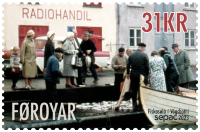
Traditional trade markets are the theme of this year’s SEPAC issue.
In an island and mountain landscape with rushing ocean currents such as the Faroe Islands, it was formerly only possible to travel by sea or on foot. These conditions and the small population gave no leeway for local markets, as commonly seen on the European mainland. In the Faroe Islands, it was vitally important to keep as much food as possible in the “hjallur”, the Faroese variant of a pantry. The farms produced their own foodstuffs, mainly products of sheep, cattle, sea birds, pilot whales and fish. The food was fermented and dried. In practice, these products only included food, down and woollen goods.
Opportunities for hunting birds and pilot whales varied between settlements, but according to special rules since ancient times, everyone was entitled to a portion of both meat and blubber from pilot whales. All the settlements engaged in sheep and cattle farming. Those who had plentiful access to birds and down could, through personal connections, engage in barter for goods that were more plentiful in other settlements. No market was required for such exchange, but the situation was somewhat different in the capital, Tórshavn.
The Monopoly Trade in Tórshavn, the Faroe Islands’ only trading place in earlier times that ended in 1856, is the sole enterprise that can be compared to a traditional market. Islanders travelled to Tórshavn on business trips a few times a year, most often in connection with St Olaf’s Day, the Faroese National Day. They did their shopping for a few days and participated in the festivities held in the capital on July 29. The Løgting, the parliament of the Faroe Islands, went into session, and the clergy from the islands convened for Mass. This market-like phenomenon continued after free trade had been established. Gradually, St Olaf’s Day became a public holiday with sporting events and cultural activities. Sale stalls and dispensing outlets of various kinds also characterize this festival, and the centre of Tórshavn buzzes with colourful events and crowds of people.
In the past, the population of Tórshavn was mainly made up of landless poor people earning wages by manual labour. But it was also inhabited by better-off citizens and civil servants. Tórshavn was in need of products from the settlements. Thus, an annual event occurred in autumn when some settlements brought live steers from far-away islands to the merchants in Tórshavn. They had the steers slaughtered and sold the meat to the population. It was also common for boats from settlements in the strait between Streymoy and Eysturoy to arrive with blue mussels, which were sold in Tórshavn. When whaling ships in the Faroes started catching large whales around the turn of the 20th century, boats were commonly sent from the whaling stations with whale meat for sale, not only in Tórshavn but also in other settlements. This was in line with the fact that people in Tórshavn used to buy fish directly from fishing boats arriving from fishing grounds. This tradition has been preserved in Tórshavn. In the very busy port area of Vágsbotnur, Tórshavn Municipality has set up a small roofed-over marketplace where you can buy fish and fish products, and also, on special days, locally grown vegetables and other home-made products of various kinds.
Also, in summer, annual salmon and sales market has been organized for the last ten years in the town of Runavík, where you can taste various salmon products for free from, among others, the local salmon producer Bakkafrost. On these market days, you can also buy products from the local home industry, and several cultural events are also held on market days.
Since ancient times, goods have been exchanged on a more personal level, also between the settlements. Today, you will still find households that buy sheep or mutton yearly from the same farmer as they have always done, without any form of barter.
In other countries, people go to the market not only to buy goods but also to establish and maintain connections with other people. In the Faroe Islands, this happened in the annually recurring dancing trips, when people visited each other, usually bringing gifts of food to the host.
Faroe Islands – The Huginn Mission
Issue date: August 11, 2023
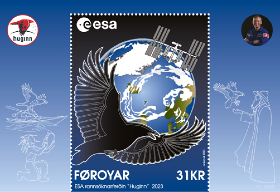
In 2023, Danish ESA astronaut Andreas Mogensen will go on his new mission to the International Space Station, ISS.
The mission has been named Huginn, named after one of Odin’s ravens, and in connection with the mission, Posta Faroe Islands and Tusass Greenland are publishing a joint stamp issue in cooperation with ESA – European Space Agency.
Andreas will go on his first long-term mission to the International Space Station in late summer 2023, where he will spend half a year on board. Here he will carry out a large collection of scientific experiments, including 10 experiments from Denmark, ranging from virtual reality and sleep to climate science.
When Posta was contacted by the University of Århus in Denmark, we were not asked to illustrate the exact purpose of the mission. Instead, we were asked if we could deliver an illustration of ravens, and Huginn in particular. We offered to make a stamp, based on the mission’s title – Odin’s mythical raven Huginn – and how it works as a symbol of science – the gathering of scientific information.
Huginn Huginn and Munin Fly every day Over the grounds of the Earth. I fear that Huginn Might not return But am yet more worried about Munin.
This is how Odin refers to his two ravens in the Old Norse Edda-lay ”Grimnirsmál.” In Norse mythology, Odin is the main deity, the god of the sky, wisdom, and the art of poetry – ruler of the divine sphere, which includes the world of the gods, Asgard, as well as Midgard, the world of men.
Chaos vs. Cosmos Old Norse mythology describes a constant alternation between Chaos and Cosmos. Cosmos, the organized world, where gods and men rule and live, stands in contrast to Chaos, the unorganized world, which actually consists of the same components, just in chaotic disarray – and where ”giants” and other creatures of chaos have free rein. Chaos is represented by the borderlands ”Udgard”, whose inhabitants are most often anthropomorphic descriptions of the untameable forces of nature (the wild sea, wind, fire, volcanoes, etc.) as well as the things that lie beyond the control and knowledge of gods and humans.
Odin – the science Huginn – the scientific exploration Odin is the wisest of all gods. He constantly keeps informed about the state of the universe – and searches and explores the unknown. In his continuous quest of knowledge, he uses, among other things, his two ravens, Huginn and Munin. ”Huginn” means ”thought/the one who thinks” – the ability to think and observe – while ”Munin” means ”memory/the one who remembers” – the ability to remember and experience. (Here I must add that ”hugur”, in Faroese and Icelandic, still means thought/thinking. We even have a term: ”hugflog” – the flight of thought, about thinking/imagining).
Every day Huginn and Munin fly over the lands and grounds of the Earth – and when they return home to Odin in the evening, they sit at his throne and tell what they have seen, heard and experienced. Based on the ravens’ information, Odin draws his conclusions and increases his knowledge of the Nordic universe and its state.
The name ”Huginn” for a scientific space expedition is particularly well chosen. In that context, you can see Odin as a symbol for science itself – and Huginn as an asset for increased knowledge. The expedition collects scientific results, which are passed on to science, which processes them based on existing knowledge and experience.
The astronaut is Odin’s raven – and Odin himself, his employer, the science.
The Shaman – the Angakok Greenland is a physical part of the Nordic countries. Culturally and linguistically, however, the Greenlanders do not belong to the Norse sphere, but rather to the Inuit cultural circle, which includes Greenland, Canada, Alaska and, in part, Arctic Russia. It therefore goes without saying that the Norse Huginn is not found in Greenlandic culture.
There is however a rather special common feature, shared by the Inuit culture and the old Norse culture – shamanism. When Odin sends Huginn and Munin out into the different worlds of the Norse universe, he appears as the shaman, who, via his animistic helper spirits, obtains information about the state of things. In the Inuit cultures, the angakok, the shaman, also uses his helper spirits to retrieve information about the big world outside the settlement.
At the beginning of the last century, the Danish ethnologist and linguist, William Thalbitzer, wrote down a traditional poem in Eastern Greenland, which describes a kind of ritual conversation between the angakok Akvkos and his helper spirit Qaartuluk, ”the raven.” In the poem, Qaartuluk has exactly the same function as Huginn, it flies out into the chaotic universe and refers what it sees and experiences to the angakok, at home in the settlement.
The line drawing on the left side of the stamp sheet, depicts the scene where the Greenlandic angakok communicates with the raven spirit Qaartukuk – while the illustration on the right side of the sheet depicts Odin in the process of receiving Huginn, at home in Asgård. Notice that both ravens have an ornamental eye on their body, which symbolizes that they are the ”eye of the shaman” – and not ordinary ravens.
The large raven on the stamp has neutrall ornamentation, so that it can represent both the Norse and the Inuit cultural circles.
We don’t have any astronauts in the Faroe Islands and Greenland, but plenty of ravens – and stories about the mythical bird. The stamp is a greeting to our astronaut from the two other nations in the Danish Commonwealth. We are proud of Andreas Mogensen and wish him a good journey to space and good luck with his project!
Faroe Islands – Stamp no. 1000 – Martin Mörck
Issue date: August 11, 2023
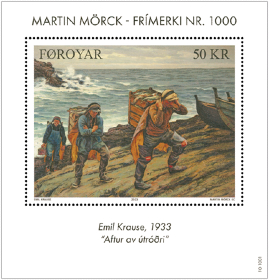

Martin Mörck, the most productive living stamp designer and engraver in the world today, will celebrate the issuance of his 1,000th stamp commission on August 11th in Cleveland, Ohio, USA. This stamp will be issued by Posta Faroe Islands.
As of that date, Mörck’s 1,000 different designs and/or engravings will have appeared on 1,152 stamps issued by 28 postal administrations around the world. 48 of these Mörck productions will have been issued by the Faroe Islands: forty of them as ordinary stamps while eight of them as franking labels (vending machine stamps).
Speaking of the total stamp count, I would like to highlight one important difference in terms of how Posta and Mörck count their stamps. Posta does not include the franking labels in their total stamp count while Mörck does. Posta classifies franking labels in a separate category from ordinary stamps although both of them are used for the purpose of postage. Mörck as an artist includes every piece of paper used for postage, bearing his artwork, in the total count of his stamps.
As a passionate collector of Mörck’s works, I always had a keen interest in playing a role in conceptualization and development of his 1,000th stamp. Knowing Martin’s genuine love for the Faroe Islands (see my Posta Stamps No. 51 article) and my own adoration of the Faroes, it has all along been my dream to have the Mörck Stamp No. 1000 to be issued by the Faroe Islands.
In July 2021, I made my initial concept proposal for Mörck’s 1,000th stamp to Svanbjørg Manai who was the Head of Posta Stamps at the time. My proposal was well-received. We had intermittent discussions on this topic along the way, but did not finalize it as a project until February 2022 when I met Svanbjørg, Ingun Olsen, the new Head of Posta Stamps, and Martin at the London 2022 International Stamp Exhibition. After our detailed discussions in London, we agreed that the stamp motif should be related to the sea, as Martin is a seafaring person, reflect the cultural identity of the Faroe Islands, and include the Faroese landscape. Our preference was using a Faroese painting if we could find one that matches the agreed criteria. Besides having an interest in this special milestone issue, it was also my aspiration for some time that Mörck’s 1,000th stamp should be the largest ever-known hand-engraved stamp. So, I expressed this desire of mine during our discussions. In the end, we agreed on this goal as well.
For the next step, Svanbjørg started searching through the Faroese artwork collections and identified a few paintings, but we could not decide on any of them. One day, Svanbjørg told me that she came across one painting that she liked very much when visiting Edward Fuglø, a well-known Faroese artist. It was the 1933 Emil Krause painting titled “Returning from fishing” hanging on the dining room wall of Edward’s house. The motif of the painting was matching our initial agreed criteria. Afterwards, we shared the image of this painting with Martin who also liked it and decided to engrave it for his 1,000th stamp.
Once the motif was chosen, I started working on the layout design of Mörck stamp No. 1,000 and its minisheet together with Durita Jacobsen from Posta. Until this day, the largest ever known hand-engraved stamp belongs to Czeslaw Slania, the legendary Polish engraver. That one is Slania’s 1,000th stamp issued by Post Sweden in 2000. For this stamp, he engraved a fragment of a Baroque style ceiling fresco from the royal summer residence at Drottningholm Palace near Stockholm. The dimensions of that stamp motif inside the perforated area is 75 x 55 mm. It was our goal to set a new record and thus defined the engraved area size of the Mörck stamp No. 1,000 as 82 x 62 mm.
In August 2022, I visited Fuglø at his house in Klaksvík and saw the original Krause painting to be engraved by Martin with my own eyes. It was totally a different experience for me seeing the actual painting. My initial reaction was “Wow”! It is a beautiful oil canvas painting sized 128 x 98 cm. The painting depicts three tired Faroese fishermen, returning from fishing, carrying their catch in a wooden crate on their back on the rugged shores of Viðareiði while enjoying smoking a pipe. The actual location of the painting motif can be found on the right side of Rt. 70 near Viðareiði boat ramp after exiting the Viðareiði Tunnel driving into the town. Edward told me that he acquired this painting because his grandfather was a fisherman from Viðareiði. He sees his grandfather whenever he looks at this painting.
Danish painter Emil A. Krause (1871-1945) visited the Faroe Islands twice in the early twentieth century. During his visits, he did a number of paintings depicting the Faroese life and landscape. He was extremely good at characterizing people, and the environment they lived in, in his beautiful paintings that became important to our understanding of the Faroese society in those years.
Besides engraving the stamp, Martin also designed and illustrated the cachet and cancellation of the FDC. The cachet depicts a profile of Mörck while engraving his 1,000th stamp. The location of the first day cancellation will be Klaksvík where the original painting is located.
This August, history will be written at the Great American Stamp Show (GASS) in Cleveland on multiple fronts. Mörck will be the second stamp artist ever reaching the 1,000th milestone after Slania. At the same time, Mörck will be the engraver who engraved the largest ever known stamp while Posta Faroe Islands will be the postal administration issuing the largest ever known hand-engraved stamp. Let’s not miss witnessing history. See you all in Cleveland!
Faroe Islands – Stamp no. 1000 – The Cairn
Issue date: August 10, 2023
The postage stamp is the mirror of a nation. It is a small glimpse into the soul of the country, its appearance, history, flora, fauna, life and manners.
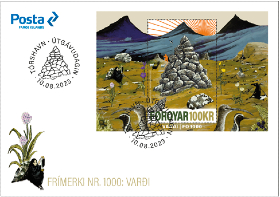
On 10 August 2023, Posta Faroe Islands issues stamp No. 1000 at the Great American Stamp Show (GASS) 2023 in Cleveland, Ohio, USA. This is truly a cause for celebration.
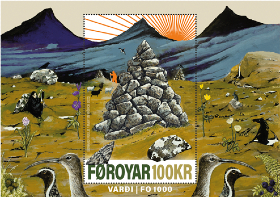
The renowned Faroese artist Edward Fuglø designed and illustrated the beautiful miniature sheet with a cairn motif in its center. Edward Fuglø has designed many Faroese stamps over the years, and he became our first choice for designing our stamp No. 1000.
The miniature sheet depicts a cairn in the outback on a summer evening. A summer atmosphere surrounds the cairn with seasonal plants, birds and animal life. Supernatural beings, fairies and water kelpies are also part of the picture. As mentioned below, a cairn can have different symbolic meanings – it can serve both as a signpost and a fixed point. Stamp No. 1000 can be seen as a memento of Posta’s numerous printings since 1975 when the first Faroese stamps were issued.
The stamp is a small culture bearer that reaches far beyond national frontiers, right into the remotest corners of the globe. On a small piece of paper, just a few centimetres across, it is possible to tell the history of many and sundry, and this has always been the aim with Faroese postage stamps.
The renowned Norwegian-Swedish artist and engraver Martin Mörck engraved the cairn and butterfly motifs which are printed in a combination of intaglio and offset. Furthermore, some special varnish effects have been added such as sand, soft-touch and neon orange.
The Cairn The cairn is a cone-shaped landmark or sun marker, made up of a mound of rough stones piled up by human hands. Since ancient times, cairns have been found all over the Nordic region as signposts and landmarks. The town name Varde in Denmark is indeed derived from this landmark.
In the Faroe Islands, cairns are always connected to the old village paths. It is ”gonguvarðar”, cairns serving as guideposts. Some cairns also mark the world corners of a settlement, such as Vesturvarði (West Cairn), Norðurvarði (North Cairn) and Suðurvarði (South Cairn) or cairns scoring the position of the sun. They are found in place names such as Middagavarði (Midday Cairn) or Nónvarði (nón = 3 p.m.). Cairns, in their monumental form, thus serve both as signposts and fixed points. Kongavarðarnir (King’s Cairns), which today refer to the neighbourhood building Undir Kongavarða close to Tórshavn, were built in 1907, on the occasion of King Frederik the 8th’s visit to the Faroe Islands.
From ancient times, the Faroe Islands have been a rural community where the settlement itself is surrounded by the infield (Faroese: bøur). Outside the settlement, separated by stone fences, lies the outfield (Faroese: hagi). Ordinarily, people stayed within the fence between the outfield and the infield. If you went outside, you had some particular purpose in mind. It was frowned upon, and even forbidden, for unauthorized persons to enter the outfield. However, shepherds and bird catchers were allowed to make their way to the mountains to catch birds. Exceptions were also made for people bringing peat from the peat stores in the outback, and in the summer, and, of course, for milkmaids who went out to milk the free-ranging cows. They did not want the sheep to be disturbed. If you went into outfield without a purpose, you might be suspected of being a sheep thief. If a sheep thief was caught, the punishment was severe. Meeting them could be dangerous, and lonely hikers walking their legal paths would avoid that.
The cairns marked the legal paths from one settlement to the other. On these paths one could feel reasonably safe from sheep thieves and supernatural beings. Hog errands could lead to you meeting the hidden people, e.g., the nymph sitting outside her mound spinning and wishing for a man to approach. If a man joined her, he was offered a drink of nectar, a magical potion. If he forgot to blow off the foam, she attacked him. The water kelpie, a supernatural creature, lived in lakes and larger streams. The kelpie could transform into a cute dog or a beautiful horse, trying to lure children and adults to its lake. If they touched it, the kelpie caught them by its tail and dragged them into the lake’s depths.
The outfield was thus a dangerous area, where you preferably only went in daylight, but something might prevent your departure, and then leave too late. Everything became more sinister in the dusk and the darkness, and supernatural forces approached the wayfarer. The light of the moon could also show eerie formations in the landscape. Even in daylight, one was not out of danger. The fog could become so dense that you couldn’t even see your hands, so the only trail available was the old, well-trodden path. There are stories of milkmaids who lost their way in the fog and strayed right into the abyss. It could even get worse in the cold and snow of winter, and then the best advice was to stick to the cairn you had reached without sitting down to rest. There are stories of men who kept awake by dismantling and rebuilding a cairn. They did this even several times to stay awake and keep warm. If they sat down, they fell into a deadly sleep.
Thus, the cairns showed the right way and became invaluable guides for people in the dangerous outback days of old. It was not until modern times, with a different perception of nature and wanting to experience nature, that people created problems for themselves when walking in the countryside.
The cairn has gained importance as a monumental symbol in Faroese history, but also as a fixed point in people’s lives and as a symbol of prominent people. The first Faroese literary society, which since 1921 has published the literary magazine Varðin (The Cairn), implying a variety of meanings. It is also no coincidence that one of the largest business and shipping companies in the Faroe Islands, established in the settlement of Gøta in 1985, took the time-honoured and symbolic name, Varðin.
Tristan da Cunha – Penguins
Issue date: August 9, 2023
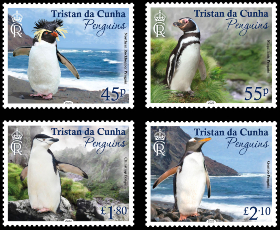
Not many realise that the UK is one of the world’s top penguin nations. In some of the UK Overseas Territories in the Southern Hemisphere the shores are awash with waddling, tobogganing, and diving penguins – seven out of 18 penguin species are found in the Falklands, South Georgia & the South Sandwich Islands and Tristan da Cunha in the South Atlantic Ocean.
On Tristan, however, king, gentoo, macaroni, chinstrap and Magellanic penguins are only rare visitors to the archipelago that is home to 90 percent of the global population of northern rockhoppers.
45p Northern Rockhopper Penguins (Eudyptes moseleyi) are known by Islanders as Pinnamins. They are the most northern-breeding of the Eudyptes (crested) penguin species and occur in the temperate South Atlantic and southern Indian oceans, breeding on just seven islands between 37 – 40° S, five in the Tristan da Cunha group in the South Atlantic.
Owing to the species’ restricted breeding range, a decline of 90-99 percent in the global population since the 19th century, and vulnerability to ever increasing land and sea-based threats such as changes in the marine environment, diseases, and oil pollution, rapidly growing seal populations, the northern rockhopper penguin has continued to be classified as Endangered by BirdLife International since 2008.
Northern rockhoppers like the shelter and protection of Spartina tussock grass as their breeding habitat which forms the rookeries on Nightingale, Inaccessible, and Middle islands. However, on Tristan itself and Gough Island, rookeries are found on the rocky shore, in gulches or under cliffs. Here penguins and their young are exposed to the elements, including wind and rain, and their nests are at higher risk of failing or being lost when the normally dry gulches flood after heavy rainfall.
Northern rockhoppers lay two eggs in early September at the Tristan da Cunha archipelago and about 3 weeks later on Gough Island. Incubation takes about 32-34 days and is divided into 2 shifts between males and females. Upon hatching, a single chick is guarded by the male for a further 20-26 days while the females provision the brood with food. After this time, when both parents forage simultaneously and leave their chick unguarded, chicks gather into creches until they fledge in December or early January on Tristan and in January/February on Gough.
Rockhoppers, like all penguins, undergo an annual so called catastrophic moult in which they replace their entire plumage in one session. It is an energetically demanding time during which they return to shore to fast and stand (as still as possible to conserve energy) for several weeks until their new feathers have grown and been waterproofed. As a result, the penguin rookeries have a distinct aroma, and the peat soil is enriched with droppings, including feathers. This guano is harvested during annual trips by Tristan islanders during late summer to provide fertiliser for their Potato Patches.
Northern rockhopper penguins are one of the smallest penguin species, and probably one of the most agile. On Nightingale Island the penguins have to negotiate steep rock surfaces and as they hop up the rocks to feed their chicks each day it is easy to see how they got their name.
The Tristan Conservation Department works closely with the RSPB to study and to help protect this charismatic yet endangered species.
55p Magellanic Penguins (Spheniscus magellanicus) belong to the genus of the ‘banded’ Spheniscus penguins and is found in South America, breeding along the coasts of Patagonia, including Argentina, Chile, and the Falkland Islands, with some migrating to Brazil and Uruguay, and with vagrants occasionally venturing further north. In one study a bird travelled 1,663 miles in 75 days.
Magellanic penguins breed under vegetation or in burrows that can be up to 2m deep with a nest chamber slightly higher than the tunnel to protect eggs from rain and wind.
Despite the great distributional breeding range of Magellanic penguins their numbers have, like other penguins, slowly been declining.
£1.80 Chinstrap Penguins (Pygoscelis antarcticus) are a rare visitor to Tristan. The penguin gets its common name from the narrow black band across its cheek making it look like it’s wearing a black helmet.
Chinstraps are abundant, with a circumpolar distribution in the Antarctic and sub-Antarctic regions (Bouvet (Norway), South Orkneys, South Shetland, South Georgia & the South Sandwich Islands, Heard and the Balleny Islands). Vagrants have also been found in New Zealand, the islands of Saint Helena, and Tristan da Cunha). The global population is estimated to be in the region of ~8 million mature individuals and on some islands, enormous colonies of chinstrap penguins can exceed several 100,000s pairs. While the species has expanded its range and its population in the mid-20th century, numbers are currently decreasing at the species’ northern range. Climate change is potentially the greatest threat to this species as, in several parts of its range, changes in their environment can negatively impact the abundance of krill which makes reproduction less successful.
£2.10 Gentoo Penguins (Pygoscelis papua) are another rare and accidental visitor to Tristan, breeding circumpolar; on the Antarctic Peninsula and sub-Antarctic islands across the Southern Ocean from the Falkland Islands, and South Georgia & the South Sandwich Islands in the South Atlantic to Macquarie Island in the South Pacific. The total breeding population is estimated to be 774,000 mature birds. Gentoos breed monogamously and infidelity is typically punished with banishment from the colony.
Although still numerous, the species faces many threats that include pollution, hunting, fishing and human recreational activities.
FDC: Macaroni Penguins (Eudyptes chrysolophus) are a species of penguin found from the sub-Antarctic to the Antarctic Peninsula. After spending the summer breeding, penguins disperse into the oceans for six months. While foraging for food, groups will range north to the islands off Australia, New Zealand, southern Brazil, Tristan da Cunha, and South Africa. A 2009 study found that macaroni penguins from Kerguelen travelled over 10,000 km (6,200 mi) in the central Indian Ocean. With about 18 million individuals, the macaroni penguin is the most numerous penguin species. Widespread declines in populations have been recorded since the mid-1970s and their conservation status is classified as vulnerable.
Malta – SEPAC – Traditional Markets
Issue date: August 8, 2023
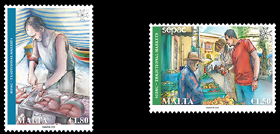
The Small European Postal Administrations Cooperation (SEPAC) is an association of 13 European postal authorities. Each year, a joint stamp issue, bearing a common theme, is launched by all member countries within SEPAC. ‘Traditional Markets’ is the theme for the 14th SEPAC joint stamp issue, which is set for release in 2023.
Outdoor markets are part and parcel of the Maltese way of life and offer the possibility of visitors grabbing a bargain. They are places where one can soak up the colourful cultural atmosphere, experience local characters, enjoy delicious food and participate in the chaotic atmosphere that constitutes the Maltese Mediterranean lifestyle.
Such traditional markets can be found all over the Islands and offer a vast selection of products including local food and beverages. Markets are typically held once or twice a week in various towns and villages, during the early morning hours and usually until noon. Tourists and locals alike are no strangers to the Island’s markets and year-round mild weather allows for a constant passage of curious visitors. The larger well-known markets are located in Valletta (‘Il-Monti’) and Marsaxlokk, where the busiest periods are on Sunday morning. A more relaxed atmosphere is found in outdoor markets scattered around the Island offering clothing, shoes, household goods, toys, antiques, souvenirs, groceries, fresh fish and traditional Maltese snacks, such as ‘imqaret’ and ‘pastizzi’.
The set of two SEPAC ‘Traditional Markets’ stamps issued by MaltaPost depict typical market hawkers at their stalls, within a traditional open-air market environment. These were designed by local artist Daniel Spiteri.
The 1.50 stamp features an outdoor market hawker in Victoria, Gozo selling fresh fruit and vegetables to a couple of tourists. One imagines some haggling taking place until a satisfactory price is agreed upon by both parties.
The 1.80 stamp features a local fisherman, at the Marsaxlokk market, descaling and cleaning ‘lampuki’, the fish species synonymous with the Maltese Islands. He works from under a tent to shelter from the hot summer sun and is flanked by the colourful ‘luzzu’, Malta’s traditional fishing boat.
Malta – Marine Life in The MediterraneanI
Issue date: July 28, 2023

The Mediterranean Sea is home to a stunning variety of marine life. Though it covers less than 1 percent of the ocean surface, the sea holds 1 in 10 known marine species, of which 28 percent are unique to the region. Unfortunately, over the past years, wildlife species in the Mediterranean have faced various threats, including whales being struck by ships, turtles ingesting plastic and the over-fishing of sharks. MaltaPost proudly introduces a set of five stamps that portray marine species found in the Mediterranean waters. The objective is to encourage the preservation of our natural environment and the protection of the unique marine fauna found in the area. Local artist Andrew Micallef, renowned for his meticulous depictions of Maltese flora and fauna, created all five stamp artworks.
Porbeagle Shark – Lamna nasus This shark is a fast swimmer, found in open waters at depths of 50 to 500 metres. It feeds on fish, squid and marine mammals and is critically endangered due to its slow growth, late maturity and low reproductive rate. The Porbeagle is a legally protected species in Malta.
Spinetail Devil Ray – Mobula mobular Has a diamond-shaped body and can reach a width of up to 5 metres. It subsists on a diet of planktonic animals, such as small crustaceans and fish larvae. The species is legal protected in Malta.
Sperm Whale – Physeter macrocephalus The largest toothed whale that grows to a length of up to 18 metres, weighing up to 60 tonnes. There is a small resident population in the Mediterranean but sightings of this mammal are quite rare. Sperm whales live in social groups called pods and feed mainly on squid. The species is protected by both national and international legislation
Atlantic Bluefin Tuna – Thunnus thynnus A highly migratory species found in the North Atlantic and the Mediterranean. This is a large and powerful fish that can reach lengths of up to 3 metres and weigh over 900 kilograms. Bluefin Tuna are voracious predatory fish that feed on smaller fish, squid and crustaceans. This species is of great economic importance with a fishery that is highly regulated to prevent over-fishing.
Swordfish – Xiphias gladius This fish is characterised by a long, flat bill that resembles a sword, used to slash prey. It can reach lengths of up to 4.5 metres and a weight of over 600 kilograms. It feeds on a variety of fish species and squid. Mediterranean swordfish fishery is regulated both nationally and internationally.
Scientific consultation provided by Professor Patrick J Schembri from the Department of Biology at the University of Malta.
Norfolk Island – Norfolk Island Lookouts
Issue date: July 25, 2023
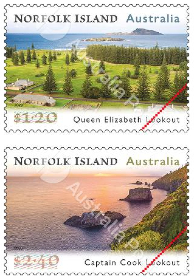
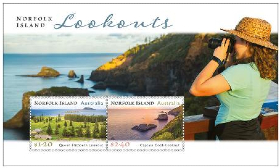
The mountainous terrain and spectacular coastline of Norfolk Island provide many opportunities for scenic views from the island’s several lookouts. This stamp issue features the impressive views from two such lookouts, Queen Elizabeth Lookout and Captain Cook Lookout.
$1.20 Queen Elizabeth Lookout On the south coast, sweeping views from Queen Elizabeth Lookout include Georgian buildings of Kingston’s Quality Row, the Norfolk Island golf course, Nepean Island and Phillip Island. Queen Elizabeth II officially opened this lookout in 1974.
The stamp photograph is by Ian Beattie/AUSCAPE/Alamy Stock Photo.
$2.40 Captain Cook Lookout Captain Cook Lookout on the north coast affords vistas of rugged cliffs and offshore formations such as Green Pool Stone, Cathedral Rock, Bird Rock and Elephant Rock. A stone obelisk marks the spot where Captain James Cook landed in 1774. A photograph of the obelisk features on the First Day Cover.
The stamp photograph is by Southern Lightscapes-Australia/Moment via Getty Images.
Gibraltar – Post & Go – Europa 2023
Issue date: July 4, 2023
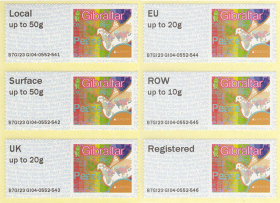
Gibraltar has a diverse and fascinating wildlife that is showcased in the set of six stamps and a miniature sheet.
The first stamp in the set depicts the Atlantic Bluefin Tuna, the largest and most endangered of the species, that can be found in the Straits of Gibraltar. The second features the Andalusian Wall Lizard, a small but colourful reptile found throughout the Mediterranean region. The third stamp depicts our famous Barbary Macaques, which are the only wild monkeys in Europe. The following three stamps feature birds, including the European Robin, the Sardinian Warbler, and the Eurasian Hoopoe. The robin is a familiar sight in gardens and parks, the warbler is a smaller bird with a distinctive black cap and brown feathers, and the hoopoe is a truly unique species with its distinctive crest of feathers and habit of nesting in tree cavities. The miniature sheet depicts the Iberian Red Fox, a cunning predator found throughout the upper rock, which features rust-coloured fur and a bushy tail. The species featured on the stamps have been carefully selected to represent the range of fauna found in Gibraltar, all of which have been photographed by Gibraltarian Photographer and wildlife enthusiast Mr. Nicholas Ferrary.