New Issues and stamp news 864
Faroe Islands – Franking labels 2024
Issue date: February 1, 2024
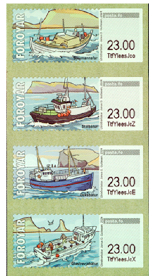
From the time of the earliest settlements in the Faroe Islands, coastal fishing has been integral to the survival of its population. The island’s agriculture couldn’t solely sustain its inhabitants, which prompted them to diversify their sustenance through seabird and whale hunting, and notably, domestic sea fishing.
Historically, the backbone of this fishing effort was the Faroese úróðrarbátur, a rowing boat, a miniature version of the Viking boat equipped with both oars and sails. Depending on its size, the boat could accommodate two to twelve oars, manned by one person each. Particularly prevalent were the ”áttamannafar” (8-oar boat) and the ”tíggjumannafar” (10-oar boat). These boats often emerged from collective efforts within settlements or larger farms.
The shift towards major sea fishing efforts with fishing ships emerged in the latter half of the 19th century, changing the Faroe Islands from a primarily mediaeval agricultural and hunting society to a fishing community. However, coastal fishing remained an ancillary source of food and income.
By the early 20th century, engines started to replace oars in these traditional boats, reducing the need for large crews to just one or two men. This evolved vessel was termed ”installeringur”, laying the foundation for the contemporary Faroese boat. An example is the ”Greipan” TN 188, depicted on the first franking label. Crafted by boatbuilder Jóan Petur Clementsen in 2018, this 7-meter boat hails from Hoyvík.
The 20th century also saw the introduction of the ”deksbátur” (deck boat – cutter), constructed from wood. These vessels, with their spacious cargo holds, could accommodate larger hauls than their predecessors. An exemplar, ”Torvanes” FD 52, showcased on the second franking label, has its origins in Eiði. It spans 18.7 meters, 49,16 gross tonnage – 19,54 net tonnage, and was crafted at Ærøskøbing Ship and Boat Building in Denmark in 1968.
Subsequently, wooden cutters paved the way for steel ones, like ”Jóannes” SA 6 from Sandur. Spanning 10.79 meters, 14,91 gross tonnage – 3,76 net tonnage, it was constructed in 1977 by Svenor Industry & Ship Service in Norway and is featured on the third franking label.
The latest in this lineage are the fiberglass boats, versatile for both professional and recreational coastal fishing. A prime example, ”Lilja” VA 72, hailing from Sandavágur and spanning 12 meters, 6,3 gross tonnage and 1,8 net tonnage. Lilja VA 72 is depicted on the fourth franking label. Lilja was crafted at Provincial Boat Marine in Canada in 1993.
Gibraltar – Birds of Prey
Issue date: February 20, 2024

Gibraltar, with its unique geographical location at the southern tip of the Iberian Peninsula, is an important habitat and migratory route for various species, making these birds of prey particularly significant to the region. The stamps and miniature sheet feature captivating photographs skillfully captured by Mr Nicholas Ferrary, a dedicated wildlife enthusiast and Gibraltarian native.
Golden Eagle: A top predator, the Golden Eagle soars over mountains, preying on a diverse range of mammals and birds. Its presence underscores the importance of apex predators in maintaining ecological balance.
Black Vulture: Dominating the skies with its broad wings, the Black Vulture is a key member of nature’s cleanup crew, efficiently disposing of carcasses and contributing to ecosystem health.
Egyptian Vulture: Known for its distinctive white plumage and yellow face, the Egyptian Vulture is an adaptable scavenger that plays a vital role in waste disposal and carrion cleanup.
Imperial Eagle: The Imperial Eagle symbolises conservation efforts, highlighting the importance of habitat preservation for endangered species and ecosystem health.
Scops Owl: The nocturnal Scops Owl, with its haunting calls, controls insect populations and demonstrates the adaptability of owls to diverse environments.
Red Kite: As a graceful glider, the Red Kite efficiently disposes of carrion, contributing to the cleanliness and health of woodland habitats.
Griffon Vulture: Soaring in groups, the sociable Griffon Vulture efficiently recycles nutrients through carrion disposal, playing a vital role in ecosystem health.
Eagle Owl: The Eagle Owl, a nocturnal giant, preys on a variety of animals with its acute vision and silent flight, maintaining the balance of nocturnal populations
Lesser Kestrel: Agile and vibrant, the Lesser Kestrel hunts insects and small vertebrates, showcasing the importance of birds of prey in regulating insect populations and ecosystem balance.
Bonelli’s Eagle: Bonelli’s Eagle, a powerful hunter, controls populations of certain species with strength and precision, contributing to ecological health and balance.
Black Kite: Versatile and agile, the Black Kite soars across diverse landscapes, playing a crucial role in ecological balance through its hunting and scavenging.
Booted Eagle: Known for its feathered legs and agile flight, the Booted Eagle demonstrates remarkable hunting skill, underscoring the significance of adaptability in maintaining a healthy ecosystem.
Gibraltar – Year of the Dragon
Issue date: February 20, 2024
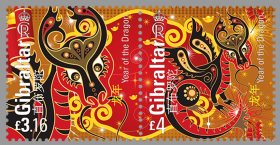
The Year of the Dragon, a revered cycle in the Chinese zodiac, is a captivating period symbolizing power, vitality, and auspicious energy. Dragons, mythical creatures in Chinese lore, embody a majestic blend of strength and wisdom. Those born under this legendary sign are believed to inherit the dragon’s dynamic characteristics, marked by charisma, intelligence, and an adventurous spirit. With a potent ability to inspire and lead, individuals born in the Year of the Dragon are often seen as destined for success. The dragon’s symbolism extends beyond personal traits; it is a harbinger of blessings and prosperity, often associated with imperial authority in Chinese culture. As the only mythical creature in the zodiac, the dragon brings a sense of grandeur and significance to the lunar calendar. The Year of the Dragon is considered a time of vibrant enthusiasm, courageous endeavors, and the pursuit of ambitious goals. It is a period marked by the promise of remarkable achievements and dynamic energy, inviting individuals to embrace the spirit of the dragon and soar to new heights.
Jersey – The Flag of Jersey’ 2024 Post& Go stamp
Issue date: February 15, 2024
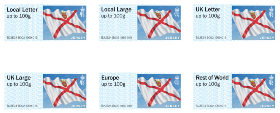
In 2014, the Flag of Jersey made its first appearance on a Post & Go issue. Ten years later, the Jersey Flag will showcase an updated design featuring the new monarch, His Majesty King Charles III.
Jersey’s flag has had an interesting history. Unofficially, a plain red saltire had been used since at least the 1830s. A 1906 letter by the Bailiff of Jersey, described the flag as ‘the red St Andrew’s cross on white ground,’ stating it was used to signal the neutrality of the Channel Islands during wars between England and France. The crest of Jersey was added in the 1980s to help distinguish it further.
Post & Go, a self-service postage stamp system, was first introduced by the Royal Mail in 2008 and later adopted by Jersey Post as the next evolution of self-adhesive stamps. Since December 2023, the Royal Mail is no longer issuing Post & Go stamps, while Jersey Post aims to continue the annual issues and overprints.
These new Post & Go stamps will be available for various postage needs, including Local Letter 100g, Local Large 100g, UK Letter 100g, UK Large 100g, Europe 100g, and Rest of World 100g.
Jersey – EUROPA: Fauna and Flora
Issue date: January 08, 2024

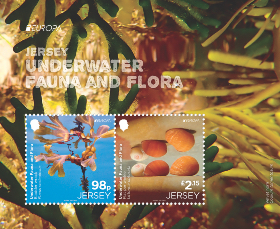
Jersey Post will release a new stamp issue on the 8th January 2024 as part of the 2024 Europa series celebrating the underwater environment, entitled ‘Europa: Underwater Fauna and Flora’.
The trade association known as ‘PostEurop’ established in 1993 to represent the interests of European public postal operators. Each year a theme is set for jurisdictions to interpret with the aim of building awareness of the common roots, culture and history of Europe. For 2024, the theme Underwater Fauna and Flora has been selected.
The issue features images from around Jersey’s coastline, taken by local underwater photographer and cold water swimmer, Nicola Miskin. Nicola describes her work, “Swimming in the sea all year round, photographing underwater opened my eyes to a beautiful world. The ever-changing sea is a studio of colours, patterns and reflections.”
Nicola’s love of underwater photography started in 2018 when she was given a worn underwater camera which she used to master the art of taking beautiful photographs whilst being buffeted by the currents. Harnessing the natural light from the water’s surface, the images showcase a vibrant under-water world hidden from view around the Island.
The stamp issue contains some of the most common underwater fauna and flora found in our bays including Snakelocks anemone (60p stamp), Bladder wrack (1st 98p stamp), Common limpet (2nd 98p stamp), Compass jellyfish (£1.65 stamp), Flat periwinkle (£2.15 stamp), Sea lettuce (£2.95 stamp), Carrageen (£3.75 stamp), Great scallop (£4.85 stamp) and Velvet Horn featured on the souvenir mini sheet.
Jersey – Year of the Dragon
Issue date: January 04, 2024
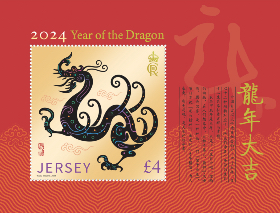
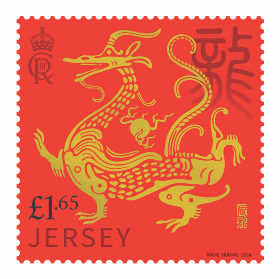
The Year of the Dragon is the subject of Jersey Post’s first stamp issue of 2024, to be released on Thursday, 4th January. Illustrated by Wang Huming in Beijing, China, the issue comprises a single stamp and a miniature sheet.
This issue forms the ninth part in Jersey Post’s series celebrating the Lunar New Year, preceded byYear of the Rabbit (2023), Year of the Tiger (2022), Year of the Ox (2021), Year of the Rat (2020),Year of the Pig (2019), Year of the Dog (2018), Year of the Rooster (2017) and Year of the Monkey(2016).
The Lunar New Year, also known as China’s Spring Festival, is one of the biggest celebrated points of the Chinese calendar. Chinese New Year festivities traditionally start on the first day of the lunar month and continue until the fifteenth, when the moon is brightest. In 2024, the first day of the Lunar New Year falls on Saturday, 10th February.
Observed predominantly by Chinese and ethnic communities worldwide, it is an important time for communities and families to get together. The cycle is repeated every twelve years with an animal from the Chinese zodiac representing the yearly cycle, and 2024 is the Year of the Dragon. As the fifth animal in the Chinese zodiac, the dragon is the only zodiac animal which is a mythical creature, and is usually used as a symbol of power in China. Dragons are also seen as a symbol of good fortune, and those born within the year are considered naturally lucky and gifted.
The stamp designer, Wang Huming, is the Deputy Chief Designer of the Postage Stamp Printing Bureau of China Post and has created the designs for each of the issues in Jersey Post’s Lunar New Year series. The designs are based on a Chinese style of painting and paper cutting.
The image on the £1.65 stamp sheet for the Lunar New Year – Year of the Dragon features a gold dragon, with a sharp red background. Golden dragons have been associated with powerful deities and harvest in Chinese culture. Additionally, red is seen as a colour of prosperity and joy. Dragon’s play a major role in Chinese history and mythology, seen as both creators and destroyers who can control the elements. In this issue, Wang Huming’s art does an excellent job at ensuring the Chinese dragon’s mystic quality is on full display.
The miniature sheet depicts a detailed Chinese dragon flying through the clouds. Wang Fu a Chinese historian and philosopher during the Eastern Han Dynesty suggested that the Chinese dragon’s unique appearance is due to it being a combination of many different animal features. These features include heads which are in similar shape to a camel, the ears of a bull, the antlers of a stag, the body of a snake, the armoured body belly of a clam, feet similar to a tigers, talons of an eagle and a body that includes the protective scales of a carp. Scholars have disputed why Chinese dragons have been deciphered this way, with some suggestions being due to a unification of the different tribes.