New Issues and stamp news 865
Faroe Islands – Queen Alexandrines Hospital 100 Years
Issue date: February 26, 2024
Originally the term hospital referred to medieval hostels, where unfortunate people affected by contagious leprosy were kept in isolation from the rest of society.
The First Hospital–Argir And this was precisely the function of the first hospital in the Faroe Islands. In medieval times leprosy spread all over Europe and the Faroe Islands did not escape the plague. This happened back in Catholic times when Kirkjubøur on South Streymoy was the Faroe Islands’ episcopal seat and greatest power centre. A leper colony, created on the initiative of the Catholic Church, was established on its secluded landholding in Argir, south of Tórshavn.
Isolating the ill was effective – the number of cases consistently dropped, and the devastating smallpox outbreak in the Faroe Islands in 1709 nearly eradicated the colony’s patients. Only three remained in the period from 1723 to 1736 – and the last leper patient in the islands died in 1752.
The Surgeon General Leprosy was not the only disease that plagued the Faroe Islands through the centuries.As a consequence of common illnesses, injuries and the isolated society’s exposure to epidemic diseases, necessary steps were taken to provide the Faroese population with salaried surgeons to be stationed in the islands, even before they were sent to other parts of the Danish Kingdom. Documents confirm that already in 1584 the first “barber” (surgeon) had arrived in the Faroes. For centuries only one medical doctor served the entire Faroese population. If someone needed medical help on one of the islands, he had to be transported to Thorshavn and if this was not possible a boat had to be manned to pick up the surgeon, or the patient simply had to wait for the doctor’s next visit to his island.
It goes without saying that, apart from actual consultations or operations, no professional care was given to patients during the course of their illness.
Faroe Islands County Hospital Finally, in 1829 a much-needed initiative was taken to build the Faroe Islands’ County Hospital on the outskirts of Tórshavn. It was a small hospital which reportedly only had seven beds – but a step in the right direction. “The old hospital”, as it was popularly called, was used for almost a century. In the 1870s, a smaller additional building was constructed, bearing the telling nickname of “the Cell”. It was intended for psychiatric patients. Despite some improvements made over time, the conditions were deplorable. Lack of space despite sporadic expansions, understaffing and underfunding plagued the old hospital throughout its active period.
In 1842, the number of doctors in the Faroes doubled to two when the first professionally trained Faroese doctor, Napoleon Nolsøe, was employed alongside the Surgeon General. He then became a district doctor in Tvøroyri in 1852 and gradually two more district doctors were added, one in Klaksvík and one in Vestmanna. But it was not until 1897 that the first nurses, Danish deaconesses, started working at the hospital while additionally attending to home care services. The deaconesses were also tasked with persuading Faroese girls to devote their lives to nursing. After 1910, the first young Faroese women travelled to Denmark to be trained as nurses. Ten years later, in 1920, and four years before the Faroe Islands County Hospital was closed, an actual training and education program for nurses was launched in the Faroe Islands, overseen by the deaconesses and the hospital’s chief medical officer.
Two Local Private Hospitals and a Tuberculosis Sanatorium In 1898 a small hospital with 8 beds was founded in Klaksvík on private initiatives. Six years later, Tvøroyri on Suðuroy, got a similar hospital with 12 beds. Both hospitals have since been expanded and function today as regional units in the Faroese health care system.
During this period, the Faroe Islands experienced a violent escalation of the tuberculosis epidemic, which ravaged the world, and as a result, a tuberculosis sanatorium with 32 beds was established in 1908 in Hoydalar, north of Tórshavn.
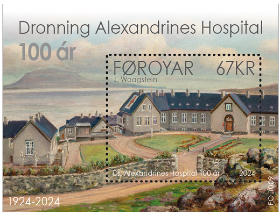
Queen Alexandrine’s Hospital – Landssjúkrahúsið In 1924, the old Faroe County Hospital was finally closed, and the hospital was moved to the newly established Dronning Alexandrines Hospital, with 65 beds. Incidentally, this coincided with the first Faroese-educated nurses finishing their education.
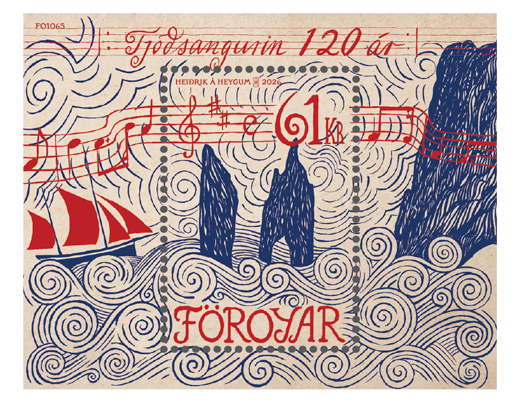
Although the new hospital represented a major evolution in capacity, it was clear from the beginning that space was still lacking. The tuberculosis epidemic still ravaged the islands, so in 1927, a TB ward with 20 beds was built adjacent to the hospital. In 1952, one of the TB buildings (depicted to the left on the stamp) was converted into a care unit for chronically ill patients.
In 1962, the sanatorium in Hoydalar was closed and a new building was constructed instead on the hospital premises for TB and a Care Department.
In 1967, the hospital facilities were expanded with a tall building and the capacity increased further.
In the years that followed, the facilities were extended but these renovations are neither shown on the stamp nor the miniature sheet. This included a psychiatric ward, increased bed capacity, administration and staff accommodation. Since this development falls outside the scope of this stamp issue we will not discuss it further – only state that we have come a long way since J. Waagstein sat on the hillside opposite the hospital in 1943 and painted “the new and charming hospital in Tórshavn.”
Faroe Islands – An undersea connection to Sandoy
Issue date: February 26, 2024
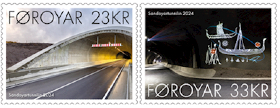
On 21st December 2023, the fourth underwater tunnel in the Faroe Islands opened: the Sandoy Tunnel. The tunnel connects central Streymoy, where Tórshavn is located, with the island of Sandoy, which has approximately 1300 residents.
Skopunarfjørður, the waterway dividing Streymoy from Sandoy and Hestur, is notorious for its challenging tidal currents and sporadic violent gusts.
The strait, at its narrowest, stretches about 5.5 km between the islands. Though ”fjørður” typically translates to fjord in Faroese, it can also denote a channel or strait, particularly when referring to a slimmer stretch of water open at both ends.
The strait gets its name from Skopun, a town located in the north of Sandoy. It acts as a geographic demarcation between the northern and southern islands. When locals discuss the northern vs. southern fjords, they’re essentially highlighting the islands on either side of this line, emphasizing the distinct dialects and, to a degree, cultural nuances of the two regions.
Historically, navigating around Skopunarfjørður wasn’t an option. Voyages between the northern and southern islands necessitated traversing this challenging waterway, either from Tórshavn or Kirkjubøur Velbastaður on the Streymoy side to Skopun or other eastern towns on Sandoy. The ferry service, previously originating from Tórshavn, transitioned over the years to depart from Gamlarætt, located between Velbastaður and Kirkjubøur, making its way to Skopun. But the journey, particularly during winter, was often unpredictable due to the strait’s difficult conditions.
The Sandoy Tunnel: An Ambitious Undertaking The challenges of Skopunarfjørður made the decision to build an undersea tunnel to Sandoy a welcome one. Work on the tunnel kicked off in 2016, with the ambitious plan to link the former ferry point, Gamlarætt on Streymoy, to Traðardalur on Sandoy. By 3 February 2022, the two ends of the tunnel converged, and since then, focus has shifted to road construction. On December 21, 2023, the Sandoy tunnel, stretching 10.8 km in length and descending up to 147 meters below sea level, opened to the public.
A Vision for the Future The completion of the Sandoy tunnel will mark a monumental advancement in Faroese infrastructure, alleviating travel concerns for Sandoy’s inhabitants and eliminating the need to contend with the unpredictable Skopunarfjørður. But it’s more than just a solution – it’s a steppingstone. The grand vision is to extend this connectivity, building another tunnel linking Sandoy and Suðuroy, achieving seamless road links across the major Faroese islands.
While the final green light for the Suðuroy tunnel is still pending, the aspiration remains, and many are optimistic about its eventual realization.
Tunnel Art Faroese artist, Edward Fuglø has created the artwork ”Díðrikur Doves and other hidden treasures” which are cave-paintings found on the walls—though these are not ochre on limestone but luminous red, white and blue lines dancing over black basalt. Light pictures shining in dark caves.
The motifs are the stories of the two places connected by the tunnel, Kirkjubøur and Sandoy. The artwork is Fuglø’s homage to Díðrikur of Skarvanes, who became the pioneer of Faroese visual arts. The 33KR stamp pictures King Sverri (1151-1202) who grew up in Kirkjubøur. Read more about the tunnel artwork here.
You can also listen to classical music while driving through the tunnel. On FM radio 100, you can hear the musical piece ‘Røddir Voices’ composed by the renowned Faroese composer, Sunleif Rasmussen, who resides on Sandoy. The piece lasts approximately 12 minutes, which is roughly equivalent to the drive time through the tunnel.
Faroe Islands – Filming Location: Peter Pan at Tindhólmur
Issue date: February 26, 2024
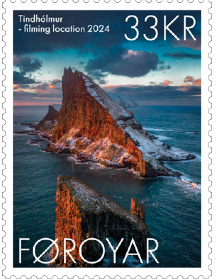
Even though these tales are ancient, we see ourselves mirrored in them. Should we overlook these narratives, they will undoubtedly recall us. Not only through inked book pages but also in digital cinema and music.
While contemporary media often gains a reputation for being superficial, they too can carry age-old tales. This is invaluable, as these stories often possess a depth that modern distractions seldom reach. They offer a respite, if only briefly, to lend clarity and perspective to our lives. Take, for instance, the tale of Peter Pan, the boy who resisted growing up. In the realm of music, Michael Jackson stands out, naming his residence after the island’s fable: Neverland.
The roots trace back to the fictional character, Peter Pan, penned by the Scottish Sir James Matthew Barrie (1860-1937) in 1902. He later adapted this into the play, ”The Boy Who Wouldn’t Grow Up” in 1904. By 1911, Barrie crafted the novel ”Peter and Wendy.” In Disney’s most recent adaptation, Neverland is depicted as Tindhólmur in the Faroe Islands, where viewers can witness Peter and Wendy soaring in flight.
Under the theme ”Filming Locations,” Tindhólmur graces the latest Faroese stamp issued by Posta.
A similar foundational narrative can be seen in the German Günter Grass’s ”Die Blechtrommel” from 1959, echoing the Scottish Barrie’s theme. In Grass’s story, the boy Oskar refuses to age. This poignant tale of clinging to youth has also been adapted into a movie.
Disney’s 1953 full-length animated rendition of Peter Pan’s adventurous tale became a global icon. While there had been previous film adaptations and even musicals centered on the same narrative, none matched Disney’s unparalleled influence.
Today, this legacy continues with Disney’s fantasy adventure, ”Peter Pan & Wendy,” directed by David Lowery. Featuring Ever Gabo Anderson and Alexander Molony as Wendy and Peter respectively, the film captures them soaring above the Faroe Islands.
While adults and especially teenagers may find nostalgia in this coming-of-age tale, reflecting on their past childhood years, there are critics who argue that the story promotes escapism, providing an avenue to flee from challenging realities and daily struggles.
Marianna Debes Dahl, when translating the story into Faroese in 1999, localized the characters and settings with Faroese names. She remarked, ”Most are familiar with the story of Peter Pan, Vónbjørt, and the other children. For many today, this familiarity might come from Disney animations, comics, and other adaptations. Here, however, is the original tale of Peter Pan, the boy reluctant to age. The moment his fairy friend, Klombru-Glint, flutters through Vónbjørt’s bedroom window, enchantment fills the air. The children are whisked away to Gyklaland, witnessing mermaids frolicking along the shoreline and battling the pirate captain Húk and his band.”
Following the earlier James Bond film narrative set in Kallurin in the Northern Islands, the tale of Peter Pan and Wendy Darling unfolds in western Vágar, showcasing Tindhólmur on the big screen.
Faroe Islands – Coal mining in the Faroe Islands
Issue date: February 26, 2024

Visitors to the Faroe Islands in the summertime are often struck by the vibrant greenery that covers the land. This lush landscape is even more impressive given the close proximity of the islands to one another, whether seen from the sky or the sea.
Below this verdant cover, one finds a foundation of basalt from long-extinct volcanoes. The southernmost island, Suðuroy, offers a geological journey, revealing the era during which the Faroe Islands were formed.
Unique to Suðuroy is its rich coal deposit history. It is the only island where significant coal mining was feasible.
Nowadays, Suðuroy’s coal mining past serves as a cultural touchstone, with remnants of its coal-rich history scattered around. Yet, a small mining operation remains active in Hvalba, albeit on a minimal scale.
The earliest record of coal mining attempts in the Faroe Islands traces back to 1733. However, it wasn’t until 1778 that substantial mining began in Hvalba. The Faroe Islands had a modest population then, with the 1801 census recording just 5,000 inhabitants. While the locals predominantly used peat for fuel, foreign investors, including Danish and Swedish capitalists, saw potential in Faroese coal, not only for energy but for other minerals like zinc, copper, and iron.
The ambitions ran so high that in 1875, Christina von Post, a Swedish artist based in Paris, alongside French investors, founded a company and acquired rights to mine coal in Suðuroy. Dubbed “Kolafrúan” or “The Coal Lady” by the islanders due to her significant investments, Christina and her co-investors hoped for a rich mineral yield from the coal mines. Their hopes were dashed, however, upon discovering no such ores, leading to Christina’s eventual financial downfall. She passed away penniless in 1917.
Over the years, the dynamics of coal mining in Suðuroy shifted. Global economic downturns, like the 1929 Wall Street crash, hit the Faroes, but coal mining persisted. Remarkably, light clay from the mines was shipped to Denmark to treat hard water. This clay, sourced primarily from the Rangabotnur mines, was even blended with red ochre soil from Nólsoy to produce paint.
However, the coal industry faced its most significant challenge in the 1960s when the Faroese transitioned from coal-based to oil and electric heating. The once-thriving coal industry dwindled, turning almost obsolete. Today, the Hvalba mine, though operational, serves more as a nod to tradition than a bustling enterprise.
Legacy echoes in the surnames of Suðuroy residents: names like Wiberg, Åkeson, and Ahlén, which hint at Swedish involvement in the coal business of yesteryears.
Interestingly, though coal mining is nearly a memory, the only active mine, Prestfjall mountain in Hvalba, could reveal one of the world’s most breathtaking vistas if excavated completely. Offering panoramic views of the sea, dramatic cliffs, and the historical traces of coal deposits, it would be a homage to a bygone industry and the unmatched beauty of Suðuroy’s western side.
Malta – The Chinese Garden, Santa Luċija, Malta – The Year of the Dragon 2024
Issue date: February 29, 2024

On Thursday 29 February 2024, MaltaPost shall issue a miniature sheet titled “The Chinese Garden, Santa Luċija, Malta – The Year of the Dragon 2024”. The miniature sheet carries a denomination of €3.00 and portrays the Chinese Garden of serenity situated in the town of Santa Luċija, Malta, while the stamp depicts a dragon – the Chinese zodiac sign for the new year. Both miniature sheet and stamp were illustrated by local artist Fabio Agius.
The Chinese zodiac is a 12-year cycle that links each year to an animal sign. The 12 animal signs are rat, ox, tiger, rabbit, dragon, snake, horse, sheep, monkey, rooster, dog and pig. The order of the animal signs is fixed, with the dragon being the fifth in the cycle, hence the Year of the Dragon in 2024, which began on 10 February. Those born in this year are believed to embody qualities associated with dragons – leadership, charisma, intelligence and enthusiasm.
In Malta, we are privileged to enjoy the scenic and tranquil beauty of the “Chinese Garden of Serenity” situated in Santa Luċija. This garden offers a peaceful space for introspection and meditation.
Jersey – 200 Years of the RNLI
Issue date: March 14, 2024

Jersey Post will release a new stamp issue on the 4th March 2024 as part of a pan-island collection issued by Jersey Post, Isle of Man and Guernsey to commemorate 200 years of the RNLI’s lifesaving work.
The RNLI was founded in 1824 by Sir William Hillary, who after witnessing dozens of shipwrecks off the coast of the Isle of Man petitioned for a volunteer service which could be called to aid those in need at sea. Six years later, in 1830, a lifeboat was established with a volunteer team and a boat, kept near Havre des Pas. In 1884, the RNLI station in St. Helier was built at Albert Quay, where it still serves as the Island’s RNLI headquarters. In 1969 a second station was established, this time on St. Catherine’s north side of Gibraltar Rock.
Across the UK, Channel Islands and the Republic of Ireland, the RNLI is formed primarily of volunteers driven by selflessness, skill and courage. These volunteer teams have saved in excess of 144,000 lives at sea with the help of public donations to fund the service and equip volunteers with the training and tools required to keep themselves and the public safe at sea.
The Jersey Post stamp issue features imagery from the RNLI’s own library depicting key moments in the Island’s RNLI history:
The first stamp of the issue (60p) features one of the fastest lifeboats in the RNLI fleet, the Atlantic 85 RNLB Eric W Wilson, named after its benefactor Mrs. Winifred Madge Wilson’s late husband. On the second stamp (98p) collectors will enjoy an image of St Heliers Tamar class lifeboat with Corbière Lighthouse in the background. The Tamar lifeboat is an all-weather craft that sets high standards in terms of safety and technology. The third stamp (98p) shows Jersey’s RNLI lifeguards typical setup at La Braye Beach where they protect beachgoers from hazards such as rip tides. The lifeboat, Howard D (£1.65), caused a stir when it arrived in 1937 as the first ever motorized lifeboat on the Island. The £2.15 stamp depicts a dramatic scene of the rescue of the yacht Fanny after which rescuers were awarded Gold and Silver Medals by the RNLI for their acts of bravery before the organization was established in Jersey. The final stamp of the issue (£2.95) is the portrait of Sir William Hillary, who founded the RNLI in 1824 after witnessing dozens of shipwrecks around the Isle of Man. The stamp issue also includes a Prestige Stamps Booklet featuring further information about Jersey RNLI and including three complete sets of the stamps set in exclusive stamp panes.
Jersey Post’s commemorative stamp issue is a tribute to the enduring spirit of the RNLI, the generations of courageous volunteers and the generosity of those who give to support their vital life-saving work.
Åland – Åland stamps turn 40 years
Issue date: March 1, 2024

On 1 March 2024, Åland Post celebrates the 40th anniversary of Åland stamps with the issue of a miniature sheet designed by internationally active illustrator Tzenko Stoyanov. “Each stamp carries a story about Åland. For 40 years, these miniature works of art have conveyed images of Åland to the outside world and attracted both collectors and visitors. The theme of this year’s anniversary edition is limitless communication. With warmth and humour, the motif illustrates a dream journey through stamps with Åland and postal elements. History and tradition meet future and innovation, showing the joy of collecting stamps, sending, and receiving mail,” says Johanna Finne, Marketing Design Manager at Åland Post Stamps.
When the first Åland stamps were issued on 1 March 1984, it was the result of a long-term process that started already in the 1950s. The turning point came in 1979 when the Ålanders turned to the Ministry of Justice, justifying the request for their own stamps by saying they would be an important symbol of the autonomy. In 1982, President Mauno Koivisto approved the Åland Stamp Ordinance, and the first Åland stamps were issued in 1984.
From 1984 to 1992, the Posts and Telecommunications of Finland was responsible for the stamp production, while the motifs were produced in collaboration with the Åland provincial government and its stamp delegation. On 1 January 1993, a new Autonomy Act came into force, giving Åland the right to establish its own postal administration. The Åland Post now took over the production and sale of Åland stamps, which have now been issued for 40 years.
A debutante in the context of stamps, Swedish-Bulgarian illustrator Tzenko Stoyanov took on the challenge of capturing the essence of Åland stamps and stamp collecting. He describes his work with the anniversary edition: “I wanted to give the miniature sheet a timeless, fairy-tale feel through a slightly surreal story where the sea becomes space, the boats spaceships, and the birds letters. With the motif, I want to show that there are no limits to communication and that Åland, through the Post, extends a hand to send love and peace to the world and the universe. I drew everything by hand before processing it digitally, all in a more or less traditional style with a contemporary flavour.”
Guernsey – RNLI’S BICENTENARY
Issue date: March 4, 2024
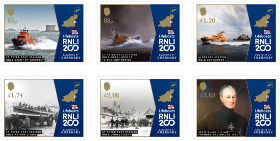
Guernsey Post announces that its philatelic bureau will release commemorative stamps to mark the 200th anniversary of the Royal National Lifeboat Institution (RNLI). The stamps, which depict the charity’s lifesaving past – and present – in the Bailiwick of Guernsey, have been produced in conjunction with the RNLI and is one of three stamp issues released by the Crown Dependencies of Guernsey, the Isle of Man and Jersey to celebrate the charity’s 200 years of lifesaving.
The RNLI has been saving lives at sea since it was founded in 1824. Since then, its volunteer lifeboat crews and lifeguards have rescued over 144,000 people – that’s nearly two every day since its founding. Charitable donations continue to power the RNLI’s lifesaving capabilities and today, the charity has a network of 238 lifeboat stations and more than 240 lifeguarded beaches across the UK, Ireland, and the Channel Islands.
The stamps SPIRIT OF GUERNSEY St Peter Port’s Severn class all-weather boat passes Bréhon Tower in the Little Roussel channel. She is the largest lifeboat in the RNLI fleet and capable of operating in the worst conditions. St Peter Port crews have been saving lives in the English Channel and Saint-Malo Bay since 1803 and have received 25 Medals for Gallantry.
ROY BARKER The Trent class lifeboat motors past Les Étacs, the gannet colony. With a top speed of 25 knots, she was the fastest all-weather lifeboat of the time and the first capable of covering 250 nautical miles. Alderney Lifeboat Station was first established in 1869 but closed in 1884, following difficulties with finding crew. The station was re-established in 1984 and her crews have saved many lives since.
RESCUE OF BONITA One of Port St Mary RNLI’s most famous rescues was in December 1981, when the volunteer crew saved the lives of 29 people from the stricken vessel Bonita. The cargo ship was listing heavily in massive seas, hurricane force winds, snow and failing light. After more than 10 hours at sea, the lifesavers and their casualties safely reached land. Lifeboat Coxswain Mike Scales received a Gold Medal for gallantry and the crew all received Bronze Medals.
ARTHUR LIONEL St Peter Port’s rowing and sailing lifeboat Arthur Lionel was the main attraction of Guernsey Lifeboat Day in August 1924. The 35ft Liverpool class craft was hauled through the streets by horses, with her volunteer crew onboard in sou’westers and oilskins. The lifeboat saved lives on the Island from 1912–29 before serving Minehead volunteers for a decade.
JOHN LOCKETT Shown in front of the boathouse with her crew onboard wearing cork lifejackets, the Self Righter class lifeboat served the RNLI volunteers of St Peter Port from 1875–88. The 32ft craft was powered by oar and sail. In 1875 she capsized at sea but, fortunately, no lives were lost. In 1881, she was rehoused in a new boathouse on the south side of St Peter Port, reusing materials from the old station.
SIR WILLIAM HILLARY Witnessing dozens of shipwrecks around the Isle of Man, Hillary refused to sit by and let people drown. With the help of locals in simple boats, he saved many lives. It inspired him to campaign for a national organisation, where volunteers would save lives from shipwrecks across the British Isles and Ireland. His impassioned plea led to the foundation of the RNLI on 4 March 1824. The new charity received public donations to help it provide lifeboats to communities that needed them – and it has, ever since.
Mark Dowie, RNLI Chief Executive, said: – “Guernsey and Alderney have a remarkable history of lifesaving courage. These stamps are a wonderful way to recognise the incredible lifesaving efforts of the volunteers across the Bailiwick as we commemorate our milestone anniversary in 2024 and look forward to the next 200 years of lifesaving.”
Bridget Yabsley, head of philatelic at Guernsey Post, added: – “As the RNLI celebrates this milestone, we are absolutely delighted to release these stamps as a piece of RNLI history, reflecting the Bailiwick’s remarkable lifesaving past, and present.”
Commemorative stamp collections from Guernsey, the Isle of Man and Jersey stand as tributes to the unwavering courage of RNLI volunteers, the legacy of lifesaving technology, and the enduring spirit of solidarity across the British Isles.
Philatelists and enthusiasts alike can delve into these collections, each offering a unique perspective on the RNLI’s remarkable journey, leaving an indelible mark on philatelic history.
Åland – 170 years of maritime education
Issue date: March 1, 2024
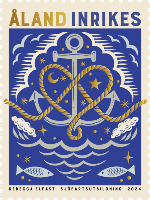
Åland Post highlights maritime education on Åland, which celebrates both a 170th and a 150th anniversary in 2024. “Seafarers have been trained on Åland since a long time ago, the sea is our path. With this stamp illustrated by Rebecca Elfast we wish to pay tribute to this maritime expertise,” says Johanna Finne, Marketing Design Manager at Åland Post Stamps.
Maritime education in Åland dates back to the 19th century. In 2024, it will be 170 years since the first navigational training started in Godby. After a long and persistent struggle, Åland public educator and vicar of Finström Frans Petter von Knorring, was able to introduce navigational education into the elementary school curriculum in 1854. It took until 1874 before the first proper nautical school that trained merchant skippers, helmsmen, and sea captains opened in Mariehamn, and which will therefore celebrate its 150th anniversary in 2024.
Swedish illustrator Rebecca Elfast describes the stamp issue: “The stamp depicts an anchor wrapped in a rope that curls into the shape of a heart – it encapsulates the pride of and love for maritime education and the sea. Reappearing as a supporting structure on the first day cover, the rope undulates like waves among navigational instruments and maritime elements. The rope is a nice symbol of education; knowledge is built strand by strand to become a robust and strong rope, and all the parts are woven together to form a whole. In the middle of the sheet, you can see islands, routes, and elements from nautical charts, inspired by older drawings showing a simplified coastal outline with important land features highlighted. “